“It Was Just a Minor Twist”...Falls Can Lead to Fractures
- Input
- 2026-09-22 09:56:24
- Updated
- 2026-09-22 09:56:24
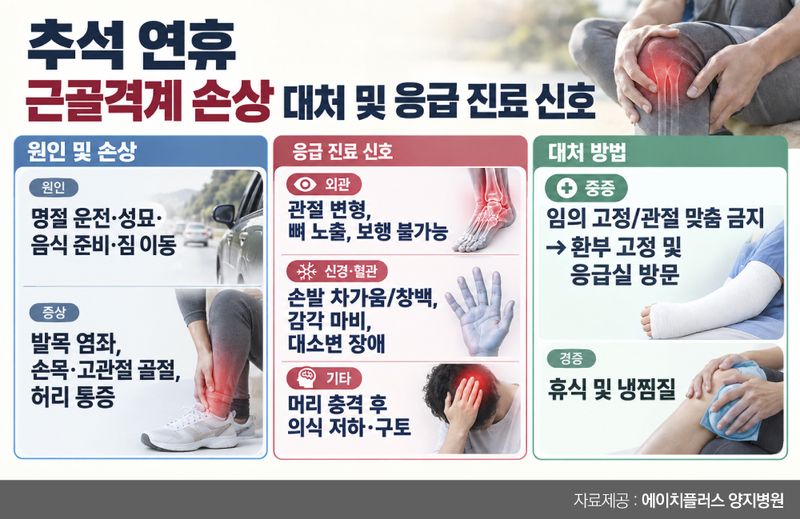
[Financial News] Pain dismissed as minor muscle soreness or a sprain may actually be caused by a fracture or ligament injury. During the Chuseok holiday, increased activity can lead to various musculoskeletal pains and injuries, so symptoms should be monitored carefully.
During the Chuseok holiday, people travel long distances, visit and clear ancestral graves, go on outings, and prepare holiday meals, resulting in much more activity than usual. Long hours of driving or sitting on the floor can worsen back and knee pain. People may also twist an ankle while visiting a grave or engaging in outdoor activities, or injure their wrists, shoulders, or knees in a fall. Back pain can come on suddenly after lifting heavy luggage or gift boxes.
Mild muscle soreness or sprains may improve with rest and cold compresses. However, severe pain, difficulty moving the injured area, joint deformity, or sensory changes should not be ignored. Fractures, dislocations, and ligament or tendon injuries may initially cause only swelling and pain, making them difficult to distinguish. The circumstances of the injury and the symptoms should therefore be assessed together.
Lee Myeong-geun, an orthopedic specialist at H+ Yangji Hospital, explained, "During the holiday, people travel and engage in outdoor activities more than usual, while many also lift heavy objects or remain in the same position for long periods. As a result, various musculoskeletal pains and injuries can occur."
From Ankle Sprains to Hip Fractures: What to Watch for After a Fall
Ankle sprains can occur frequently when people walk more than usual, such as when visiting or clearing ancestral graves or going on outings. Misstepping on uneven ground can stretch or tear the ankle ligaments, and a severe impact may also cause a fracture.
Immediately after an injury, avoid walking unnecessarily, apply a cold compress, and monitor the condition. However, imaging may be needed to check for a fracture if swelling rapidly worsens, the ankle becomes deformed, or pain makes it difficult to put weight on the foot.
Bracing a fall with the hands can injure the wrists or shoulders. Older adults, in particular, can suffer wrist or hip fractures even from relatively minor falls. Hip fractures should be suspected if pain develops in the groin or buttocks after a fall, making it difficult to stand or bear weight on one leg. A wrist fracture may also be suspected if the wrist becomes swollen or deformed, or if moving the fingers is difficult.
Maintaining the same position for long periods, such as while driving or preparing holiday meals, can also strain the back and knees. In people with a herniated disk, spinal stenosis, or degenerative arthritis, existing pain may suddenly worsen.
If there is only ordinary back or joint pain, changing positions and getting enough rest while monitoring the condition may be sufficient. However, emergency assessment is needed to check for neurological problems if back pain is accompanied by sudden leg weakness, severe sensory changes, or bowel or bladder dysfunction.
Do Not Try to Realign It Yourself...Immobilize the Injury and Seek Medical Care
When a fracture or dislocation is suspected, do not forcibly move the injured area or try to realign the joint yourself. Doing so could cause additional damage to nearby blood vessels or nerves. Immobilize the injured area as much as possible. If there is bleeding, apply pressure with clean gauze or a cloth to stop it, then seek medical attention.
Not everyone who develops musculoskeletal pain during the holiday needs to visit an emergency medical center. If the pain is relatively mild, the joint can be moved, and the symptoms decrease over time, it is advisable to first rest, apply a cold compress, and monitor the condition.
However, early assessment is important for trauma involving a suspected fracture or dislocation or possible nerve or blood vessel damage. Medical attention should be sought if there is deformity of a joint or limb, severe swelling, restricted movement, an inability to bear weight, or sensory changes.
Because access to regular outpatient care may be limited during the holiday, it can also be helpful to identify in advance emergency medical facilities equipped to coordinate care between emergency medicine and major specialties.
Lee Myeong-geun emphasized, "When someone is injured during the holiday, it is important to look beyond the severity of the pain and also check whether the limbs can be moved normally after the injury, whether weight can be placed on them, and whether deformity or sensory changes are present." He added, "Especially after a fall in an older adult or severe trauma, a fracture may be hidden even when the visible wound is not extensive. If abnormal symptoms persist, it is best to seek medical attention without delay."
[email protected] Jung Myung-jin, medical correspondent Reporter