SKT Unveils Digital Twin Technology for Building Quantum Cryptographic Communication Networks
- Input
- 2026-09-22 10:42:00
- Updated
- 2026-09-22 10:42:00
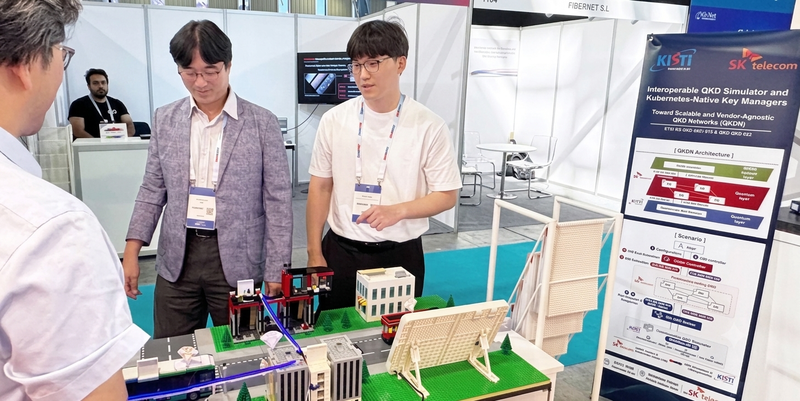
[Financial News] SKT has developed digital twin technology that can verify the performance and operability of a quantum cryptographic communication network in a virtual environment before it is actually built.
SKT announced on the 22nd that it had unveiled the quantum cryptographic communication network digital twin technology jointly developed with KISTI at ECOC (European Conference on Optical Communication) 2026, the largest international optical communications event in Europe, being held in Málaga, Spain.
Once built, a quantum cryptographic communication network is difficult to modify in terms of its communications environment, including optical cable length and optical loss. The high cost of the equipment also limits repeated testing under various conditions in real-world settings. The new technology enables users to virtually configure equipment placement, communication distances and optical loss before building the network, making it possible to identify suitable conditions.
The key feature is the real-time connection between SKT's quantum key management system, or Key Manager, and KISTI's quantum key distribution (QKD) simulator. QKD is a technology that generates and transmits encryption keys using the principles of quantum mechanics.
When the key management system requests a quantum key, KISTI's simulator recreates the configured communications environment and provides information on the quantum keys generated under those conditions, along with the performance and status of the QKD system. This allows the entire process—from quantum key generation to management and supply—to be jointly verified without using actual equipment.
In addition to communication distance and optical loss, the virtual environment can reflect characteristics of actual QKD equipment, such as reception efficiency and post-processing algorithms. It functions as a digital twin because equipment configurations, distances and settings verified in the virtual environment can be applied when building the actual communications network.
SKT's quantum key management system is container-based, making it independent of specific hardware or virtual machines, and is operated through Kubernetes. This allows the system to be expanded and tested according to the various network environments and key management scenarios implemented by the simulator. KISTI developed the QKD simulator to reproduce a range of conditions, including communication distances and optical loss.
In particular, the system uses an internationally standardized interoperable interface established by the European Telecommunications Standards Institute (ETSI). Because it is not tied to specific equipment or a proprietary interface, it can also be connected in the future to quantum cryptography equipment developed by other institutions or companies, SKT explained.
SKT emphasized, "This is the first time that a quantum key management system and a QKD simulator independently developed by different institutions have been connected and publicly verified."
The technology was developed under projects led by the Ministry of Science and ICT, including "elementary technologies to expand the efficiency of QKD networks and optimize resources" and "the development of quantum cryptographic communication network technologies based on national research infrastructure." The ECOC demonstration was held at the SK Broadband booth, which received support from the "demand-based quantum technology demonstration and consulting" program.
Ryu Tak-gi, who oversees network technology at SKT, said, "By linking the Kubernetes-based key management system with the quantum key distribution simulator, we can flexibly verify various network environments and key management functions." He added, "Based on this, we will build a highly scalable operating environment for quantum cryptographic communication networks."
[email protected] Yoon Hong-jip Reporter