'Seoul's Last Hillside Neighborhood' Gaemi Maeul Area to Become Forest-Adjacent Residential Complex... Rapid Integrated Planning Confirmed for Hongje-dong 9-81 Area
- Input
- 2026-09-22 11:15:00
- Updated
- 2026-09-22 11:15:00
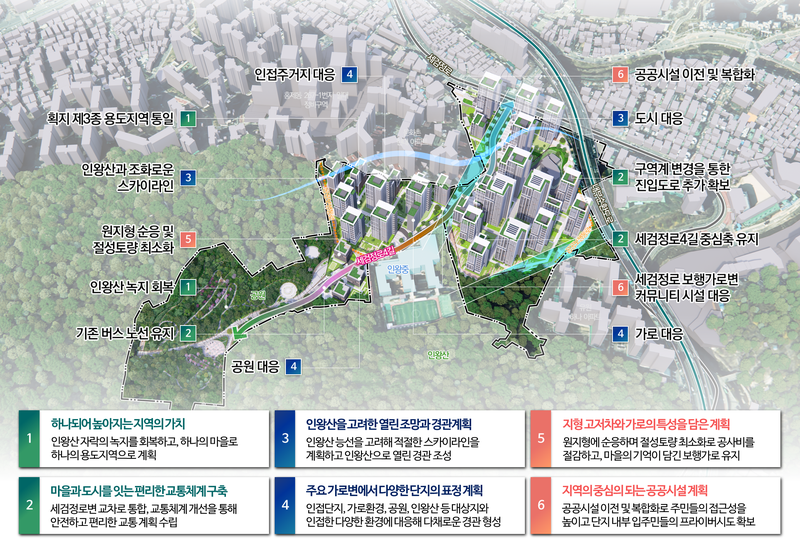
[Financial News] Gaemi Maeul, Munhwa Maeul and the former Hongje 4 District in Seoul's Seodaemun District will be combined and transformed into a forest-adjacent residential complex with up to 30 stories and approximately 2,520 households.
According to the Seoul Metropolitan Government on the 22nd, it has finalized the Rapid Integrated Planning for the residential redevelopment project in the Hongje-dong 9-81 area.
The project area consists of Gaemi Maeul, Munhwa Maeul and the former Hongje 4 District. Each village had pursued its own redevelopment project, but efforts faced difficulties due to restrictions on protecting the Inwangsan landscape, limits on upzoning areas released from development-restricted zones, and low project feasibility.
Since the development-restricted zone was lifted in 2006, Gaemi Maeul had pursued a private housing construction project, a residential-environment management project, a Moa Town project and a residential regeneration innovation district, but none came to fruition. Munhwa Maeul pursued public redevelopment but was excluded from the project area, while the former Hongje 4 District was also removed from the planned redevelopment zone.
To improve the project's feasibility, the city integrated the three villages into a single redevelopment district. Residents' opinions were also reflected in the planning process. The Seoul Metropolitan Government and Seodaemun District collected residents' views on nine occasions in total through site visits, meetings and briefing sessions.
The plan incorporates three principles: creating a single village with connected living spaces; establishing a landscape open toward the Inwangsan ridge and linked to the mountain's contours; and developing a three-dimensional spatial plan that takes differences in terrain elevation into account.
First, approximately 30,000 square meters at the foot of Inwangsan, where unauthorized buildings are densely concentrated, will be developed into a park. The zoning for residential land will also be upgraded from existing Type 1, Type 2 (seven-story), and Type 2 general residential areas to Type 3 general residential areas. The plan calls for allowing high-density development on residential land while restoring the damaged foothills of Inwangsan as green space.
The transportation and pedestrian systems will also be overhauled. Segeomjeong-ro 4-gil, which runs through the center of the complex, will be designated as a multi-level road and included in the lot area while retaining its existing function as a village road. The idea is to preserve residents' travel routes while securing project feasibility.
To ease traffic congestion, routes for vehicles entering the Naebu Expressway and residents' vehicles will be separated. Public land beneath the Naebu Expressway will be incorporated into the redevelopment district, and an additional access road toward Segeomjeong-ro will be built.
A height plan taking the Inwangsan landscape into account will also be applied. Two 20-meter-wide view corridors will be secured from the Naebu Expressway toward Inwangsan. Buildings will be planned at around 20 stories in areas close to Inwangsan and around 30 stories along the Naebu Expressway, creating a natural skyline that reflects the mountain's contours.
Since the site has an elevation difference of up to 105 meters, the existing terrain will be used as much as possible. The plan will reduce cutting and filling to lower site-preparation costs and secure community facilities and outdoor courtyards beneath the decks.
The Hongje 3-dong Community Service Center and social welfare facilities beneath the Naebu Expressway will be relocated and integrated with neighborhood facilities at the entrance to the complex.
Kim Chang-gyu, head of the Seoul Metropolitan Government's Urban Space Planning Bureau, said, "The Gaemi Maeul area of Hongje-dong is Seoul's last hillside shantytown neighborhood, where unauthorized shacks built after the Korean War remain densely clustered to this day. Various redevelopment projects have fallen through over the years, leaving it as a long-standing priority for the Seoul Metropolitan Government. We will provide all necessary administrative support to advance the project so residents can enjoy a safe and pleasant living environment as soon as possible."
[email protected] Choi A-young Reporter