Kim Min-seok on calls to replace Kim Yong-min on the Legislation and Judiciary Committee: "One of several options"
- Input
- 2026-09-22 08:49:40
- Updated
- 2026-09-22 08:49:40
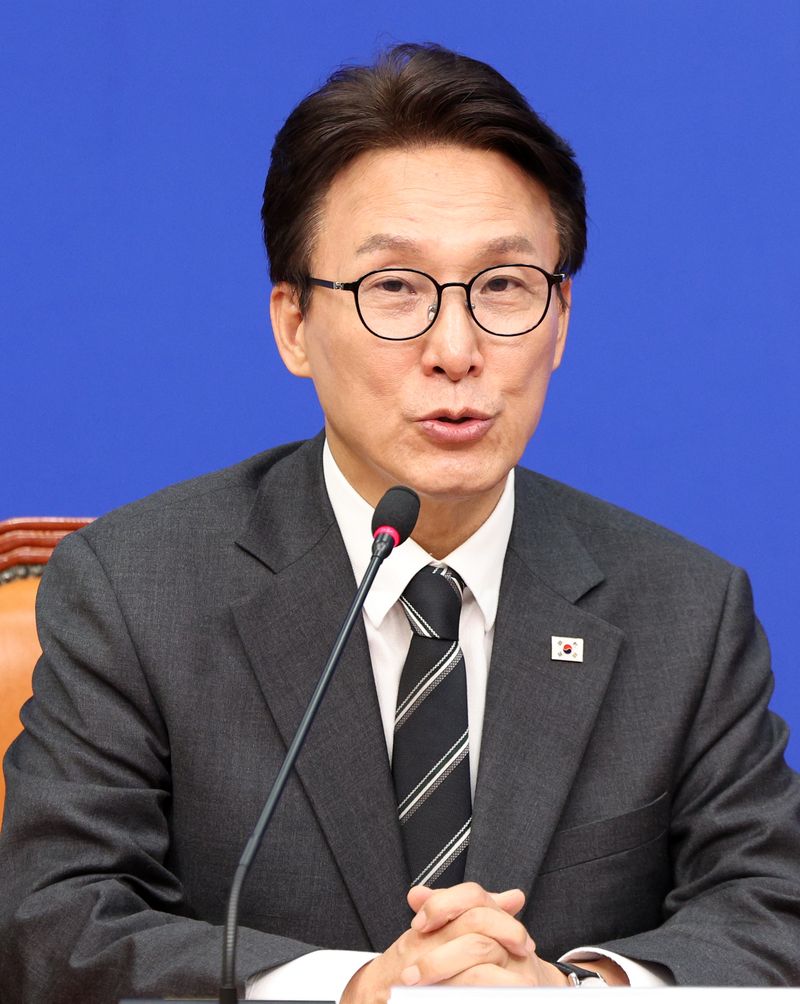
[Financial News] Kim Min-seok, leader of the Democratic Party of Korea, said on the 22nd that, in response to calls from some party supporters to remove lawmaker Kim Yong-min from the National Assembly's Legislation and Judiciary Committee and replace him, "It would be one of several options."
During a Democratic Party of Korea YouTube broadcast called "Minty07" that day, Kim answered a viewer's question calling for Kim Yong-min to be replaced on the Legislation and Judiciary Committee. "If it is indeed inappropriate to include such a measure, it could be one of several options," he said. However, he made clear that he was not announcing an actual plan to replace Kim, explaining, "I was saying this to help people understand the matter of principle."
Kim Yong-min has recently publicly criticized the selection of Kim Ji-yong as a candidate for chief of the Serious Crime Investigation Agency, as well as the organizational structure of the Public Prosecution Office. Without naming any particular lawmaker, Kim Min-seok laid out principles for how ruling-party lawmakers should raise objections to the president's appointments.
Kim first stressed, "It is preferable to raise such concerns internally whenever possible." He explained, "Ruling-party lawmakers should be able to convey their views in one way or another," adding, "They can do so through the Senior Presidential Secretary for Political Affairs, or through the parliamentary caucus, the party, or the standing committee."
He also said that publicly raising objections to appointments requires caution. Kim stated, "Concerns raised within the ruling party should be handled more carefully, and it is better to go through internal procedures," adding, "Because matters involving individuals are extremely sensitive, it seems difficult to raise them by singling out a specific person rather than, as much as possible, presenting them as matters of principle."
In particular, he stressed that after internal discussions, the ruling party should respect the appointing authority's final decision.
Kim said, "When making a final decision based on a judgment that is roughly five to five or six to four, it reflects the appointing authority's difficulties after taking everything into account. Within the ruling party, we discuss the matter sufficiently, and once a final conclusion is reached, we respect the appointing authority's decision."
He added, "Otherwise, one should not be part of the ruling party," and continued, "If someone goes too far beyond that, it would be appropriate for the party to point it out and establish its own principles and discipline."
[email protected] Kim Kyung-min Reporter