Hyundai Motor Company's Electric Buses Enter Morocco for the First Time; 15 Supplied to Marrakesh
- Input
- 2026-09-22 08:38:34
- Updated
- 2026-09-22 08:38:34
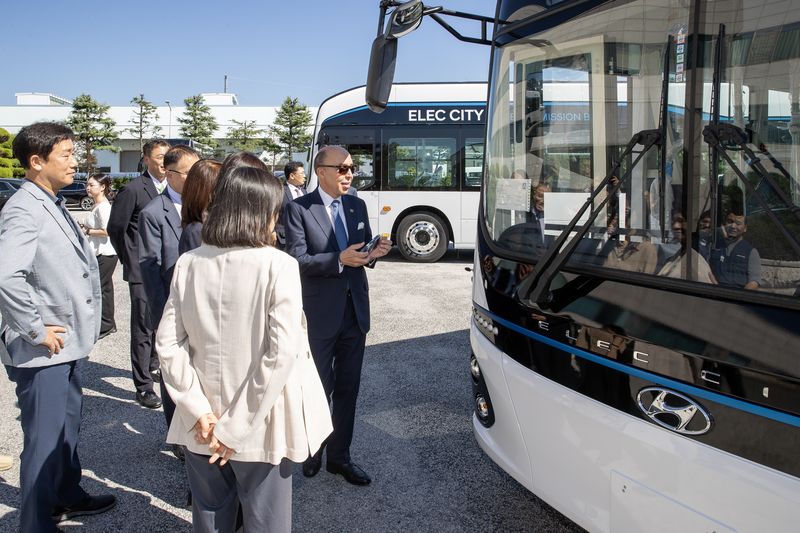
[Financial News] Hyundai Motor Company, together with the Korea International Cooperation Agency (KOICA), will supply domestically produced electric buses to Morocco for the first time. The project will provide vehicles and charging infrastructure through official development assistance (ODA), along with training in operations and maintenance. It will support the electrification of public transportation in Marrakesh's tourist districts and expand the potential use of eco-friendly commercial vehicles in North Africa.
Hyundai Motor Company announced on the 22nd that it will supply 15 Hyundai Elec City electric buses to Marrakesh. The domestic handover ceremony, held the previous day at Hyundai Motor Company's Jeonju Plant in Wanju County, North Jeolla Province, was attended by Lee Seung-min, a senior executive in Hyundai Motor Company's Commercial Product Office; Do Young-a, director of KOICA's Regional Projects Division 2; and Chafik Rachadi, Morocco's ambassador to South Korea.
The supply is part of an ODA project being pursued by KOICA and the city of Marrakesh to establish an eco-friendly electric bus transportation system. KOICA will provide 15 Hyundai Elec City buses and related equipment, including fast chargers, while also offering training and technical cooperation to enable local personnel to operate and maintain the electric buses.
The Hyundai Elec City buses will be deployed on city bus routes in Marrakesh's major tourist districts. They will help meet the public transportation needs of tourists and residents while reducing urban air pollution and carbon emissions from the transportation sector.
Morocco is pursuing a low-carbon transition in the energy, industrial, and transportation sectors, aiming to reduce greenhouse gas emissions by up to 45.5% from business-as-usual projections by 2030 and achieve carbon neutrality by 2050. The project was also established to support Marrakesh's shift to eco-friendly public transportation in line with these policy goals.
The domestic handover ceremony was held to mark the completion of the first two buses produced out of the total 15. Hyundai Motor Company will complete production and shipment of the remaining vehicles before supplying all 15 buses, and plans to hold a local handover ceremony in the first quarter of next year.
Park Cheol-yeon, head of Hyundai Motor Company's Global Commercial & LCV Business Division, said, "This project will serve as a meaningful example of expanding the potential for public transportation electrification through electric buses. Hyundai Motor Company will provide eco-friendly commercial mobility suited to operating environments in various regions and work with partner organizations to contribute to creating a sustainable transportation environment."
Do Young-a, director of KOICA's Regional Projects Division 2, stated, "I hope this support for electric buses will lead to the wider adoption of eco-friendly public transportation in Morocco and contribute to sustainable urban development. I also hope that the supply of Hyundai Motor Company's Hyundai Elec City buses will serve as an opportunity for domestically produced electric vehicles to enter Morocco and North Africa more actively."
Chafik Rachadi, Morocco's ambassador to South Korea, said, "The introduction of Hyundai Motor Company's eco-friendly electric buses in Marrakesh, the host city of the 22nd Conference of the Parties to the United Nations Framework Convention on Climate Change (COP22) and one of Morocco's leading economic and cultural centers, carries great symbolic significance. I hope this project will help Morocco achieve its carbon neutrality goal and improve transportation convenience for its citizens, while also serving as a new starting point for cooperation between South Korea and Morocco toward sustainable urban mobility."
[email protected] Kim Dong-ho Reporter