Aging Industrial Complexes in Jeju, Wanju, and Wonju Selected as Candidate Sites for AI and Green Transition
- Input
- 2026-09-22 10:30:00
- Updated
- 2026-09-22 10:30:00
According to the Ministry of Trade and Industry and the Ministry of Land, Infrastructure and Transport (MOLIT) on the 22nd, the Committee for Promoting Competitiveness Enhancement of Aging Hub Industrial Complexes selected the three areas as candidate sites for this year's project.
The Competitiveness Enhancement Project for Aging Hub Industrial Complexes targets industrial complexes where construction began more than 20 years ago. It links support programs from eight ministries, including the Ministry of Industry and MOLIT, with local government projects to improve infrastructure and transform industrial structures.
The measure comes as industrial complexes have served as major production bases for regional economies and national industry, while concerns about declining competitiveness have grown because of aging facilities and young people's reluctance to work there.
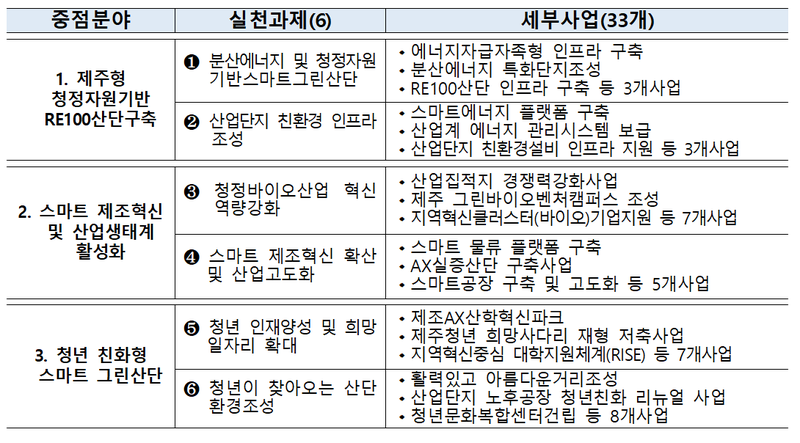
In Jeju, authorities will build a smart green industrial complex centered on the Jeju Science Park National Industrial Complex, using distributed energy and clean resources. Through projects such as the Competitiveness Enhancement Project for Industrial Clusters, they plan to create a Jeju-resource-based RE100 (Renewable Energy 100%) innovation industrial complex and upgrade the clean biohealth industry ecosystem. The project budget totals KRW 323.25 billion, comprising national funding of KRW 187.46 billion, local funding stated as 1,114 ten-thousand-won units plus 4,000 ten-thousand-won units, and KRW 24.35 billion in private funding.
In the Gangwon Wonju Munmak General Industrial Complex, authorities will establish and upgrade smart factories and create a training center for specialists in medical AI semiconductors. The aging manufacturing hub will be transformed into a smart green industrial complex through digital and green transitions. The total project budget is KRW 312.4 billion, including KRW 207.2 billion in national funding, KRW 77.7 billion in local funding, and KRW 27.5 billion in private funding.
Relevant ministries, including the Ministry of Industry and MOLIT, plan to supplement the regional project plans through expert consultations and finalize and officially announce the areas as Competitiveness Enhancement Project districts in the first quarter of next year.
[email protected] Choi Ga-young Reporter