South Korea-U.S.-Japan Foreign Ministers Discuss Denuclearization of the Korean Peninsula at UN General Assembly Meeting
- Input
- 2026-09-22 06:17:18
- Updated
- 2026-09-22 06:17:18
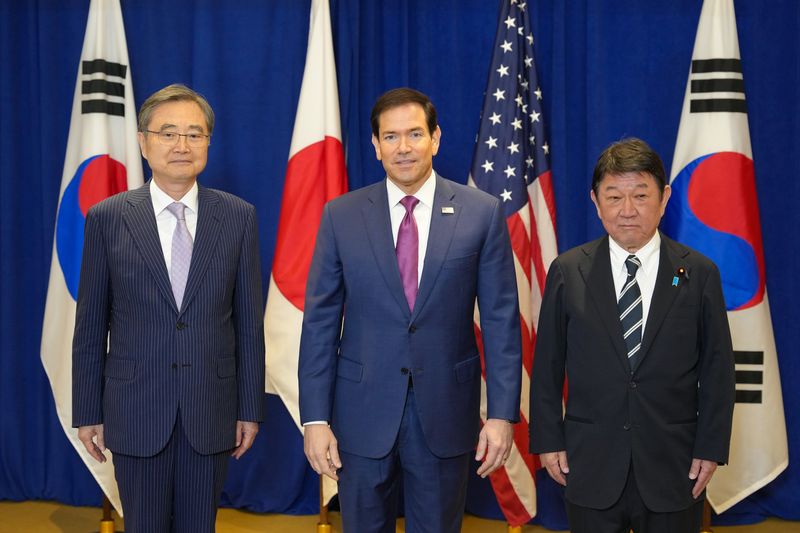
Foreign Minister Cho Hyun met with United States Secretary of State Marco Rubio and Japanese Foreign Minister Motegi Toshimitsu in New York on September 21 for a South Korea-U.S.-Japan foreign ministers' meeting while attending the High-Level Week of the 81st United Nations General Assembly.
The ministers discussed the Korean Peninsula issue, regional and global affairs, economic security, and practical cooperation before adopting a joint statement. The South Korea-U.S.-Japan foreign ministers' meeting was held for the third time this year, following meetings held on the sidelines of the North Atlantic Treaty Organization (NATO) summit and an Association of Southeast Asian Nations (ASEAN)-related ministerial meeting in July.
The three ministers agreed to continue close coordination to maintain peace and stability on the Korean Peninsula and achieve the goal of denuclearization through dialogue and diplomacy, while maintaining a firm deterrence posture against North Korea's threats in relation to North Korea policy.
The three ministers exchanged views on major regional and global developments, including those in Northeast Asia and the Middle East. They agreed on the need to further strengthen communication and coordination among the three countries amid growing uncertainty in international affairs.
They also emphasized the importance of freedom of navigation and overflight worldwide, including in the Indo-Pacific, compliance with international law reflected in the United Nations Convention on the Law of the Sea (UNCLOS), and stronger maritime security. They agreed to continue expanding cooperation in areas where the three countries can make practical contributions, including efforts to combat transnational crime, disaster relief, and humanitarian assistance.
The three ministers agreed that cooperation among the three countries in energy and economic security is more important than ever as volatility in the global economy persists.
They agreed to strengthen practical cooperation in critical and emerging technologies, including semiconductors, artificial intelligence (AI), quantum technology, digital infrastructure, and biotechnology. They also decided to deepen coordination on protecting advanced technologies, diversifying supply chains and enhancing their resilience, and responding to economic coercion.
The three ministers welcomed the establishment of an implementation plan to effectively and mutually beneficially carry out the South Korea-U.S.-Japan Memorandum of Cooperation on Small Modular Reactors (SMR), which was signed on the sidelines of the previous South Korea-U.S.-Japan foreign ministers' meeting.
The three ministers agreed to activate consultations in various fields and at various levels more actively so that South Korea-U.S.-Japan cooperation can produce tangible benefits for the people of all three countries. They also agreed to continue expanding the scope of trilateral cooperation through close communication and by meeting as frequently as possible on various occasions, including major multilateral meetings.
[email protected] Kim Kyung-soo Reporter