South Korea-U.S.-Japan Foreign Ministers' Meeting; U.S. Reaffirms "Ironclad Defense" of South Korea
- Input
- 2026-09-22 04:53:21
- Updated
- 2026-09-22 04:53:21
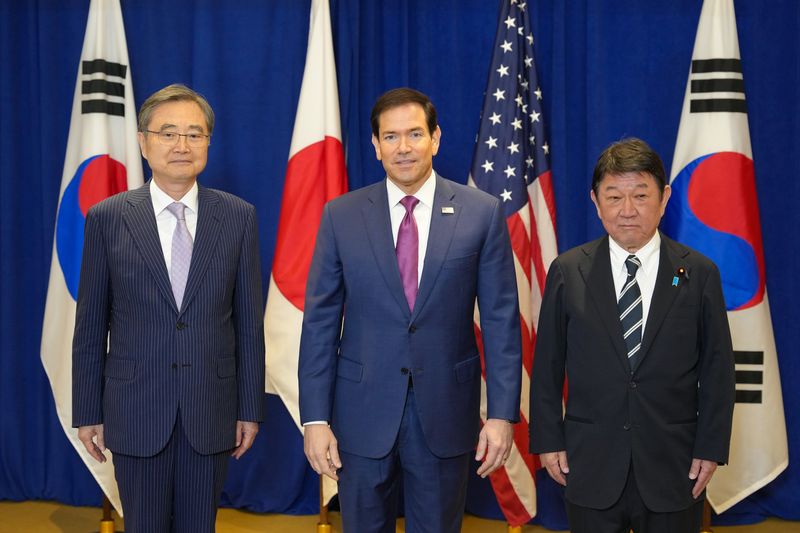
Foreign Minister Cho Hyun, U.S. Secretary of State Marco Rubio, and Japanese Foreign Minister Motegi Toshimitsu held a trilateral foreign ministers' meeting in New York, where the UN General Assembly is being held, on the 21st (local time). The meeting took place three days before President Trump is scheduled to hold a summit with President Xi Jinping in Washington, D.C., on the 24th. President Xi Jinping is scheduled to make a state visit to the United States from the 23rd to the 25th.
In a joint statement issued after the meeting, the three foreign ministers agreed to strengthen cooperation in security and economic affairs. In particular, the United States reaffirmed its "ironclad commitment" to defend South Korea and Japan, based on U.S. military capabilities including nuclear capabilities, as well as its extended-deterrence commitments to both countries.
The Taiwan issue was also included in the joint statement. The three countries emphasized the importance of maintaining peace and stability in the Taiwan Strait and expressed support for Taiwan's meaningful participation in appropriate international organizations. Regarding North Korea, they reaffirmed their commitment to complete denuclearization and urged it to return to dialogue.
Although China was not named directly, the three countries issued a message effectively aimed at Beijing in the area of economic security. They agreed to respond firmly to "economic coercion and non-market policies and practices" and "arbitrary export restrictions that disrupt supply chains." They also welcomed the launch of a new trilateral consultative mechanism on economic security. The initiative is intended to strengthen supply-chain early-warning systems and expand cooperation in critical technology fields.
Reuters and other foreign media outlets noted that the meeting took place as South Korea and Japan grew increasingly wary of U.S. negotiations with China ahead of the Trump-Xi summit. Experts said Seoul and Tokyo are closely watching the possibility that President Trump could make concessions on Taiwan or trade with China in exchange for securing trade and economic gains from Beijing. If trade barriers against China are lowered, the move could also affect the competitiveness of South Korean and Japanese companies in the U.S. market.
[email protected] Correspondent Lee Byung-chul Reporter