Mongolia's Road Management Undergoes K-Digital Transformation... Advanced Road Survey and Testing Equipment Donated
- Input
- 2026-09-21 17:51:04
- Updated
- 2026-09-21 17:51:04
[Financial News] Korean road-management technology is leading Mongolia's digital transformation of road management.
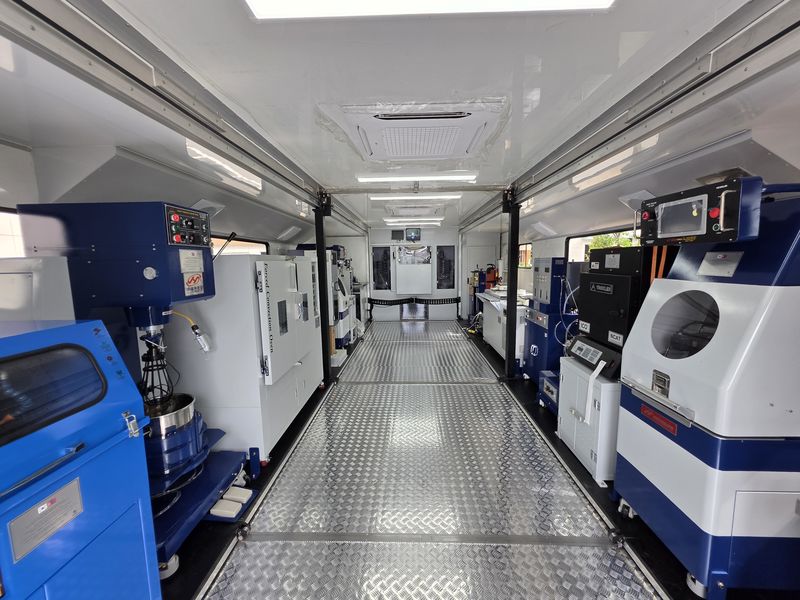
The Korea Institute of Civil Engineering and Building Technology (KICT) announced on the 21st that it had donated automated road pavement condition survey equipment and a mobile quality control laboratory to the Mongolian government and held a donation ceremony in Ulaanbaatar, Mongolia, to support the establishment of a digital management system for the country's national roads.
The event was part of an initiative to establish and introduce road management and pavement quality management systems tailored to Mongolia, drawing on more than 30 years of road-management technology accumulated by the Republic of Korea. The project is expected to strengthen Mongolia's road management and pavement quality control capabilities while laying the foundation for objective road policy and budget planning.
The donated equipment and systems fall into two main categories. First, the automated road pavement condition survey equipment (MRISS) automatically examines surface conditions—including cracks, rutting and smoothness—as a vehicle travels along the road, enabling rapid and accurate assessments. The mobile quality control laboratory (MAT LAB) is a mobile facility that can test and manage pavement materials and construction quality directly at worksites, improving the quality of pavement maintenance.
KICT Deputy Director Kim Hong-mok said, "This donation is an example of transferring and disseminating the road-management technology and equipment that Korea has accumulated over many years, adapting them to local conditions in Mongolia." He added, "By taking responsibility for supporting the project through its local implementation during the remaining project period, we will contribute not only to Mongolia's digital transformation of road management, but also to the expansion of Korea–Mongolia infrastructure cooperation and the joint overseas expansion of Korean companies."
Choi Jin-won, Ambassador of the Republic of Korea to Mongolia, said, "Since establishing diplomatic relations in 1990, Korea and Mongolia have cooperated in various fields for mutual prosperity and development." He added, "I hope this project will serve as an opportunity to further deepen and broaden cooperation between the two countries."
[email protected] Yeon Ji-an Reporter