Korea Land and Housing (LH) Moves to Predict Retaining Wall Risks Up to 72 Hours in Advance; AI Monitoring to Be Upgraded
- Input
- 2026-09-21 17:10:12
- Updated
- 2026-09-21 17:10:12
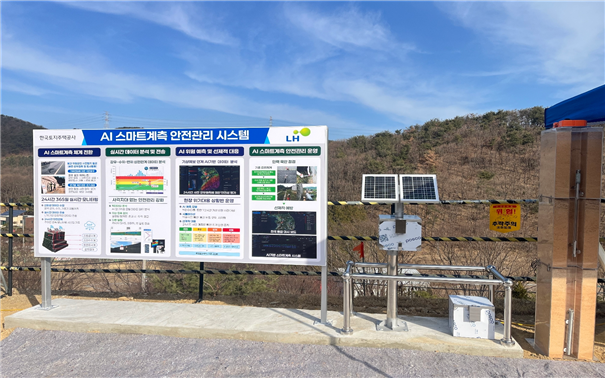
On the 21st, LH said it would enhance the danger-detection and continuous-monitoring functions of its "AI smart monitoring system." The system has been installed at 80 retaining wall sites nationwide under LH's jurisdiction that require priority management, enabling real-time checks of their safety conditions. The initiative is intended to secure time for advance responses to torrential rain, heavy snow and other hazards while improving the accuracy of facility safety management.
The AI smart monitoring system uses high-precision sensors installed on retaining walls to measure displacement, tilt and other conditions. AI comprehensively analyzes the accumulated measurement data and issues real-time alerts when it detects signs of abnormalities.
The system can detect subtle changes that are difficult to identify through visual inspections, helping officials spot warning signs at an early stage. LH plans to expand the scope of its analysis to respond to weather changes that can occur throughout the year, including sudden torrential rain and heavy snow.
The upgraded system will enable AI to repeatedly learn from measurement data collected during disasters, as well as rainfall patterns. By analyzing patterns in the data, LH aims to improve the detection of warning signs and issue alerts up to three days before an incident occurs.
LH will also introduce a three-dimensional visualization-based monitoring function powered by digital twin technology. After recreating actual sites as 3D models in a virtual space, the system will simulate structural cross-sections and calculate danger scores in real time.
This will allow managers to view subtle changes in structures three-dimensionally and assess danger levels more intuitively.
The condition behind retaining walls, which is difficult to assess through sensor measurements alone, will be further examined through electrical resistivity testing. LH plans to conduct additional surveys of the areas behind retaining walls, analyze the findings comprehensively alongside the measurement results, and improve the accuracy of its risk assessments.
[email protected] Choi Ga-young Reporter