Jeju Province and Provincial Council Form 'Joint Front' on 7 Issues, from 2027 Budget to G20
- Input
- 2026-09-21 16:40:12
- Updated
- 2026-09-21 16:40:12
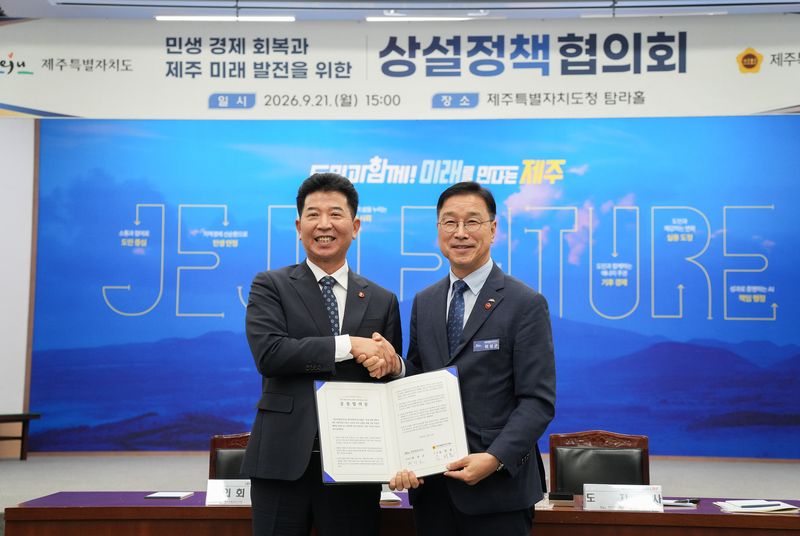
[Financial News, Jeju — Reporter Jeong Yong-bok] Jeju Special Self-Governing Province and the Jeju Special Self-Governing Provincial Council will jointly address issues ranging from the 2027 Jeju budget and securing national funding to the Jeju uprising, the second relocation of public institutions, the bid to host the 2028 Group of Twenty (G20) summit, and electricity-pricing reforms. At the first standing policy consultative meeting since the launch of the ninth popularly elected provincial administration and the 13th Provincial Council, the two sides grouped seven key issues into a joint agreement.
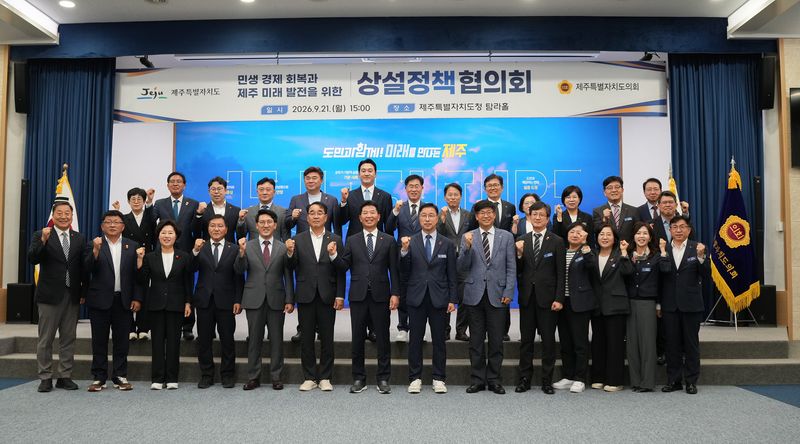
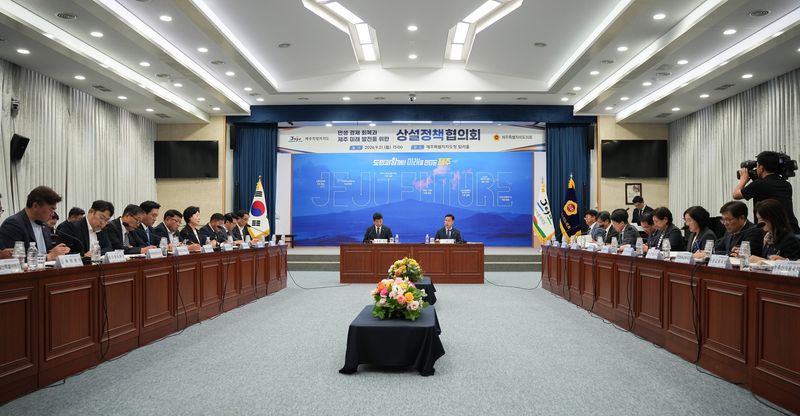
Jeju Special Self-Governing Province and the Jeju Special Self-Governing Provincial Council held a standing policy consultative meeting at Tamna Hall of the Jeju Special Self-Governing Provincial Office on the afternoon of the 21st and adopted a "Joint Agreement for Reviving the Local Economy and Advancing Jeju's Future."
Wi Seong-gon, governor of Jeju Special Self-Governing Province, and Song Young-houn, chair of the Jeju Special Self-Governing Provincial Council, attended the meeting along with senior officials and council members from both institutions. It was the first standing policy consultative meeting since the launch of the ninth popularly elected provincial administration and the 13th Provincial Council.
The first issue on which the two sides reached agreement was the direction of fiscal management for 2027. Despite challenging fiscal conditions, Jeju Special Self-Governing Province and the council agreed to prioritize residents' livelihood stability and the recovery of the local economy by reflecting essential livelihood programs in the budget. The move means they will jointly discuss the broad direction of fiscal management before the existing process, in which the provincial administration drafts the budget and the council adjusts it during deliberations.
The operating system for local government subsidies will also be revamped. Jeju will pursue improvements to its local subsidy system to enhance public interest, efficiency, and accountability.
The two sides also agreed to establish a joint organization to secure national funding. They will form and launch the "Jeju Special Self-Governing Province–Jeju Special Self-Governing Provincial Council Joint National Funding Task Force" at an early stage and jointly negotiate with the National Assembly and the central government to secure funding for Jeju's future industries, key local issues, and local allocation tax.
The plan is for the provincial administration and the council to divide responsibilities for the same projects, from the budget-drafting stage and inclusion in the government's proposal to deliberations by the National Assembly. A key question will be how quickly the task force's membership, launch date, and list of core national-funded projects take shape.
Regarding the Jeju uprising, the two sides agreed to work together on discussions over its proper designation, responses to historical distortions, and institutional reforms, including revisions to the Jeju 4·3 Special Act.
In particular, Jeju Special Self-Governing Province and the council will jointly prepare commemorative projects for the 80th anniversary of the Jeju uprising as initiatives involving people nationwide. The challenge ahead is whether the 80th anniversary can be linked to a national-level resolution of historical issues and institutional reform rather than being limited to one-off commemorative events.
The second relocation of public institutions will also become a joint bid effort. Jeju Special Self-Governing Province has been reviewing the Korea Racing Authority (KRA) and Korea Airports Corporation (KAC) as major targets for relocation while expanding its dedicated organization and province-wide response system. If the government's policy for the second relocation of public institutions to regional areas takes concrete shape, Jeju Special Self-Governing Province and the council plan to jointly develop institution-specific arguments, settlement-support measures, and efforts to persuade the central government.
The two sides will also jointly pursue Jeju's bid to host the 2028 G20 summit. They view the bid as an opportunity to raise Jeju's standing as an international conference city and agreed to work together to build support among residents, conduct efforts to win the central government's backing, and promote the bid.
In the actual bid campaign, however, Jeju will need to provide concrete evidence of its ability to host the summit, including the meeting and accommodation facilities at Jeju International Airport and Jungmun Tourist Complex, as well as security, transportation, medical, and communications infrastructure.
Electricity rates have also become a joint agenda. The two sides agreed to work to ensure that Jeju is included among the areas covered by the region-based industrial electricity-rate system being pursued by the government. They will also jointly propose to the central government improvements to the supply methods and rate-setting criteria for agricultural electricity.
Jeju has treated industrial and agricultural electricity rates as separate issues because renewable energy accounts for a large share of its power generation and electricity use in agriculture, fisheries, and livestock production is directly linked to the local economy.
The defining feature of the agreement is that it placed diverse local issues on a single consultation table.
Some issues, such as the 2027 budget and local subsidies, can be decided within Jeju. Others, including securing national funding, the Jeju 4·3 Special Act, the relocation of public institutions, the G20 summit, and electricity rates, require decisions by the central government and the National Assembly.
As a result, the follow-up implementation methods will inevitably differ. Success in the budget and subsidy fields should be assessed through actual budget proposals and institutional reform plans; national funding through the amount reflected in the government proposal and National Assembly deliberations; and the public-institution and G20 efforts through the government's decisions on the selected destinations.
Wi Seong-gon said, "The administration and the council, as well as the ruling and opposition parties, cannot go their separate ways when it comes to residents' lives and Jeju's future." He added, "We must clarify the timelines and responsibilities for each issue discussed and move forward swiftly together as the provincial administration and the council."
Song Young-houn stated, "The provincial administration and the council have joined forces on issues directly tied to residents' lives, including bringing the 2028 G20 summit to Jeju, relocating the KRA and other public institutions to Jeju in the second round, and easing the burden of agricultural electricity rates."
[email protected] Jeong Yong-bok Reporter