Tokyo, Japan, under 'highest alert' for landslides; 275 flights canceled and prime minister's departure delayed
- Input
- 2026-09-21 16:33:53
- Updated
- 2026-09-21 16:33:53
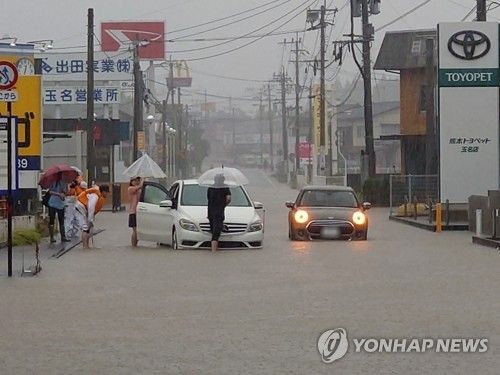
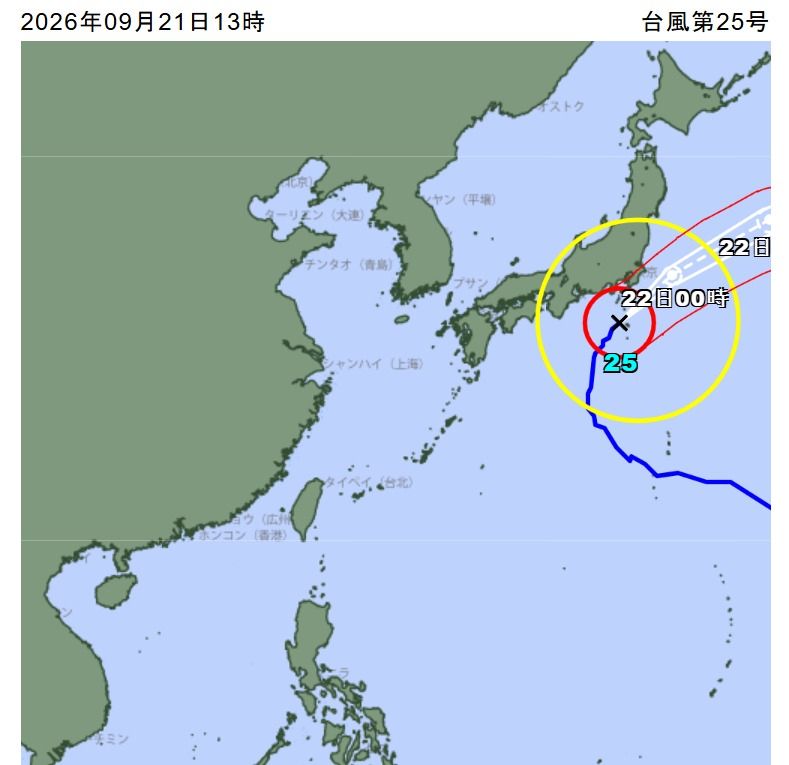
[Financial News, Tokyo—Correspondent Seo Hye-jin] As powerful Typhoon No. 25 approached Japan's metropolitan area, a Level 5 landslide special warning, the highest level, was issued on the 21st for Oshima Town in Tokyo Metropolis's Izu Islands. A landslide risk warning was also issued for central Tokyo, while a string of impacts—including damaged homes, flooding and canceled flights—was reported.
According to the Japan Meteorological Agency (JMA), Typhoon No. 25 was moving northeast at 30 km/h over waters near the Izu Islands as of 2 p.m. that day. Its central pressure was 960 hPa, and its maximum instantaneous wind speed was 55 m/s. The typhoon was expected to approach Tokyo and the surrounding metropolitan area very closely by late that night.
At 12:40 p.m., the JMA issued a Level 5 landslide special warning for Oshima Town, the highest of the five alert levels. Level 5 indicates that a serious disaster is highly likely to have already occurred.
Oshima Town received 583 mm of rain from the 19th through noon that day. Authorities issued 'Emergency Safety Measures' for all 1,901 households and 3,020 residents on the island. Around 110 mm of rain per hour was recorded in other parts of the Izu Islands.
The JMA warned, "The danger to life is imminent," and urged people, "If moving to an evacuation shelter is dangerous, move to a room away from cliffs or ravines or to the second floor or higher of a building and secure your safety immediately."
As the typhoon's rain bands moved northward, Level 4 landslide risk warnings were issued in central Tokyo, including Shibuya Ward and Minato City. Some rivers in the metropolitan area rose above their flood risk levels.
In Chiba Prefecture, one vacant house completely collapsed in a landslide, and several homes were flooded. In another incident, a vehicle crashed into earth and debris that had spilled onto the road in a landslide, injuring the driver. In Yokohama, part of an apartment building's foundation collapsed, prompting authorities to instruct residents to evacuate.
All 275 flights—including 140 operated by All Nippon Airways (ANA) and 135 by Japan Airlines (JAL)—were canceled, affecting approximately 42,000 people. Some rail services in Chiba Prefecture were suspended, while the Tōkaidō Shinkansen was also expected to face delays or service suspensions.
Tokyo Metropolis closed Ueno Zoo and Hama-rikyū Garden due to the typhoon. Kamogawa Sea World in Chiba Prefecture also closed temporarily that day.
Japanese Prime Minister Sanae Takaichi delayed her departure for New York, United States, to attend the United Nations General Assembly from 7 p.m. that day to 11 p.m., a four-hour delay. Her schedule in the United States was reportedly unchanged.
The JMA forecast up to 250 mm of additional rain in Tokyo, the Kanto region, the Izu Islands and the Tōkai region through noon on the 22nd. In some areas, cumulative rainfall could exceed the normal amount for the entire month of September.
[email protected] Seo Hye-jin Reporter