Air-Purifying Car That “Catches Dust While Driving” Set to Hit the Road
- Input
- 2026-09-28 08:40:00
- Updated
- 2026-09-28 08:40:00
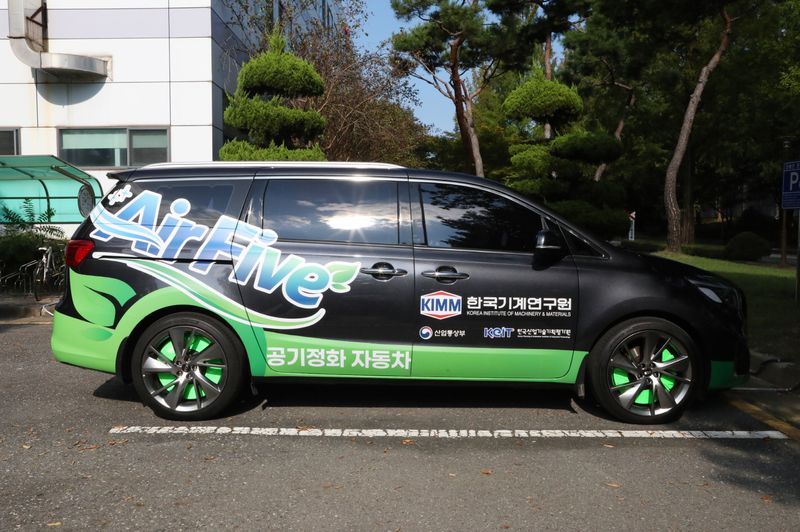
[Financial News] A new air-purifying vehicle technology has been developed that removes fine dust from the surrounding air while driving and captures dust generated by braking before it is released.
A research team led by Han Bang-woo, head of the Urban Environment Research Laboratory at KIMM’s Eco-Friendly Energy Research Division, announced on the 28th that it had developed an air-purifying vehicle technology that reduces both fine dust around roads and brake-wear dust while a vehicle is in motion. The technology is one of the key research achievements under AirFive, one of KIMM’s five flagship brands. Its performance was verified by installing the system on different vehicle models, including the Kia Carnival and Hyundai Sonata. The technology is expected to enable vehicles to serve as mobile air-purifying devices that clean the air as they travel throughout urban areas.
The grille-type dust-collecting device first electrically charges fine dust entering through the vehicle’s grille, then removes it by using electrical forces to attach the particles to collection plates. Carbon fibers far thinner than human hair minimize ozone generation while treating fine dust with a low electrical current. During driving, the system uses airflow generated by the vehicle’s motion to purify the air without a separate high-powered blower. In parking spaces equipped with wireless power-supply facilities, the vehicle’s existing radiator fan can be operated to purify the surrounding air even while the vehicle is stationary.
Brake dust is also captured directly at its source by a dust-collecting device installed behind the caliper. The system uses the tendency of dust to become naturally charged through friction between the brake pads and discs, capturing it through electrical forces without a separate charging device or suction fan. Under the Worldwide Harmonized Light Vehicles Test Cycle (WLTC), the system captured 22.2 mg of brake-wear dust per kilometer for one vehicle. Based on approximately 450 km of driving, that amounts to about 10 g.
The technology uses an electrostatic precipitation method that creates little air resistance and makes use of existing vehicle spaces and components, minimizing the need for additional power and structural modifications.
Performance evaluations showed that the grille-type dust-collecting device removed more than 95% of ultrafine particles (PM2.5) and more than 99% of fine dust (PM2.5-10) at a speed of 30 km/h. It maintained the same level of performance at 50 km/h, while one vehicle was able to purify approximately 1,800 cubic meters of air per hour. Both the Kia Carnival and Hyundai Sonata showed fuel-efficiency changes of less than 1% before and after the devices were installed.
Han Bang-woo, head of KIMM’s Urban Environment Research Laboratory, said, "This technology is characterized by its ability to purify fine dust around roads as a vehicle moves and reduce brake dust at the point where it is generated." He added, "In connection with AirFive, one of KIMM’s five flagship brands, we will expand the use of air-purification technology that can contribute to improving urban air quality."
KIMM’s Urban Environment Research Laboratory developed the grille-type air-purification device and brake-dust collection technology and verified their performance on actual vehicles. The research findings were published in the international journals Tribology International and Atmosphere, and multiple patent applications were filed in South Korea, the United States, Germany and other countries.
[email protected] Yeon Ji-an Reporter