Kia Mexico Plant Ships 2,269 EV3s in First Month; North American Electrification Production Hub Gets Underway
- Input
- 2026-09-22 14:07:31
- Updated
- 2026-09-22 14:07:31
■EV3 Drives Shipment Growth; First Annual Output of 300,000 Units Expected
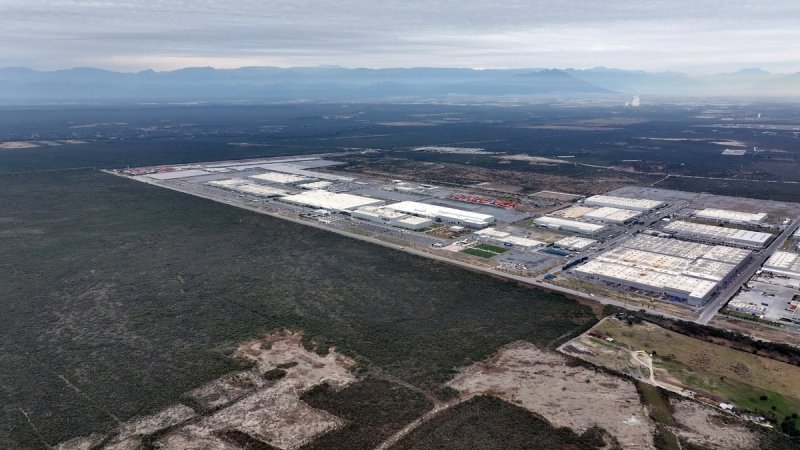
The Pesquería plant, which began operations in 2016, has an annual production capacity of 400,000 vehicles. Until now, it had produced only internal-combustion-engine vehicles such as the Kia K3 and Kia K4. The Kia EV3 is the plant's first electric vehicle. It is also the world's second Kia EV3 production site after Korea's Gwangmyeong EVO Plant and the only one outside Korea.
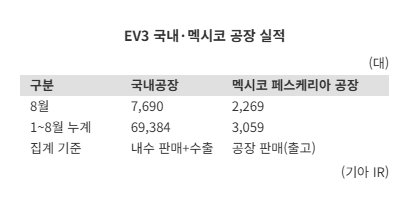
The Kia EV3 drove the plant's shipment growth from its first month. Total August shipments from the Pesquería plant reached 27,020 units, up 14.0% from 23,695 in the previous month. Of the 3,325-unit increase, 1,484 were Kia EV3s, accounting for nearly half. By model, the Kia K4 led with 18,479 units, or 68.4% of the total, followed by the Kia K3 with 6,272 and the Kia EV3 with 2,269, or 8.4%.
Kia expects annual production at the Pesquería plant to exceed 300,000 units for the first time this year, helped by Kia EV3 production. If the 205,100 units shipped during the January-August period are simply annualized based on the monthly average, the plant would produce approximately 308,000 units for the year. After producing about 100,000 units in its first year of operation in 2016, the plant came close to producing 300,000 units for two consecutive years beginning in 2018.
At its CEO Investor Day in April, Kia set a goal of selling 1.48 million vehicles in emerging markets such as Mexico, Latin America and India by 2030, targeting a 6.6% market share. That would be about 500,000 more vehicles than last year. To achieve this, Kia plans to expand production at local plants in Mexico, India and China, as well as exports of completely knocked-down (CKD) kits, to increase supply flexibility. Horacio Chávez, an executive vice president at Kia Mexico, said in July, "Kia EV3 production will provide an opportunity to respond to demand from Mexican consumers and introduce new technology."
■K4 Export Network Opens Sales Channels; United States Is the Key
Shipment volumes far exceed the local sales target. Kia Mexico's target for sales in Mexico during the remainder of this year is 500 units. Shipments in the first month alone were 4.5 times that target. This means the vehicles are not intended solely for the Mexican domestic market.Export routes have already opened. In August, retail sales of Mexico-built Kia EV3s totaled 214 units: 126 in Mexico, 82 in Canada and six in the United States. Sales in Canada began in the first month of mass production. Since there is typically a one- to three-month lag between plant shipments and retail sales, the August shipments are expected to be reflected in sales gradually going forward.
The existing export network is also well established. From January through August, vehicles produced at the Pesquería plant were sold not only in Mexico, where 47,848 units were sold, but also in Latin America, with 12,947 units; Europe, with 10,358; Canada, with 8,448; the Middle East, with 6,281; and Asia-Pacific, with 5,730. This means the export network built around the Kia K3 and Kia K4 could provide sales channels for the Kia EV3.
The United States is the largest market. Of the 190,522 vehicles produced at the plant and sold at retail during the same period, 98,561, or 51.7%, were sold in the United States. Virtually all of them were Kia K4 compact sedans. In August, 12,887 units, or 15.4%, of Kia's 83,793 sales in the United States were vehicles made in Mexico.
Unlike the Kia K4, it has not yet been decided whether the Mexico-built Kia EV3 will be exported to the United States. In a recent interview with local media, Chávez said of exports to the United States, "It cannot be confirmed at this point."
Meanwhile, Kia plans to invest $649 million, or approximately 940 billion won, in Mexico from this year through 2028. Rather than building a separate plant, Kia will modify existing production lines and shift to a mixed-production system that makes internal-combustion-engine vehicles and electric vehicles together. The share of locally sourced parts will start at 26.5% and gradually increase.
[email protected] Kim Dong-chan Reporter