Jeju Fire Service Uses AI at Emergency Scenes to Screen for Heart Attack Risk; Reperfusion Treatment Referrals Rise 25%
- Input
- 2026-09-21 15:10:31
- Updated
- 2026-09-21 15:10:31
【Financial News Jeju = Jeong Yong-bok】In Jeju, the response to severe cardiovascular diseases, which previously intensified only after patients reached the hospital, is now beginning at the scene of a 119 emergency call.
According to the Jeju Special Self-Governing Province Fire Safety Headquarters on the 21st, 85 patients with severe cardiovascular disease were connected to emergency reperfusion treatment from March through August this year. That was 17 more than the 68 patients recorded during the same period last year.
The transfer rate for patients suspected of having severe cardiovascular disease to specialized treatment hospitals also rose from 98.3% to 100%.
During the same period, the rate at which 119 emergency crews performed 12-lead ECGs increased by 28.4 percentage points, from 66.4% to 94.8%. A 12-lead ECG records the heart’s electrical signals from multiple directions and is used to assess cardiac abnormalities, including heart attacks.
In March, the Jeju Fire Service fully introduced an AI-based ECG analysis system at 119 emergency response sites across the province. The fire headquarters described it as the first full-scale implementation of its kind nationwide.
The system is designed to assess a patient’s severity and identify a hospital capable of providing treatment before the patient arrives.
When emergency medical technicians perform a 12-lead ECG at the scene, AI analyzes the electrical signals and provides information indicating suspected severe cardiovascular disease. EMTs use the results in their on-site assessment and share them with specialized medical institutions. Hospitals can determine whether they are able to accept the patient and begin preparing for treatment before the patient arrives.
Acute myocardial infarction occurs when a coronary artery supplying blood to the heart muscle becomes blocked. Because the extent of heart muscle damage and the prognosis can depend on how quickly the blocked vessel is reopened, it is important to rapidly identify the appropriate hospital at the scene.
Jeju’s geography as an island makes it particularly important to have a system that allows emergency crews to determine at the scene which hospital should receive a patient directly.
The Jeju Fire Service, in cooperation with Jeju National University Hospital, has applied AI ECG analysis and transmission technology in actual emergency response settings and analyzed its effects.
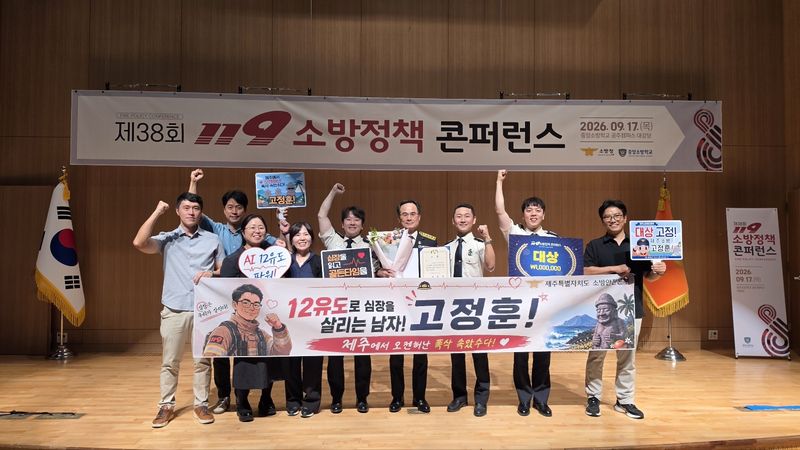
The field validation study received the highest evaluation in a nationwide fire service policy competition.
The Jeju Fire Service’s study, titled “Establishment and Field Validation of a Cardiovascular Patient Transfer System Based on AI ECG Analysis and Transmission Technology,” received the Presidential Award, the grand prize, at the 38th 119 Fire Service Policy Conference held at the National Fire Service Academy on the 17th.
Nineteen municipal and provincial fire headquarters took part in the competition, and eight teams that passed the first-round paper review advanced to the final presentations. The Jeju Fire Service earned the highest overall score, combining 60 points from the paper review and 40 points from the presentation evaluation. This was the first time Jeju had won the grand prize in the competition.
Go Jeong-hun, chief of the Jeju Fire Station, served as the principal investigator. Fire Sergeants Yang Jun-hwan and Park Dae-pil, along with Fire Corporal Go Bong-jun, participated in the study. Song Seong-uk, a professor at Jeju National University Hospital, served as an adviser.
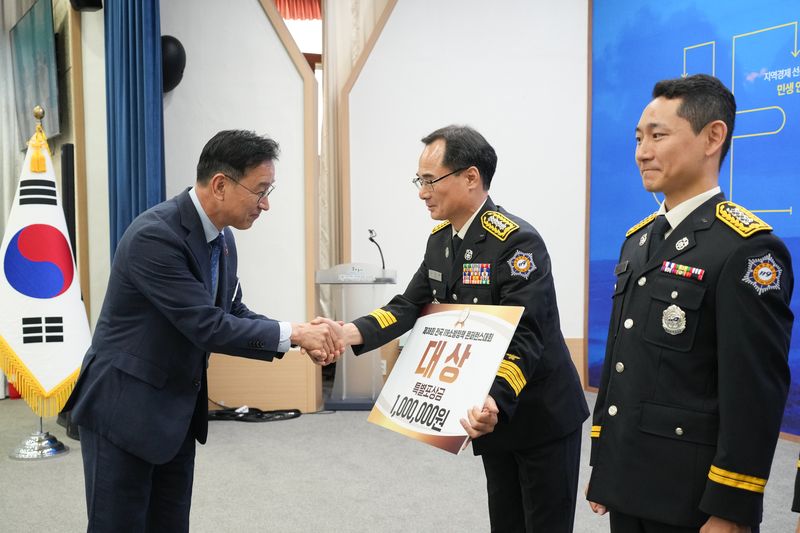
Wi Seong-gon, governor of Jeju, presented a special commendation award to the researchers during a weekly policy meeting held at the Jeju Special Self-Governing Provincial Office’s Tamna Hall that day.
“The approach of having AI interpret ECGs measured by EMTs at the scene and identify high-risk patients first has taken root in Jeju,” said Park Jin-su, chief of the Jeju Special Self-Governing Province Fire Safety Headquarters. “We will expand the use of advanced technology beyond cardiovascular diseases to a range of emergency medical and disaster response settings,” he added.
[email protected] Jeong Yong-bok Reporter