Emergency Martial Law Military Commanders Found Guilty at First Trial: Yeo In-hyung Sentenced to 18 Years, Lee Jin-woo to 15 Years, and Others
- Input
- 2026-09-21 16:15:02
- Updated
- 2026-09-21 16:15:02
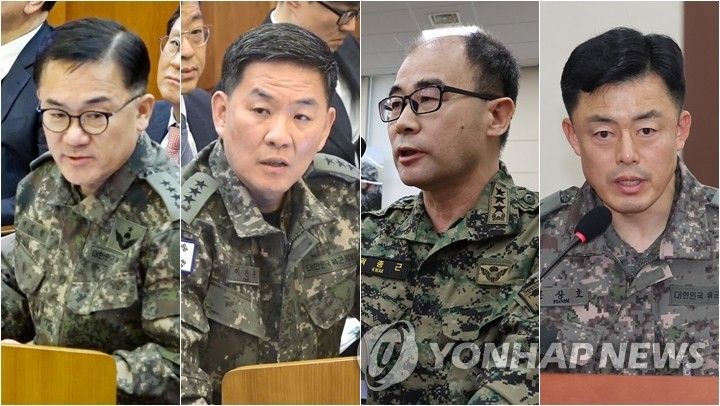
[Financial News] Key martial law military commanders who were indicted on charges including performing important duties in an insurrection and abusing their authority to obstruct the exercise of rights during the Dec. 3, 2024, emergency martial law incident were all found guilty at their first trial. The court characterized the declaration of emergency martial law as 'a riot aimed at subverting the constitutional order' to paralyze the functions of the National Assembly and the National Election Commission, and determined that the commanders actively supported it by mobilizing troops despite being aware of its nature.
The 26th Criminal Division of the Seoul Central District Court, presided over by Presiding Judge Lee Hyun-kyung, sentenced Yeo In-hyung, former commander of the Defense Counterintelligence Command, to 18 years in prison on charges including performing important duties in an insurrection and abusing his authority to obstruct the exercise of rights.
Lee Jin-woo, former commander of the Capital Defense Command, was sentenced to 15 years in prison. Sang-ho Moon, former commander of the Defense Intelligence Command, received 12 years; Park An-su, former Chief of Staff of the Republic of Korea Army and former martial law commander, received 10 years; and Kwak Jong-geun, former commander of the Republic of Korea Army Special Warfare Command who confessed to the offenses, received nine years. Lee, Park and Kwak, who had been tried while out on bail, were immediately taken back into custody in court after their bail was revoked following the prison sentences.
Before ruling on the merits, the court rejected all procedural objections raised by Park's and Moon's legal teams concerning investigative jurisdiction and the execution of warrants. Regarding the emergency martial law actions of former President Yoon Suk Yeol and former Minister of National Defense Kim Yong-hyun, the court stated, "They neutralized the National Assembly and the National Election Commission through an unconstitutional and unlawful martial law decree and obstructed lawmakers' voting rights by deploying troops," and premised its ruling on the conclusion that it was "an insurrectionary riot carried out by multiple people acting together with the aim of subverting the constitutional order."
The court also recognized the detailed facts of the offenses attributed to each defendant. Regarding Yeo, who was accused of drafting a pre-operation planning memo and directing the operation of arrest teams and the securing of NEC servers, the court found all related charges, as well as perjury in court, proven, saying, "He clearly recognized the illegality and actively conspired in advance." It also found that Lee participated in carrying out the insurrection, stating, "He planned in advance to use crowbars and fire blank rounds and ordered, 'Drag the lawmakers out,' immediately before the vote in the National Assembly plenary chamber."
The court also recognized Moon's intent to participate in the insurrection in connection with the allegation that he attempted to seize control of the NEC. In Park's case, although he had been the martial law commander, the court found that a conspiracy had not been proven regarding his orders to deploy the Capital Defense Command and the Republic of Korea Army Special Warfare Command and acquitted him of abuse of authority on those counts for lack of sufficient grounds. However, it found him guilty of obstructing lawmakers' voting rights by asking the commissioner general of the Korean National Police Agency to impose a second blockade of the National Assembly, as well as of performing important duties in an insurrection through the issuance of the martial law decree.
In explaining the sentences, the court rebuked the defendants, saying, "They seriously abandoned the military's political neutrality and mobilized military force for the political benefit of a particular faction," and, "They mobilized subordinate soldiers and police officers, who were supposed to perform their duties lawfully, in acts of insurrection, inflicting damage that will be difficult to repair."
However, the court reduced Kwak's sentence by applying the mandatory sentence-reduction provision under the Special Counsel Act on the insurrection, as he submitted a written statement from the outset and cooperated with efforts to establish the facts. It also gave limited consideration to the circumstances of Park, who prevented bloodshed by controlling the use of Tasers and blank rounds, and Lee, who ordered troops to be deployed without weapons. By contrast, the court ruled that heavy sentences were unavoidable for Yeo and others who denied the charges and shifted responsibility onto their subordinates.
[email protected] Lee Chang-hoon Reporter