"China’s memory-chip catch-up is accelerating too quickly"—How Samsung and SK Can Maintain Their Lead
- Input
- 2026-09-21 16:31:18
- Updated
- 2026-09-21 16:31:18
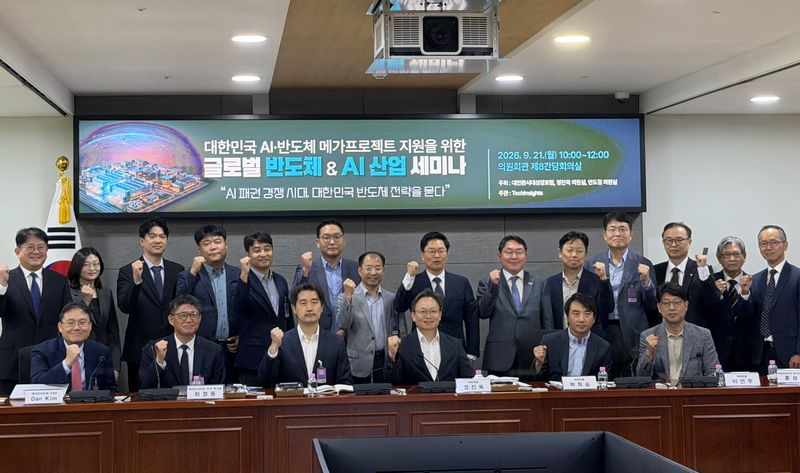
[Financial News] As competition in AI memory semiconductors spreads across the board, experts have suggested that Samsung Electronics and SK hynix should extend their product-level technological advantages into broader system competitiveness. With China accelerating its catch-up efforts on the strength of its massive domestic market and local supply chain, Korean companies also need to enhance their customer-specific co-design capabilities.
Choi Jeong-dong, senior vice president at TechInsights, said at the Global Semiconductor and AI Industry Seminar held at the National Assembly in Yeouido, Seoul, on the 21st, "China should not be assessed solely by looking at how many generations behind it is today." He added, "The speed at which CXMT and YMTC learn, validate and scale new technologies is extremely fast."
At the seminar, held to explore ways to strengthen Korea’s competitiveness in the global semiconductor market, experts said the technology gap with China in memory semiconductors should be assessed comprehensively. Factors such as yield, mass-production capabilities, costs and the broader system ecosystem should be considered, rather than relying only on product generations or the level of process miniaturization.
Chinese memory-chip makers are rapidly expanding their reach from commodity DRAM to mobile DRAM and NAND. On the 20th, local time, CXMT announced that it had begun mass production on a fifth-generation DRAM process platform and unveiled two 24Gb LPDDR5X products based on the platform. Beyond its core DRAM business, CXMT is also pursuing entry into the NAND market. According to foreign media reports, CXMT is considering establishing a NAND flash research institute in Beijing and building an R&D production line at a new plant.
One challenge for Korean companies is that competition in AI memory is expanding beyond high-bandwidth memory (HBM) to DRAM, NAND flash, storage and advanced packaging. As AI spreads from training to inference and agentic AI, capacity, power efficiency and data-storage capabilities are becoming equally important. In China, memory-chip companies such as CXMT and YMTC are being linked with foundry, equipment and packaging firms, including Huawei and Semiconductor Manufacturing International Corporation (SMIC), to form a domestic supply chain. The country’s strengths include its ability to quickly validate new products and move on to follow-up development, supported by its massive domestic market and government assistance.
Choi said, "China’s competitiveness is underestimated when its companies are viewed individually." He explained, "AI processors, memory, foundries, equipment, packaging, and server and cloud companies are all connected, accelerating the pace of technology validation."
As China builds its own ecosystem, experts have called on Samsung Electronics and SK hynix to go beyond supplying individual memory products and strengthen their customer-specific system competitiveness. Samsung Electronics is seen as having an integrated advantage through its memory, foundry and advanced-packaging capabilities, while SK hynix is recognized for its technological expertise and customer responsiveness developed in the HBM market. After HBM4, the ability to co-design logic base dies and packaging with customers is expected to become even more important.
Experts also emphasized the need to establish demonstration infrastructure for materials, parts and equipment, along with a skilled workforce to support companies’ technology development. Jinha Kim, head of the Advanced AX Division at the Korea Institute for Advancement of Technology (KIAT), said, "Taiwan also succeeded by building an ecosystem around Taiwan Semiconductor Manufacturing Company Limited (TSMC), rather than focusing only on fabs." Kim added, "We need to build infrastructure where technologies developed by materials, parts and equipment companies can be validated before mass production so that companies and talent can cluster in the region."
[email protected] Park Ji-yeon Reporter