"Sing along to 'Soda Pop' and slurp down Ppongtta"... Korean ice cream wins over the United States and Europe
- Input
- 2026-10-02 11:23:28
- Updated
- 2026-10-02 11:23:28
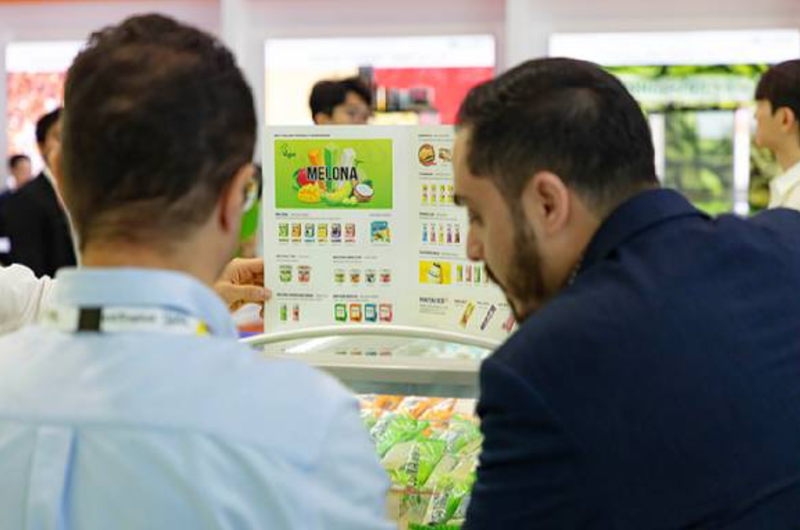
[Financial News] Europe and North America are emerging as new growth engines for South Korea's ice cream industry. Korean ice cream challenges have recently surged in popularity on social media, prompting companies to accelerate their efforts to capture overseas markets with localized products.
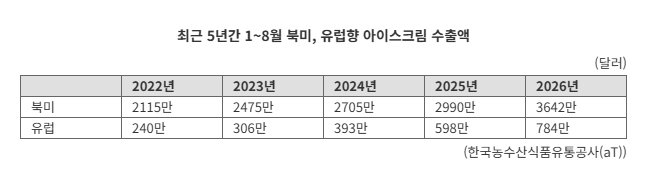
According to the Korea Agro-Fisheries & Food Trade Corporation (aT) on the 2nd, ice cream exports to Europe totaled 7.84 million dollars from January through August this year, up 1.86 million dollars, or 31.1%, from 5.98 million dollars during the same period last year. South Korea's ice cream exports to Europe have continued to rise, from 2.40 million dollars in January-August 2022 to 3.06 million dollars in 2023 and 3.93 million dollars in 2024.
Exports to North America also increased significantly. Ice cream exports to the region totaled 36.42 million dollars from January through August this year, up 6.52 million dollars, or 21.8%, from 29.90 million dollars during the same period last year. The figure has followed a clear upward trend each year, rising from 21.15 million dollars in January-August 2022 to 24.75 million dollars in 2023 and 27.05 million dollars in 2024.
The surge in South Korean ice cream exports is attributed to the K-food craze and ice cream challenges spreading across social media. In particular, a challenge involving eating Ppongtta ice cream to the Netflix animated film KPop Demon Hunters' soundtrack song "Soda Pop" swept social media last year. As the film's popularity grew, demand from people wanting to recreate the video also increased, driving a sharp rise in sales of the related product.
The ice cream industry's active expansion into Europe and the United States reflects the increasingly clear limits to growth in the domestic market. According to aT, South Korea's retail ice cream market shrank steadily from 2.0184 trillion won in 2015 to 1.4864 trillion won in 2024, then fell to about 1.41 trillion won last year. The growing number of premium ice cream stores such as Baskin-Robbins and Van Leeuwen, along with the expanding handmade gelato market, has further narrowed the foothold of ice cream products sold in supermarkets.
Compared with other countries, Europe and the United States have particularly stringent regulations on dairy imports, including hygiene and ingredient requirements. Ice cream exporters must obtain approval for each ingredient and meet strict hygiene standards at their manufacturing facilities.
Despite these hurdles, South Korean ice cream companies are overcoming non-tariff barriers by using plant-based ingredients as a localization strategy. Binggrae has replaced the dairy components in its flagship product Melona with plant-based ingredients and is expanding exports to the Netherlands, Germany and the United Kingdom. In particular, the product entered more than 1,300 Carrefour stores in France late last year.
Lotte Wellfood is also seeking to enter the European market with plant-based products. After beginning research and development on plant-based ice cream last year, Lotte Wellfood received positive reviews for showcasing plant-based gukhwappang at Anuga, the world's largest food trade fair, held in Cologne, Germany, last year.
A food industry official said, "Dairy products face high non-tariff barriers, including hygiene and quarantine requirements, so we are broadening export opportunities with products that use plant-based ingredients tailored to local standards. As K-food's overall popularity continues to grow, overseas distributors are increasingly inquiring about importing South Korean ice cream."
[email protected] Park Kyung-ho Reporter