After 97 rounds of negotiations... 100% recognition of work experience from other job categories for Jeju Province education support staff
- Input
- 2026-09-21 14:33:21
- Updated
- 2026-09-21 14:33:21
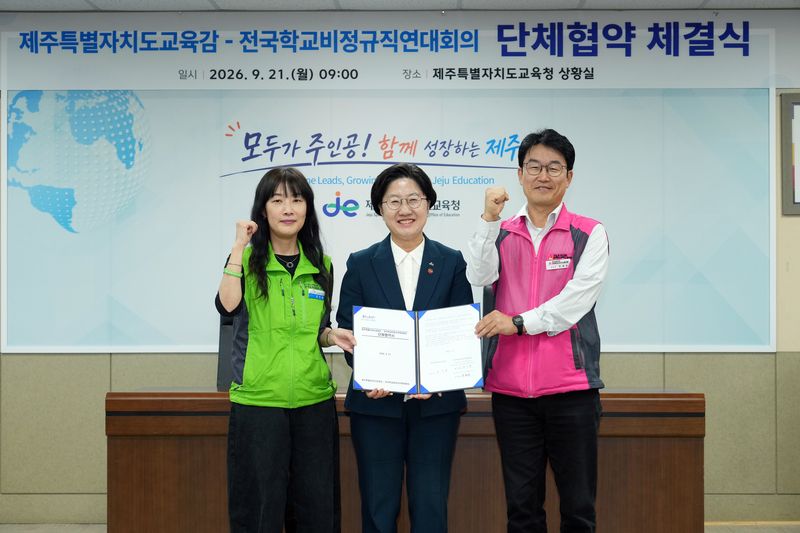
[Financial News Jeju = Reporter Jeong Yong-bok] The scope of recognition for previous work experience of educational civil service employees in the Jeju Province region will be expanded, and working conditions, including leave, childcare time, and industrial accident support, will be significantly changed. The previous standard of fully recognizing only experience within the same job group while reflecting only half of experience in other job groups has been eliminated, and it will now be 100% recognized regardless of the job group.
According to the Jeju Special Self-Governing Province Office of Education on the 21st, the Office of Education and the National Federation of Non-Regular School Workers signed a collective agreement consisting of a total of 144 articles and 593 items at the situation room of the main building of the Office of Education this morning.
This agreement comes approximately 21 months after negotiations began in December 2024, based on 417 demands submitted by the labor union in September of the same year. Labor and management held a total of 97 rounds of negotiations through the 16th, including consultations between floor leaders, working-level negotiations, and consultations by job category.
The most notable change is the recognition of work experience. Previously, work experience within the same job category was recognized at 100%, while experience in a different category was recognized at only 50%. From now on, all previous experience as an educational support staff member will be recognized regardless of the job category. The same standards will apply to work experience at other city or provincial offices of education.
For sick leave newly approved after the conclusion of the agreement, the first year shall be included in the length of service.
The vacation system is also being expanded. Learning leave will increase from four days to seven days per year. The additional three days can be used during school vacations. The Provincial Office of Education explained that the seven-day annual learning leave is the highest level among all city and provincial offices of education nationwide.
Paid sick leave increases from 40 days to 45 days per year. Holidays and unpaid leave days are excluded from the sick leave days.
Long-term service leave has also been revised. Three days of leave will be newly granted to educational civil service employees with a tenure of 5 years or more but less than 10 years. For those with 10 years or more, the leave will be expanded from the existing 5 days to 7 days, and for those with 20 years or more, it will be expanded from 10 days to 15 days.
The scope of childcare support is also being expanded. The criteria for children eligible for childcare time will be extended from the current age of 5 or younger to age of 8 or younger, or to the second grade of elementary school or lower. This measure is intended to reduce the childcare burden on educational support staff working in schools.
Five days for back-to-school preparation are being newly established for occupations that do not work during vacation. This is intended to allow for the use of time for preparing for the new semester and training.
Working hours and welfare systems for some job categories will also change. Starting March 1 next year, the daily working hours for environmental workers at schools with 20 or more classes will be expanded to 8 hours.
Customized welfare benefits will be gradually increased from the current 650 points to 950 points by 2029. It was decided to continue labor-management consultations on the issue of expanding working hours for care specialists.
New support measures have also been established for workers who are unable to work for an extended period due to industrial accidents. If an employee on leave due to an industrial accident maintains their leave during the treatment period, they will be paid 20% of their basic salary as a livelihood support allowance. This system is designed to alleviate the problem of a gap in income and treatment occurring simultaneously following a work-related injury.
Job titles will also be revised to align with actual duties. Titles will be changed to Academic Affairs Assistant, Special Education Assistant, Science and Invention Assistant, and Public Library Support Assistant.
This collective agreement holds great significance in that it redefines the overall service and working conditions of educational support staff responsible for administrative support, special education, science lab operations, library support, and facility management at schools and educational institutions in Jeju Province.
In particular, with the change in the method of recognizing work experience, the previous work experience of employees who change job types or move to Jeju Province from other city or provincial education offices can now be more broadly reflected in their length of service.
Expanding vacation and childcare time can have a direct impact on long-term employment and work-family balance. On the other hand, since measures such as extending working hours for environmental assistants and increasing customized welfare benefits affect budget and personnel management, the burden on schools and financial requirements must be examined together during the actual implementation process.
The Provincial Office of Education introduced the measure in this agreement to unify the calculation period for leave and sabbatical leave for employees from March 1 to the end of February of the following year as the first case in the nation.
As of April this year, the authorized number of educational support staff at the Jeju Provincial Office of Education is 2,315. Separate from teachers and general civil servants, they are responsible for various on-site duties at schools and educational administrative institutions, such as school meals, childcare, administrative support, and facility management.
Jeju Superintendent of Education Go Ui-sook stated, "We reached a meaningful agreement through an attitude of mutual growth and cooperation," adding, "We will provide detailed guidance to schools and institutions and monitor implementation to ensure that this leads to improved working conditions for educational support staff and stable operations in the field."
The Provincial Office of Education plans to report this collective agreement to the Ministry of Employment and Labor (MOEL) by October 6 and inform educational institutions and schools of all levels of the changed system during October.
[email protected] Jeong Yong-bok Reporter