Hyundai Motor: "Consistent policies are essential for hydrogen investment... Chung Eui-sun is firmly committed"
- Input
- 2026-09-21 15:55:54
- Updated
- 2026-09-21 15:55:54
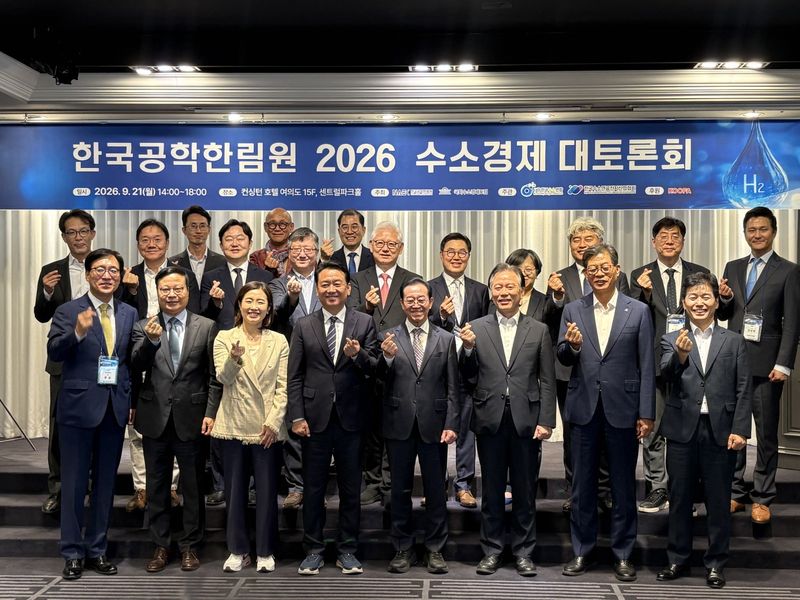
[Financial News] Calls are growing for expanded supply infrastructure, the creation of an early-stage market, and consistent policy support to help Hyundai Motor expand its hydrogen mobility business. Experts say the role of hydrogen and the direction of government support must be clearly defined to encourage companies to make long-term investments. Hyundai Motor also reaffirmed its commitment to advancing its hydrogen business.
The National Academy of Engineering of Korea (NAEK) and the National Assembly Hydrogen Economy Forum held the 2026 Hydrogen Economy Grand Debate at Kensington Hotel in Yeouido, Seoul, on the 21st. About 150 industry, academic, and research-sector representatives attended to discuss issues facing the hydrogen industry and related policy challenges.
Shin Seung-gyu, a Hyundai Motor vice president, emphasized, "For new technologies to take root, technology and investment must accumulate over 10 to 20 years, and that requires consistent energy policies. If the vision for hydrogen energy in the energy transition roadmap and the support policies are unclear, it is extremely difficult for companies to decide to invest."
He also expressed concern about China catching up. Shin pointed out that while South Korea has experienced ups and downs in implementing its hydrogen economy roadmap since announcing it in 2019, China has rapidly advanced in mobility, water electrolysis, and hydrogen power generation. He said, "We must create practical and specific opportunities to take the lead before it is too late, so that the technologies our companies have secured in advance do not go to waste."
Asked whether Hyundai Motor's focus on new businesses such as physical AI had weakened the momentum of its hydrogen business, he said, "Chairman Chung Eui-sun’s commitment to hydrogen is unwavering." He explained that the company views hydrogen as an energy source for preparing for the environmental challenges facing future generations and will continue securing related technologies.
The mobility and utilization session discussed ways to create demand, with commercial vehicles and forklifts identified as priority markets. Participants also addressed ways to improve the operating economics of charging stations and the direction of government financial support to link vehicle deployment with the expansion of charging infrastructure.
Im Man-gyu, CEO of ILJIN Hysolus, said, "To foster the hydrogen industry and create demand, large-scale hydrogen supply infrastructure with convenient access for users must be established first under government leadership and expanded continuously. In hydrogen production, we should initially adopt a flexible approach that includes gray and blue hydrogen, while gradually increasing the share of green hydrogen through various methods, such as using surplus electricity from solar power."
The forum also saw active participation from representatives of materials, parts, and equipment companies, who discussed on-the-ground difficulties and policy challenges in technology development, demonstration, and market creation, and proposed improvements. The practical concerns of small and midsize companies responsible for the core of the hydrogen industry’s supply chain and job creation were also reflected in the policy discussions in various ways.
The production session covered the division of roles between domestic production and overseas imports, as well as ways to stimulate investment in production plants by expanding tax credits for hydrogen production. The storage and distribution session identified policy tasks linking the industry's long-term decarbonization strategies with investment in hydrogen infrastructure.
[email protected] Kim Dong-ho Reporter