Stagnating Probiotics Market: Big Three Brands Seek Breakthrough Strategies
- Input
- 2026-09-21 16:08:43
- Updated
- 2026-09-21 16:08:43
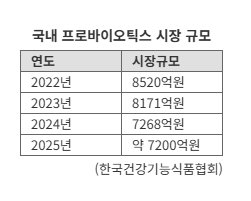
According to industry sources on the 21st, Korea's probiotics market was estimated at about 723.2 billion won in 2025. It edged down from 726.8 billion won in 2024 and was roughly 15% smaller than the approximately 852 billion won recorded in 2022. Although probiotics have become a representative health functional food, competition among companies is intensifying as the market enters maturity.
Against this backdrop, CKD Healthcare is targeting the mass market with its flagship product, 'LactoFit.' It is improving consumer access through relatively affordable prices and a broad product lineup while expanding its online and offline distribution networks. Rather than relying on market growth, the strategy aims to secure sales volume by broadening the existing consumer base for probiotics.
Hecto Healthcare is seeking to secure long-term customers by promoting its premium product image and offering a subscription service. DeSimone's subscription service automatically charges and delivers products on dates selected by customers, making purchases more convenient for consumers who take probiotics regularly. Subscribers also receive benefits such as discounts, free delivery, the ability to skip a delivery cycle and product changes. The number of subscribers has now surpassed 130,000. In February this year, the company introduced 'Gudok Plus,' reducing the minimum subscription commitment from 12 billing cycles to six and extending discounts beyond probiotics to other health functional foods, including omega-3 products and vitamins. Through subscriptions, the company aims to expand customers' purchases from specific probiotics to health functional foods more broadly.
Cell Biotech has identified overseas markets as a new growth engine. With its flagship product, 'DUOLAC,' it has expanded its export destinations, particularly in Europe and Asia, and has now established an export network spanning 56 countries worldwide. Korea's total probiotic exports amounted to 72 billion won in 2025, of which Cell Biotech accounted for 29.1 billion won. Cell Biotech has remained Korea's leading probiotic exporter for 13 consecutive years since 2013, when related statistics began to be compiled.
After recently entering the Republic of South Africa for the first time, the company expanded its export regions to Africa, in addition to Europe, Asia, North America, South America and Oceania. It has thereby established an export network spanning six continents. The share of overseas sales has also continued to rise. Cell Biotech's overseas sales accounted for 48.22% of its total sales in 2023, increasing to 59.90% in the first half of 2026. Rather than relying solely on the domestic market, the company continues to broaden its growth base through exports.
An industry official said, "It is becoming increasingly difficult to grow in Korea's probiotics market simply by selling more products." The official added, "As the market's growth rate slows, how companies create new demand and revenue is expected to determine their performance."
[email protected] Jung Sang-hee Reporter