Germany's far-right party wins two straight state elections; governing CDU suffers historic rout
- Input
- 2026-09-21 14:21:26
- Updated
- 2026-09-21 14:21:26
[Financial News] Germany's far-right Alternative for Germany (AfD) won its second consecutive victory in a state parliament election in a former East German state on the 20th (local time). The center-right governing Christian Democratic Union (CDU) suffered a crushing defeat that day in northeastern Mecklenburg-Vorpommern. The CDU also endured the humiliation of being excluded from the state parliament there for the first time ever.
As anti-immigrant sentiment and economic hardships intensify in Germany, the decline of centrist parties such as the CDU and the country's accelerating shift toward the far right are expected to continue. The CDU also suffered a crushing defeat in Saxony-Anhalt on the 6th. Like Saxony-Anhalt, Mecklenburg-Vorpommern was formerly part of East Germany.
According to ARD, Germany's public broadcaster, and the Mecklenburg-Vorpommern state election commission, final results showed that the AfD became the largest party with 38.2% of the vote, ahead of the center-left Social Democratic Party (SPD) at 35.5%, The Left at 6.5%, and the Greens at 5.7%. The AfD will receive 32 of the state parliament's 71 seats, more than doubling its 16.7% vote share from the 2021 election.
However, the AfD fell short of a majority and is not expected to join the new government because the other parties have rejected forming a coalition with it. The SPD, which secured 29 seats, is expected to form a progressive coalition with The Left and the Greens, which won five seats each.
Decline of centrist parties expected to accelerate Germany's shift to the far right
The CDU's performance was particularly notable: Its vote share fell from 13.3% five years ago to 4.9%, or nearly one-third of its previous level, below the 5% threshold required for seat allocation. The CDU recorded a historic rout by failing even to enter the state parliament. It was the first time since its founding in 1945 that the CDU had won no seats in any of Germany's 16 state parliaments.
The region has faced a severe shortage of skilled workers due to an aging population and a low birth rate, and about 50,000 people with immigrant backgrounds have moved there for work. Although they play an important role in the regional economy, their presence has fueled far-right anti-immigrant sentiment. The AfD capitalized on voters' anger over economic inequality and their discontent over immigration-related issues. Its campaign pledges included the mass deportation of illegal immigrants, an end to military support for Ukraine, and stronger ties with Russia.
In the Berlin state parliament election held on the same day, the CDU was also at risk of losing the mayor's office as the AfD made gains.
The final count confirmed The Left as the largest party with 25.7% of the vote, followed by the CDU at 18.8%, the AfD at 16.3%, and the Greens at 14.3%. The SPD, currently the CDU's coalition partner, fell to fifth place with 12.1%. CNN reported, "This is a notable sign that a far-right party is gaining support even in the capital, Berlin." The AfD received 9.1% in 2023.
"Far-right party also gains support in capital Berlin... a notable sign," CNN
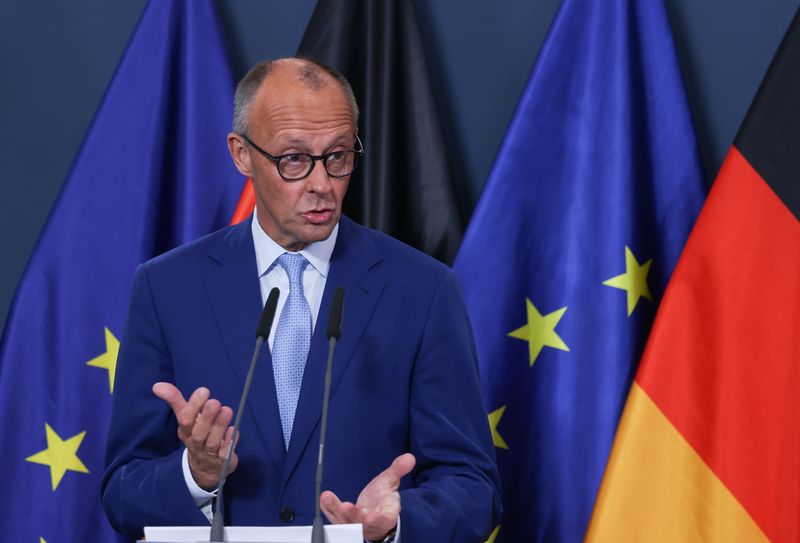
The CDU's vote share fell by 9.5 percentage points from the 2023 election, while the AfD's rose by 7.2 percentage points. Of the 159 seats in total, The Left is expected to take 47, the CDU 35, and the AfD 29. If a new government is formed under The Left's leadership, the CDU will lose the mayor's office it reclaimed after 22 years in the previous election. The election was viewed as an "indirect vote of confidence" in Chancellor Merz, and the crushing defeats have left him politically besieged.
[email protected] Lee Seok-woo, International Affairs Specialist Reporter