Takaichi Touts 85 Trillion Yen Investment—Can She Fend Off Trump's Additional Demands?
- Input
- 2026-09-21 14:07:16
- Updated
- 2026-09-21 14:07:16
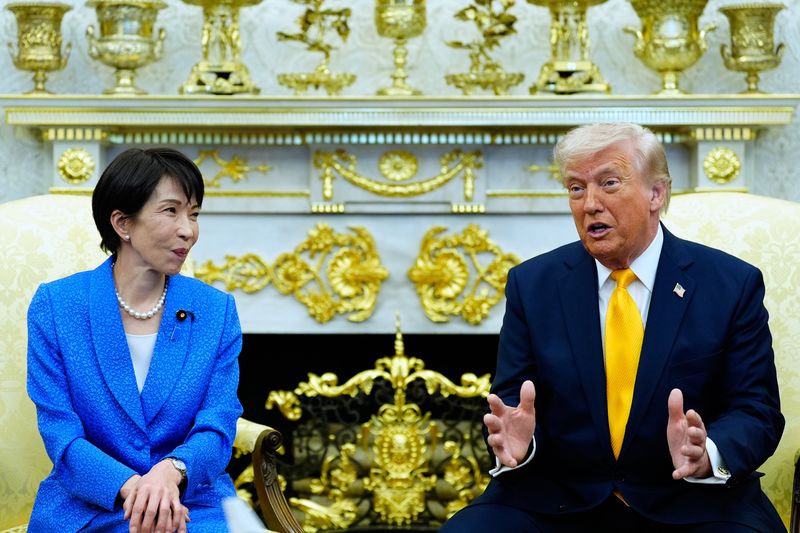
【Financial News, Tokyo—Correspondent Seo Hye-jin】Japanese Prime Minister Sanae Takaichi is scheduled to meet with U.S. President Donald Trump in New York on the 22nd (local time) and emphasize that Japan's large-scale investment in the United States is contributing to job creation there. Her strategy is to use the results of Japan's $550 billion investment, approximately 761 trillion won, to minimize additional U.S. demands concerning defense spending and the costs of stationing U.S. forces in Japan.
According to Nihon Keizai Shimbun (Nikkei) on the 21st, Prime Minister Takaichi departed for New York that day and will hold a summit with President Trump on the 22nd. This will be the first formal meeting between the two leaders since Takaichi visited Washington, D.C., in March. At the G7 Summit in June, they spoke only briefly for five minutes.
Prime Minister Takaichi plans to give a detailed explanation of the results and future plans for Japan's promised $550 billion investment in the United States in response to U.S. tariff measures.
Japan's government and companies plan to develop oil-related infrastructure and power-generation facilities for artificial intelligence (AI) in the United States. They are expected to highlight how these projects will lead to new investment and job creation in the country.
A senior Japanese government official said, "We will discuss the investments promised to the U.S. side at the summit." The Takaichi administration is also expected to present its policy of investing more than 370 trillion yen in total public- and private-sector funds across 17 strategic sectors, including AI and semiconductors, as a growth strategy capable of creating new businesses in the United States.
The key issue will be the additional demands President Trump may put forward. The United States is pressuring its allies to increase defense spending to 3.5% of gross domestic product (GDP). Higher Japanese defense spending and an expanded Japanese contribution to the costs of stationing U.S. forces in Japan could be placed on the summit agenda.
Japan says it is difficult to present a specific defense spending figure at this point because it is preparing to revise three key security documents by the end of the year. Its plan is to explain both its contribution to the U.S. economy through investment and its policy of strengthening Japan's defense capabilities, thereby limiting U.S. demands for Japan to shoulder additional costs as much as possible.
The issue of sanctions imposed by the U.S. government on Tomoko Akane, president of the International Criminal Court (ICC), is likely to be left off the main agenda. If Prime Minister Takaichi directly called for the sanctions to be lifted, she could provoke President Trump. An official close to the prime minister said, "There is no need for the prime minister to discuss it directly with the president."
The summit will take place just before the U.S.-China summit scheduled for the 24th in Washington, D.C. If the United States and China make progress toward an agreement on international rules for AI and restrictions on rare-earth exports, it could affect Japan's industries and security. Prime Minister Takaichi plans to gauge President Trump's intentions while conveying Japan's position ahead of the U.S.-China summit.
[email protected] Seo Hye-jin Reporter