Iran War at a Crossroads Between Escalation and Compromise Ahead of Global Diplomatic Super Week (U.N. General Assembly)
- Input
- 2026-09-21 16:03:57
- Updated
- 2026-09-21 16:03:57
[Financial News] The Middle East war has once again reached a crossroads as an attack on mainland Saudi Arabia by the Houthi rebels raises the prospect of further escalation. The conflict now stands between another expansion of armed clashes and a dramatic compromise through a face-to-face meeting between national leaders on the occasion of the United Nations General Assembly.
As U.S. President Donald Trump raised the pressure by saying he was nearing a decision, including a major attack on Iran, Iran heightened tensions by emphasizing retaliatory strikes against the United States and its partner countries.
As the two sides resumed their brinkmanship, Iran disclosed that it had conveyed to the United States its "conditions for negotiations to end the war," indirectly pressuring Washington to make concessions while strengthening its own justification.
Trump nearing a decision... "Face ruin... or compromise"
On the 20th (local time), President Trump told a Fox News reporter by phone that Iran's leadership faced a choice between economic ruin and being eliminated if it failed to reach an agreement with the United States.
Fox News reporter Trey Yingst reported that day, "President Trump said he is in 'deciding mode' regarding Iran and that something very big will happen in the not-too-distant future." Trump reportedly told him, "The question is when to blow up the entire country (Iran)," adding that "they had better behave themselves."
As tensions rose again, the State Department on the 19th urged Americans in the Middle East to heighten their vigilance and prepare for flight cancellations or possible airspace closures. It also warned that "this military conflict could rapidly escalate" and advised Americans planning to visit the Middle East to reconsider their travel plans.
President Trump also returned to the White House on the 19th, a day earlier than scheduled. Some observers believe the move may be related to the rapid changes in the situation in the Middle East.
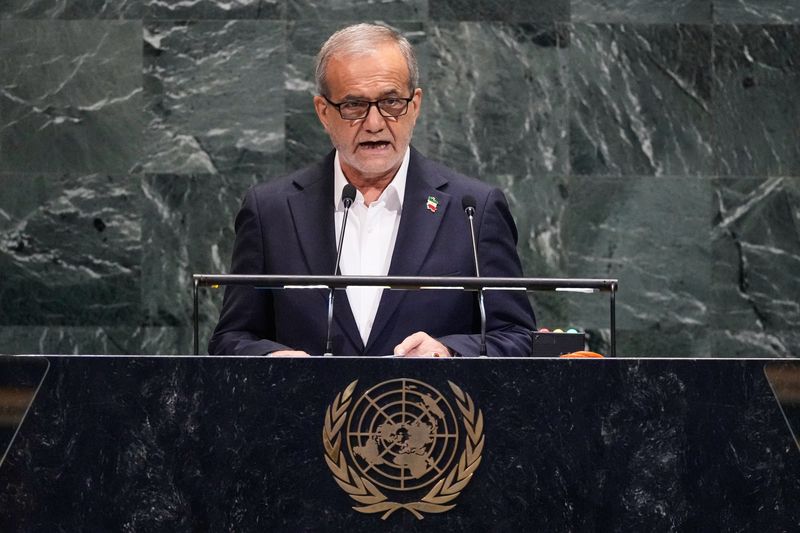
However, Trump said he would be "open" to meeting Iranian President Masoud Pezeshkian at the United Nations General Assembly, leaving room for compromise. While raising pressure on Iran by mentioning the possibility of a major attack, Trump also kept open the possibility of meeting Pezeshkian in person, which is interpreted as an effort to pressure Iran into reaching an agreement.
As a result, the possibility has increased that Trump and Pezeshkian, who is scheduled to attend this week's United Nations General Assembly and deliver a speech on the 23rd, could meet during the period of the "global diplomatic super week." President Trump is also scheduled to address the United Nations General Assembly on the 22nd.
If the United States attacks, all U.S. military bases in the Middle East will be targets of retaliation... U.S. naval forces in the Indian Ocean also targeted
Iran's central military command warned that any new attack would be met with continued retaliation against U.S. military bases and American interests. It also said that the United States' regional allies would be considered parties to the conflict. Iran's military claimed it had obtained intelligence that a new U.S. attack was being prepared. Iran's Islamic Revolutionary Guard Corps (IRGC) repeatedly warned that if the United States actually launched an attack, all U.S. military bases in the Middle East would become targets of retaliation. It also emphasized that the scope of retaliation could extend to U.S. naval assets in the Indian Ocean.
Houthi rebels strike Riyadh... U.S. warns of possible unexpected escalation
With Iran having blocked most shipping through the Strait of Hormuz and the Bab el-Mandeb Strait also under threat, concerns are growing over disruptions to energy exports from Gulf oil-producing states and further upward pressure on global oil prices. The Iran-aligned Houthi rebels in Yemen have recently expanded their presence along Yemen's coastal areas and are working to increase their control over the Bab el-Mandeb Strait, a key maritime route linking the Red Sea and Asia. The Houthi rebels' attack on Riyadh, the capital of Saudi Arabia, a pro-U.S. country, is also serving as leverage against the United States.
The United States is also blockading Iranian ports to prevent Iran's oil exports. Although the economic damage to both sides is mounting, there are still no signs that the ceasefire talks that broke down in July will resume. Iran reaffirmed that day that it would not reopen the Strait of Hormuz until the terms agreed upon in June were implemented according to its interpretation.
Meanwhile, The New York Times (NYT) reported that President Trump had put airstrike operations against the Houthi rebels on hold, despite attacks by the Iran-aligned group, including its strike on the Saudi capital. The NYT said Trump had ordered preparations for Houthi airstrikes but had decided not to carry them out for the time being, following advice from aides who were skeptical of or opposed to opening a new front against the Houthi rebels during the war with Iran.
[email protected] Lee Seok-woo, international affairs correspondent Reporter