SMR Manufacturing-Development-Demonstration Package Policy to Accelerate the Drive for Market Leadership
- Input
- 2026-09-21 14:17:35
- Updated
- 2026-09-21 14:17:35
[Financial News] As the government pursues small modular reactors (SMRs) as a national strategic technology, it plans to strategically industrialize them by advancing SMR research and demonstration simultaneously. Its goal is to gain an early lead in the global nuclear power market through a package policy encompassing manufacturing, development and demonstration to accelerate SMR development.
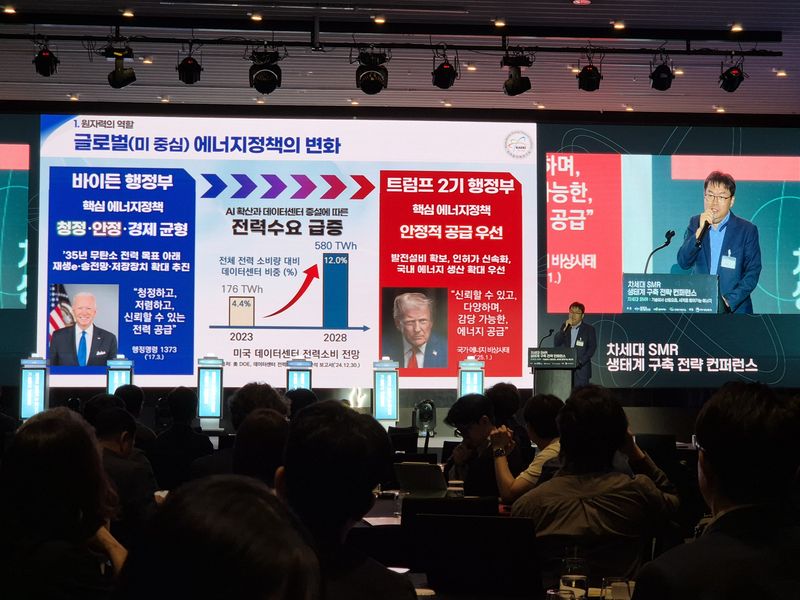
At the Next-Generation SMR Ecosystem-Building Strategy Conference held at GLAD Hotel in Seoul's Yeouido district on the 21st, the Ministry of Science and ICT presented this policy direction for SMRs. Koo Hyuk-chae, First Vice Minister of Science and ICT, emphasized, "With the global nuclear power market expected to at least double and potentially triple by 2060, it is important to determine who will gain an early lead in the global nuclear power market. SMRs can no longer remain at the research and development stage. We must pursue R&D and demonstration simultaneously and strategically industrialize them." He added, "We need to further accelerate nuclear power development by leveraging Korea's nuclear power construction and research personnel," and said, "We will consider ways to increase the pace and expand the industry."
The conference also introduced the policy support direction for next-generation SMRs. The tasks cover four areas, including supply and demand, institutions and the ecosystem.
Lee Young-jun, head of the Nuclear Energy Promotion Strategy Division at KAERI, said, "Nuclear power is almost the only clean energy source that can supply energy reliably around the clock without emitting carbon dioxide. Around the world, pro-nuclear countries are expanding nuclear power, while countries that had pursued nuclear phase-outs are turning back. As advanced countries develop nuclear power as a key energy source, Korea is pursuing an SMR policy in package form."
Lee said, "The manufacturing and demonstration of next-generation SMRs must be prepared at the same time. We are establishing a policy to package development, manufacturing and demonstration simultaneously. We need to promote supply efforts that build a chain spanning development, manufacturing, demonstration and nuclear fuel procurement." He continued, "We must transfer SMR design technology to the private sector and innovate mass-production processes. Through this supply chain, we should cultivate specialized commercialization capabilities and promote exports."
He also added, "We intend to shift policy from public-sector-led efforts to private-sector-led efforts," saying, "Because SMRs will be used across various industrial sectors, we can no longer rely solely on the public sector."
Lee also noted, "Institutional governance for this is important," and said, "The Ministry of Science and ICT will take the lead in establishing integrated governance and support institutional improvements with one voice."
This year's SMR conference marked its inaugural event and was held under the theme "Next-Generation SMR: Energy Reaching from Technology to Industry and the World." The Ministry of Science and ICT, KAERI, the National Research Foundation of Korea (NRF), and the Advanced Reactor Industrial Technology Research Association participated. Industry representatives from Hyundai Engineering and Construction, Daewoo Engineering & Construction and POSCO E&C also attended to discuss policy, technology and industrial development.
[email protected] Yeon Ji-an Reporter