Chinese Content Capital Looks Beyond 'Exports' to Target Korean IP, Expanding Its Footprint Through Investment and M&A
- Input
- 2026-09-21 11:21:33
- Updated
- 2026-09-21 11:21:33
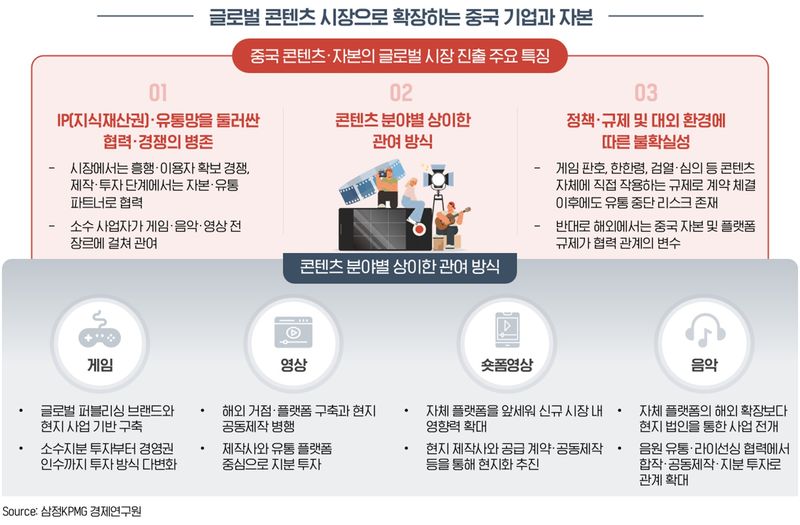
In a report published on the 21st, titled "The Expansion of Chinese Content and Capital: Strategic Responses for Korean Companies," Samjong KPMG said, "The global expansion of Chinese content companies is moving beyond distribution and publishing toward directly securing local business foundations through investments in and acquisitions of local companies, as well as co-production."
The shift is particularly pronounced in the gaming sector. Chinese game companies are establishing overseas subsidiaries to secure publishing and operational capabilities, while also investing directly in global game companies, including those in Korea, to gain greater access to leading IP and development capabilities. The report noted that recent moves have gone beyond minority-stake investments, with companies seeking to acquire management control, as seen in the case of Wemade.
Chinese capital is also exerting greater influence in video content. Chinese platforms such as iQIYI are establishing overseas bases in Southeast Asia and the Middle East and Africa, while expanding content exchanges and co-production with local companies. Short-form content is likewise rapidly extending its reach through the overseas expansion of proprietary platforms and collaboration with local production companies.
The report warned, "As the scope of Chinese capital's investments expands, the risks surrounding Korean companies' core IP and data, as well as management rights and control over their businesses, may also increase."
Samjong KPMG stressed that transactions with Chinese companies should not be assessed solely on whether they attract investment. Companies should comprehensively examine not only the stakes, IP, and distribution rights acquired by the Chinese side after the investment, but also its actual control over business operations.
The report recommended, "Rather than blocking Chinese capital, Korean companies need a strategy of selectively leveraging it." This approach involves protecting core IP and data, managing dependence on specific Chinese partners, and using Chinese capital and overseas networks to expand production and distribution capabilities.
Kim Ik-chan, an executive vice president at Samjong KPMG, said, "The expansion of Chinese content companies and capital provides Korean companies with funding and opportunities to enter overseas markets, but it also brings intensified competition, dependence on partners, and policy and regulatory risks." He added, "A balanced approach is needed—one that protects core assets and control over the business, leverages partners' capital, distribution networks, and operational capabilities, and strengthens companies' own content competitiveness."
[email protected] Kim Hyun-jung Reporter