"Work and Leisure in One Place"... Supertall Buildings Evolve into Work-Live-Play Mixed-Use Hubs
- Input
- 2026-09-21 11:28:42
- Updated
- 2026-09-21 11:28:42
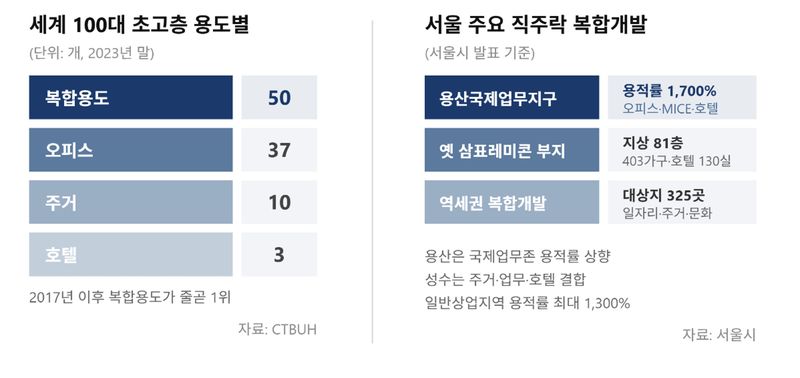
According to the Council on Tall Buildings and Urban Habitat on the 21st, mixed-use buildings account for half of the world's 100 tallest buildings and have consistently represented the largest share since 2017. As existing buildings are also being converted to other uses amid rising office vacancy rates, Japan is promoting high-density mixed-use development in central Tokyo through National Strategic Special Zones. South Korea has likewise established an institutional foundation by introducing Spatial Innovation Zones.
In practice, major cities around the world are transforming aging facilities into large-scale mixed-use hubs. Azabudai Hills in Tokyo, with a total floor area of more than 860,000 square meters, has created a vast community equipped with offices, residences and a hotel, as well as an international school and a medical center. London's Battersea Power Station has also been reborn as a destination combining Apple's UK headquarters with luxury residential and commercial facilities. New York's Hudson Yards and London's King's Cross have likewise been redeveloped using former railway sites into urban mixed-use complexes where offices, housing and cultural and arts spaces coexist.
The Seoul Metropolitan Government has also announced plans to transform entire areas around subway stations into spaces combining jobs, housing and culture, accelerating high-density mixed-use development. To encourage high-density, mixed-use projects, a floor-area ratio of up to 1,300% is permitted in general commercial areas. The largest project, Yongsan International Business District (YIBD), is being developed as a compact city combining prime offices, MICE facilities, hotels and residential facilities, with a floor-area ratio of up to 1,700% expected to be granted.
Meanwhile, the need for mixed-use development is also growing in Seongsu-dong, where businesses and tourists are concentrating. Hyundai AutoEver and Gmarket have announced plans to relocate their headquarters, while MUSINSA and SM Entertainment have already established a presence there. Krafton is also developing large-scale office facilities. According to an analysis commissioned by Seongdong District from the Hanyang University Industry-Academic Cooperation Foundation, Seongsu-dong's economic value increased by approximately 33.3 trillion won from 2014, while spending by foreign tourists rose nearly 15-fold, from 13.3 billion won in 2018 to 198.9 billion won in 2024.
However, despite this explosive demand, large office buildings and high-end accommodations, including five-star hotels, remain in critically short supply. To fill this infrastructure gap, the Seoul Metropolitan Government is pursuing the development of Sampyo Global Landmark (SGL) on the former Sampyo ready-mix concrete site. The project will include an 81-story residential tower and a 53-story office-and-mixed-use tower, along with apartment housing, officetels, hotels, and commercial and cultural facilities. Incorporating a green corridor linking Seoul Forest and the Hangang River, SGL is expected to address Seongsu-dong's shortage of large-scale office and lodging facilities and establish itself as Seongsu-dong's signature work-live-play mixed-use hub.
[email protected] Jeon Min-kyung Reporter