Semiconductors Give Korea's Economy Wings, but Concerns Grow That 'Jobless Growth' Is Becoming Entrenched
- Input
- 2026-09-21 12:00:00
- Updated
- 2026-09-21 12:00:00
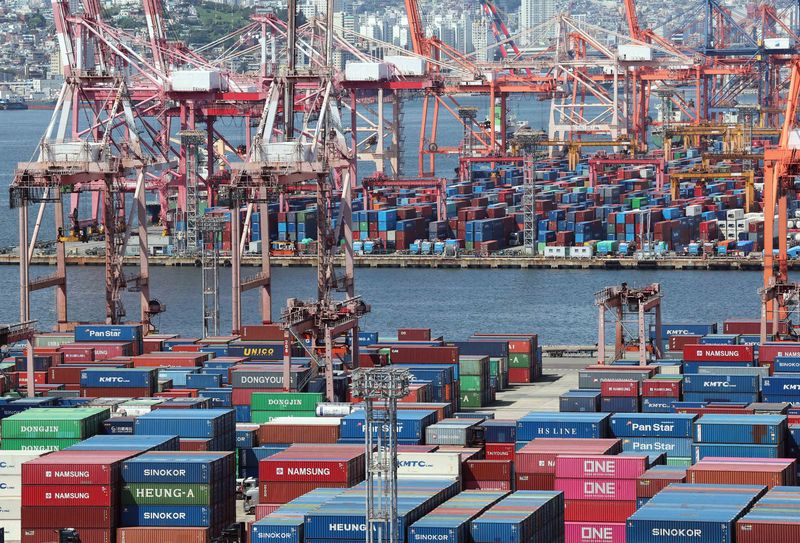
[Financial News] Korea's external openness and capacity to create value added strengthened further in 2024, buoyed by strong semiconductor exports. However, amid export-led growth, the shares of economic ripple effects generated by consumption and investment both declined, while the labor market slowed. Experts point out that a pattern of "jobless growth," in which the total number of employed persons falls alongside an industrial shift toward advanced technology- and capital-intensive sectors such as semiconductors, is becoming structural.
According to the 2024 input-output table (extended table) released by the BOK on the 21st, the number of full-time-equivalent employed persons, which measures the amount of labor used in actual production activities, fell by 28,000 from the previous year to 25.96 million in 2024. The decline was driven mainly by the construction and agriculture, forestry, and fisheries sectors.
The employment coefficient for the entire economy, which represents the number of employed persons required to produce 1 billion won of output, stood at 4.3 persons. The economy-wide employment inducement coefficient was 7.8 persons. By sector, the employment inducement coefficient was highest for agriculture, forestry, and fisheries products at 21.9 persons, followed by services at 9.5 persons. The figure was relatively low in the industrial goods sector, including manufacturing, at 4.7 persons.
The share of employed persons induced by exports among final demand increased from 20.7% to 22.2%, further deepening the economy's overall dependence on exports for employment.
Bu Sang-don, head of the BOK's Input-Output Team, said, "Because the semiconductor sector has a low employment inducement effect, the number of jobs it generates did not increase and remained at a level similar to the previous year. However, as investment in semiconductor facilities and exports have increased sharply, we expect their positive impact on employment to expand going forward."
The backbone of export-led growth has become more pronounced.
The share of exports in total demand rose from 14.7% to 16.1%, while exports' share of final demand increased from 29.4% to 31.8%. The share of external trade in total supply also climbed from 29.6% to 31.1%, further deepening the export-dependent economic structure.
Among final demand components, exports' shares of induced production, value added, and employment all increased, rising from 32.7% to 35.1%, 25.4% to 28.2%, and 20.7% to 22.2%, respectively.
By contrast, the shares of production, value added, and employment induced by consumption and investment all declined due to shrinking domestic demand.
Production inducement coefficients were highest for investment at 1.956, followed by exports at 1.861 and consumption at 1.705. All three declined from the previous year. In contrast, value-added inducement coefficients were highest for consumption at 0.839, followed by investment at 0.802 and exports at 0.626, and increased across all categories.
Indicators related to the input structure and value added showed notable improvement.
As operating surpluses in exported manufactured goods increased, the value-added ratio rose for the second consecutive year, reaching 40.1% in 2022, 41.2% in 2023, and 42.0% in 2024.
In addition, the share of services used as intermediate inputs rose from 35.4% to 36.4%, led by producer services such as wholesale and retail trade, transportation, information and communications, finance, and professional services. The share of services among employed persons also continued to increase, from 71.7% to 72.0%.
[email protected] Jeong Sang-gyun Reporter