"A Wave of Three-Time Maturity Extensions"—PF Market Before the Storm... "Special Treatment for Maturity Extensions Needed"
- Input
- 2026-09-21 16:44:22
- Updated
- 2026-09-21 16:44:22

[Financial News] The industry is on edge as project sites with three or more maturity extensions on real estate project financing (PF) bridge loans are expected to pile up starting in the second half of this year. Under the current 'Real Estate PF Evaluation Criteria,' such sites are classified as either 'watch list' or 'concern for insolvency,' effectively receiving a death sentence. This will inevitably have a negative impact on the 'supply-at-all-costs' drive.
According to industry sources on the 21st, many sites with more than three bridge-loan extensions are reaching maturity, creating a strong possibility that even projects capable of being normalized will be classified for forced resolution. As a result, industry players are calling for temporary special treatment on maturity extensions for sites that meet certain conditions.
The government introduced and began implementing a new PF management plan in the second half of 2024. An industry official said, "Given that bridge loans typically last six or nine months, sites entering their third maturity extension or exceeding it inevitably could be concentrated in the second half of this year."
In fact, the second round of the PF Voluntary Agreement for a prime apartment development in the Seoul metropolitan area expires at the end of this year. With permits delayed, sales are expected to begin in the second half of next year. Another project is also negotiating a fourth maturity extension, but the situation remains difficult.
PF bridge loans are currently proving difficult even for projects with secured feasibility because of tighter soundness regulations, including risk-weighted assets (RWA) and the net capital ratio (NCR). Funding rates have also soared. Sites with three or more maturity extensions may proceed after an external evaluation, but they are classified as carrying a 'risk of non-recovery' and must set aside additional provisions.
According to industry sources, the exception to the restriction on more than three extensions does not work in practice, leaving projects dependent on refinancing short-term securitized securities. In addition, sites with more than two maturity extensions are classified as 'watch list' projects.
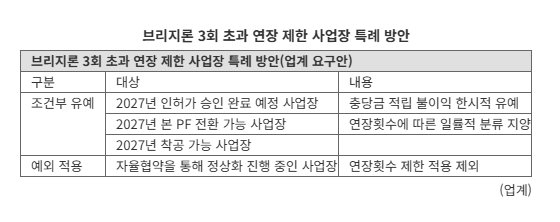
Industry players say measures are needed to prevent the indiscriminate application of uniform standards from producing large numbers of distressed projects. For example, sites undergoing normalization through a voluntary agreement should be granted an exception. They also say that projects with more than three extensions should be given breathing room if they are expected to complete housing permit approvals next year.
Industry sources are also calling for projects that can raise funds through the main PF next year or begin construction to pursue additional extensions actively, rather than being constrained by the number of maturity extensions.
[email protected] Lee Jong-bae Reporter