Party-government officials vow tough action only against speculation amid farmers' anger
- Input
- 2026-09-21 10:23:03
- Updated
- 2026-09-21 10:23:03
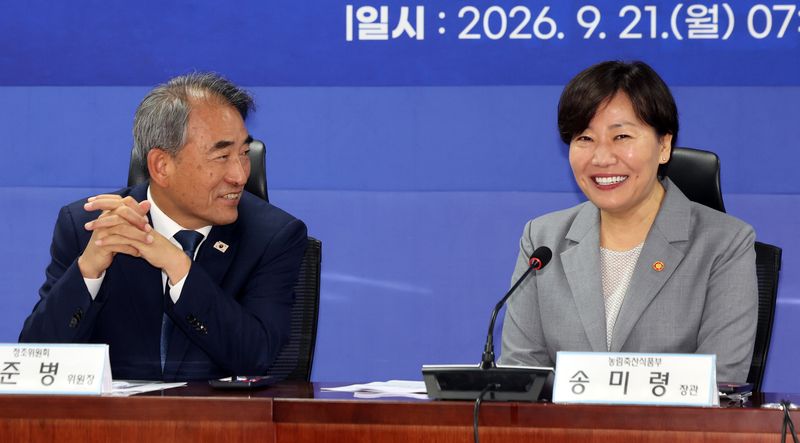
The party and government held a consultation at the National Assembly on the direction of the comprehensive farmland survey and disclosed these plans. Yoon Joon-byung, the Democratic Party of Korea's floor leader on the Agriculture, Food, Rural Affairs, Oceans and Fisheries Committee, told reporters after the meeting, "The party and government have agreed to deal with clear-cut speculation and serious illegal conversion to other uses in accordance with the law and principles. At the same time, we will flesh out the basic principle of normalizing customary and minor violations arising from rural realities as legitimate farmland use."
The areas targeted for tough action include the acquisition and use of farmland for speculative purposes and serious illegal conversion to other uses. Speculative acquisition and use includes obtaining farmland in land transaction permit zones without an intention to farm, leaving it fallow without authorization, or leasing it illegally. The government and ruling party also maintain that farmland in agricultural promotion areas illegally converted into non-agricultural facilities prohibited by law, such as storage yards and campgrounds, will be dealt with strictly in line with the purpose of the comprehensive farmland survey.
Yoon said, "Speculative activity includes acquiring farmland near cities for purposes other than agricultural use, as well as cases in which farming corporations engage in activities similar to real estate businesses instead of farming. The intent is to establish a framework that curbs speculation while minimizing inconvenience for farmers and fishermen."
The party and government agreed to provide opportunities for voluntary correction in cases involving customary practices arising from rural realities, such as inherited farmland or land owned by elderly farmers, as well as minor violations involving leaving farmland fallow or farmland leasing laws. They will also pursue a plan to defer disposition measures if owners entrust the Korea Rural Community Corporation's Farmland Bank with leasing or management rights for their farmland. Policy support needed to promote long-term leasing through the Farmland Bank will also be reviewed. In addition, they plan to identify farmland with little practical value, change its land category to reflect current circumstances, and exclude it from the scope of the Farmland Act.
The party and government will also pursue measures to legalize illegally converted farmland. Owners will be allowed to apply for retroactive conversion when facilities installed on farmland are legally permissible or when the land violates the law because the required conversion procedures were not completed, providing a way to resolve the issue after the fact. However, obtaining retroactive approval requires payment of a farmland preservation charge and subsequent ratification by the government.
To provide relief for minor violations, the party and government plan to enact a special measures law by the end of the year. They will also revise the Farmland Act, where it does not reflect reality, by the first half of next year. An increase in the Farmland Bank's budget for purchasing farmland to promote farmland transactions will likewise be reviewed during the current budget deliberations.
Yoon noted, "The law currently imposes fairly strict requirements that farmland be used exclusively for agricultural purposes. There is a gap between the law and realities such as leaving land fallow and tenant farming. In particular, when land is left fallow because of an owner's advanced age, it is technically classified as illegal unless the Farmland Act is amended."
He added, "There are also matters that have not gone through legal procedures for a long time but can realistically be improved. The party and government agreed that matters to be addressed through a special law should be handled under that special law, while provisions of the Farmland Act should be improved through the Farmland Act itself."
[email protected] Kim Hyung-gu Reporter