[Exclusive] Government Takes Credit, Korea Expressway Corporation Takes on Debt? Toll-Exemption Compensation Left Unaddressed for 18 Years
- Input
- 2026-09-21 15:28:48
- Updated
- 2026-09-21 15:28:48
[Financial News] Korea Expressway Corporation has been exempting or reducing highway tolls each year under government policy, but the government has never once allocated a budget to compensate the corporation for the lost revenue, it has been confirmed. The corporation is concerned that toll increases may become unavoidable if the situation continues. With tolls also set to be reduced during the Chuseok holiday from the 24th to the 27th, concerns are mounting within the corporation.
Holiday and Eco-Friendly Vehicle Discounts Push Toll Reductions to 5.4 Trillion Won
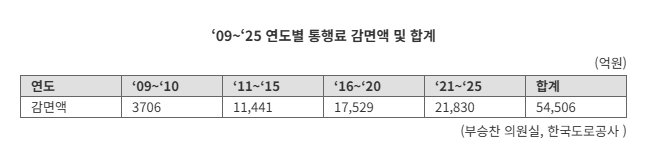
According to data Boo Seung-chan, a lawmaker from the Democratic Party of Korea and a member of the National Assembly's Land, Infrastructure and Transport Committee, obtained from Korea Expressway Corporation on the 21st, total highway toll reductions from 2009 through 2025 amounted to 5.4506 trillion won. However, there has not been a single case in which the government allocated a budget to compensate the corporation for the reductions. Although the Korea Highway Corporation Act was amended in 2009 and the Toll Road Act in 2018 to establish a legal basis for the state to compensate public service obligation (PSO) costs, the provisions have effectively failed to serve their purpose.
Korea Expressway Corporation currently operates 23 types of highway toll exemption and discount programs. Major examples include toll exemptions during holiday periods, introduced in 2017, and discounts for eco-friendly vehicles such as electric and hydrogen vehicles. Toll reductions totaled 471.2 billion won last year, including 119.2 billion won in holiday exemptions and 58 billion won in discounts for electric and hydrogen vehicles. This means that 10.7% of total toll revenue, which stood at 4.4024 trillion won, was reduced. In particular, reductions for electric and hydrogen vehicles surged approximately 3.7-fold, from 15.6 billion won in 2021 to 58 billion won in 2025, as the number of eco-friendly vehicle users continued to grow.
The Corporation Bears a Growing Burden, While the Government Looks the Other Way
Since 2009, when the Korea Highway Corporation Act was amended, the Ministry of Land, Infrastructure and Transport (MOLIT) has requested compensation for toll reductions every year except 2024. However, fiscal authorities have not included the funding. MOLIT included 28 billion won in PSO compensation in its 2027 budget proposal, but the amount was not reflected in the government proposal drawn up by the Ministry of Planning and Budget.
Korea Expressway Corporation is concerned that the burden could ultimately be passed on to road users because it has been denied government support while its finances deteriorate and debt rises each year. Toll reductions from 2009 to 2025 totaled 5.4 trillion won, equivalent to 12% of the corporation's debt, which stood at 44.5369 trillion won as of 2025. The corporation maintains that PSO compensation is necessary to prevent the reductions from leading to toll increases. In a submission to Boo Seung-chan, the corporation identified a "lack of funding to ensure safe highways and improve the public's right to mobility" as a problem, stating, "Under current conditions, toll revenue is not even sufficient to cover operating expenses, and rising debt has left us short of the funds needed to operate roads safely."
Private Highways and Railways Receive Compensation, Raising Fairness Concerns
By contrast, the government compensates private highway operators and the Korea Railroad Corporation (KORAIL) for waived tolls and fares, prompting criticism that the system lacks fairness. Compensation provided to KORAIL totaled 362.3 billion won as of 2025. Unlike the Korea Highway Corporation Act, which states that the state "may be required" to bear PSO compensation costs, the Framework Act on the Development of the Railroad Industry explicitly states that the state "shall provide compensation." Korea Expressway Corporation pointed out, "Toll reductions provide users who benefit from them with an immediate economic benefit," adding, "Making future generations bear higher costs or forcing them to shoulder the burden through reduced services is the result of the funding shortfall they create."
Experts also said the government must take greater responsibility. Dong-min Lee, acting president of the Korean Society of Transportation and a professor of transportation engineering at the University of Seoul, argued, "It is wrong to shift the burden of national policies onto public institutions. When a public institution provides services in line with national policy, the state must take responsibility." He added, "Making public institutions shoulder the burden as if it were theirs to bear is merely turning a blind eye while the deficit widens." Lee also said that a toll increase should be considered, as tolls have been frozen since 2015.
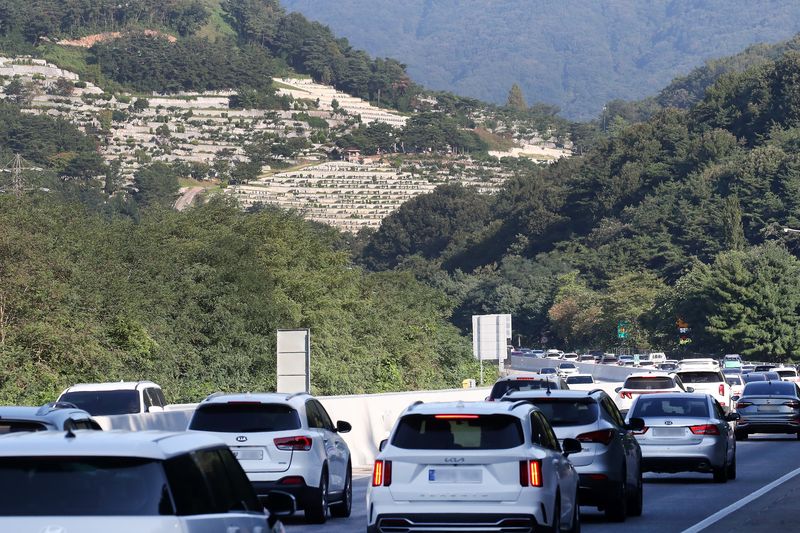
Meanwhile, the government will also waive highway tolls during this year's Chuseok holiday, from the 24th to the 27th. The Korea Transport Institute (KOTI) and Korea Expressway Corporation forecast that 30.93 million people will travel during this year's Chuseok holiday, with 88.4% of them expected to use passenger cars. Average daily traffic on highways is projected to reach 6.05 million vehicles. The corporation will not be compensated by the government for these exemptions either.
Boo Seung-chan said, "Although the Toll Road Act and the Korea Highway Corporation Act clearly establish a legal basis for compensating public service obligation costs, the failure to include the funding in the budget for 18 years ignores the purpose of the law." He added, "The government must actively consider providing PSO budget compensation to Korea Expressway Corporation in line with the legal basis and standards of fairness."
[email protected] Lee Hae-ram and Kim Hyeong-gu Reporter