Even as Rates Rise, Investors Still Buy Chip Stocks... KOSPI Touches 7,000 as 'Samjeonix' Rallies
- Input
- 2026-09-21 10:05:55
- Updated
- 2026-09-21 10:05:55
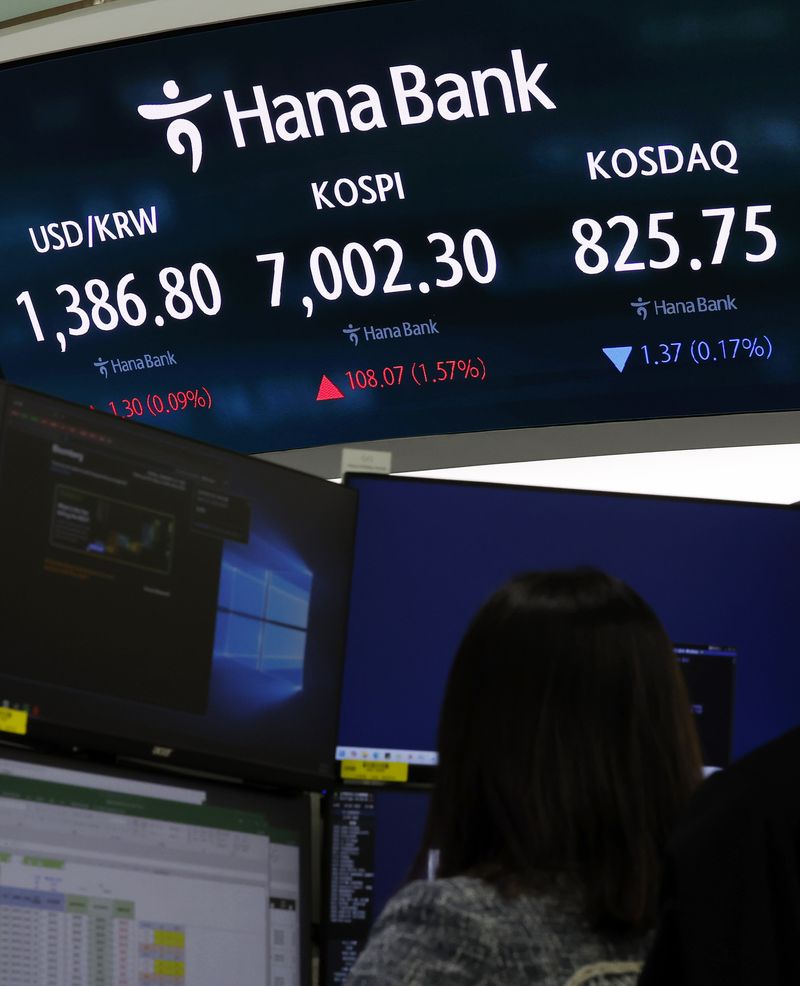
[Financial News] Samsung Electronics and SK hynix rose together despite pressure from higher interest rates, supporting the KOSPI's strength. Amid continued increases in AI investment and semiconductor prices, Samsung Electronics gained more than 3%, while the KOSPI surpassed the 7,000 level during the session. As of 9:55 a.m. on the 21st, Samsung Electronics was trading at 269,500 won, up 3.26% from the previous session. After opening at 263,500 won, the stock climbed as high as 271,500 won before moving around 270,000 won. SK hynix was up 0.43% at 1,865,000 won. It rose from an opening price of 1,858,000 won to an intraday high of 1,888,000 won before giving back some of its gains.
At the same time, the KOSPI Composite Index was up 68.52 points, or 0.99%, at 6,962.75. It opened at 6,938.34 and rose as high as 7,007.10 before falling back below 7,000. KOSDAQ was up 5.10 points, or 0.62%, at 832.22.
Investment and pricing indicators in the semiconductor industry continue to improve. Park Jun-woo, an analyst at Hana Securities, said in a report that "The outlook for big tech's AI capital expenditures (Capex) and semiconductor spot prices continues to trend upward." He explained that capex forecasts for major big tech companies, including Google, Amazon, Meta and Microsoft, have been revised upward, while DRAM prices are also rising.
Some analysts also expect market attention to shift toward companies with solid earnings following monetary policy meetings in major economies. Choi Bo-won, an analyst at Korea Investment & Securities, said, "Unlike in early and mid-September, this is a time to pay attention to factors beyond Treasury yields." Choi explained, "Ahead of the Federal Open Market Committee (FOMC) and Bank of Japan (BOJ) meetings, rebound buying could flow into companies that experienced sharp corrections. Companies whose solid earnings had been overshadowed by rising interest rates and economic uncertainty could also come back into focus."
However, the day's gains were concentrated in large-cap stocks. The KOSPI large-cap index rose 1.09%, while the mid-cap and small-cap indexes fell 0.55% and 0.50%, respectively. On the main board, decliners outnumbered advancers, 539 to 313. On KOSDAQ, 1,047 stocks fell compared with 584 that rose, highlighting a divergence in market tone between the indexes and individual stocks.
It is still too early to say that concerns over interest rates have been resolved. Park said, "The recent decline in Treasury yields was driven more by stabilizing oil prices than by easing uncertainty over monetary tightening," adding, "Although uncertainty over the timing of the first rate hike has been resolved, uncertainty over the level of the final policy rate is actually growing."
This week's U.S.-China summit and United Nations (UN) General Assembly are also key variables. Choi noted, "Expectations for reduced geopolitical and tariff uncertainty through summit diplomacy may be reflected in the market," but cautioned, "Investors should also be mindful of a temporary contraction in liquidity caused by hegemonic competition surrounding AI and other areas, as well as market holidays in major Asian countries."
[email protected] Choi Do-seon Reporter