Hanwha Qcells and POSCO to Jointly Develop Agrivoltaic Package
- Input
- 2026-09-21 10:03:11
- Updated
- 2026-09-21 10:03:11
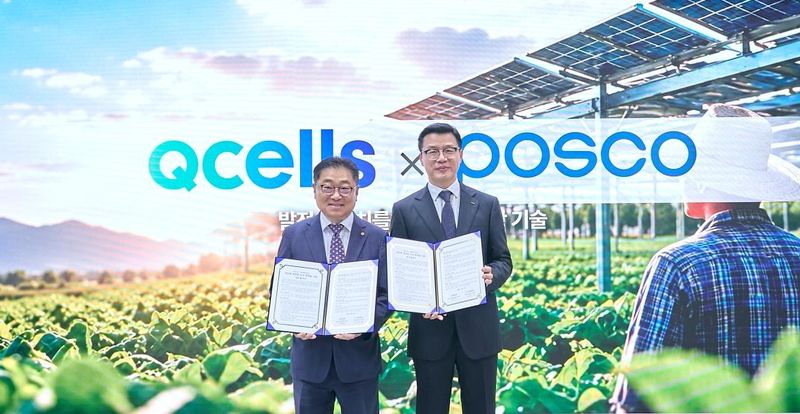
[Financial News] Hanwha Solutions' Qcells division (Hanwha Qcells) and POSCO will jointly develop a Korean-made package combining agrivoltaic modules and supporting structures. They plan to expand their business by establishing a cooperation network with domestic companies and offering an integrated solution spanning financing, equipment, construction, and electricity sales.
Hanwha Qcells and POSCO announced on the 21st that they signed an MOU on the 17th to promote agrivoltaics and build a domestic industry ecosystem.
Agrivoltaics is a method of generating electricity by installing solar power facilities above farmland while continuing agricultural production. Solar power generation is carried out alongside crop cultivation by adjusting the placement and angle of the modules to secure the sunlight needed for growing crops.
The institutional foundation for agrivoltaics is also expanding. Under the Act on the Promotion and Support of Agrivoltaic Power Generation Projects, which takes effect this December, the maximum permit period for agrivoltaic projects will increase from the current eight years to 23 years.
Based on the MOU, the two companies plan to form the 'Shintoburi Alliance' to build an agrivoltaic industry ecosystem. Through the alliance, they envision providing an integrated solution covering financing, equipment, construction, and electricity sales.
Hanwha Qcells will manufacture and supply high-efficiency modules designed specifically for agrivoltaics at its Jincheon plant in North Chungcheong Province. Drawing on its solar business expertise and industry network, the company also plans to provide construction and maintenance services. After a power plant is completed, it will offer electricity-sales solutions, such as brokering power purchase agreements (PPAs) with companies seeking renewable energy and supporting entry into the real-time bidding market.
POSCO will supply supporting-structure materials that are resistant to soil corrosion and tailored to Korea's agricultural environment. It plans to establish standards for agrivoltaic structures by developing designs that protect crops and farmland without interfering with farming activities.
The two companies agreed to jointly develop a package of modules and supporting structures designed specifically for domestic agrivoltaic projects, drawing on their respective business capabilities.
Yoo Jae-yeol, head of Hanwha Qcells' Korea business division, said, "Agrivoltaics is a solution that can simultaneously promote the expansion of renewable energy and the sustainability of rural communities."
Hong Sam-su, head of POSCO's Cold-Rolled and Coated Marketing Office, said, "Agrivoltaics is an effective alternative that can expand renewable energy while preserving farmland and continuing agricultural activities," adding, "We will work with Hanwha Qcells to develop structural solutions suited to Korea's agricultural environment."
[email protected] Kim Mi-hee Reporter