"P-CBO Joint and Several Guarantees to Be Fully Abolished, KRW 4.5 Trillion Exempted"... FSC Holds Policy Finance Support Council
- Input
- 2026-09-21 10:00:00
- Updated
- 2026-09-21 10:00:00
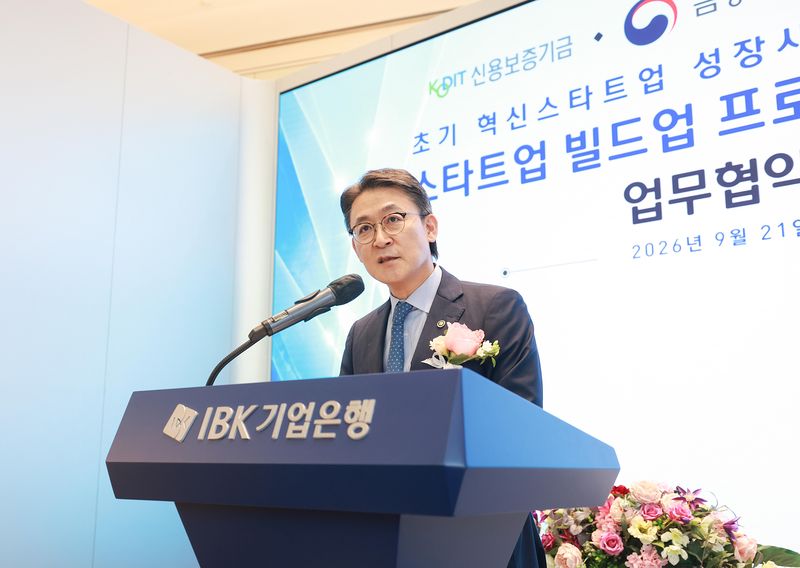
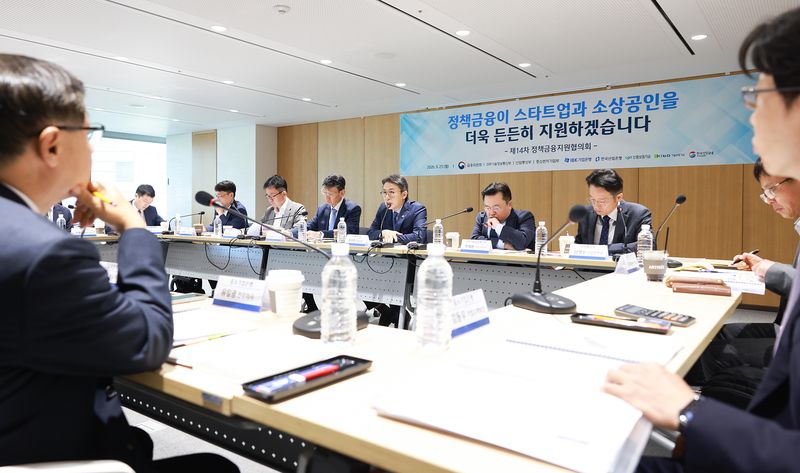
[Financial News] The FSC held the 14th Policy Finance Support Council at the Industrial Bank of Korea (IBK) headquarters in Eulji-ro, Seoul, on the 21st. The council discussed measures to advance the Startup Build-Up Program, expand and revamp the Small Business The Dream Package, and exempt small and medium-sized enterprises from joint and several guarantees on Primary Collateralized Bond Obligations (P-CBOs).
In his opening remarks, FSC Vice Chair Kwon Dae-young said, "We are continuing to strengthen our efforts in productive finance so that financial support for key industries that will drive future growth in our economy can be expanded." He emphasized that "the role of policy financial institutions is important in carrying out key policies, including the KRW 200 trillion National Growth Fund over five years and the provision of KRW 150 trillion to five priority strategic areas in 2026."
The Startup Build-Up Program is designed to lower the guarantee threshold for early-stage startups that have strong technological capabilities and growth potential but low credit ratings because of insufficient sales and transaction histories. The program will be jointly implemented by the Korea Credit Guarantee Fund (KODIT) and IBK.
The Small Business The Dream Package is a program that offers preferential terms, including interest rates and financing limits, to small business owners who faithfully repay their financial obligations without delinquency. As of August, KRW 5.7 trillion had been provided. The program will be expanded from KRW 10.5 trillion to more than KRW 12 trillion. Details of the revamp will be announced at the end of this month.
KSTP is a specialized asset manager that provides large-scale, long-term funding for future strategic technologies and core technologies in key industries. The initiative is being pursued with the goal of completing the establishment of the entity and obtaining the necessary approvals within the year, led by Korea Development Bank (KDB) and Growth Finance. It is scheduled to begin operations in the first half of next year to support growth industries.
Joint and several guarantees for SME P-CBOs will be fully abolished. The FSC expects the measure to exempt approximately KRW 1.9 trillion worth of P-CBOs annually from such guarantees. As of the end of last year, the outstanding balance of P-CBOs stood at KRW 4.5 trillion across approximately 3,000 companies. A joint and several guarantee is a system that requires founders, company representatives, or other individuals to repay a company's debt if the business fails. Critics have argued that the system shifts the obligation to repay debt onto individuals. If founders who provided joint and several guarantees face an increasing debt burden after a business failure, making it difficult for them to try again, it could become harder to create a healthy startup ecosystem.
The FSC has gradually expanded exemptions from joint and several guarantees since 2012. Although public institutions fully abolished such guarantees for SMEs in 2018, they have continued to apply to P-CBOs. Following the abolition of joint and several guarantees for P-CBOs by KODIT and the Korea Technology Finance Corporation (KIBO), discussions within the private investment industry about ending the practice are also expected to expand.
In the first half of this year, support for the five priority strategic areas under policy finance totaled KRW 101.5 trillion, representing an achievement rate of 67.6%. Support for advanced strategic industries under the National Growth Fund came to KRW 17 trillion, or 56.7%. Performance under the target system for expanding preferential policy finance for local areas totaled KRW 57.2 trillion, or 57.2%, while National Growth Fund support for areas outside the capital region amounted to KRW 7.2 trillion, or 42.5%.
The seventh revision of the Common Criteria for Innovative Growth was also discussed. The parties agreed to strengthen links with major government policies, including the National Growth Fund, by reflecting the latest technology trends and newly establishing core infrastructure items for AI data centers to support Korea's rise as one of the world's three leading AI powers. The seventh revision will take effect early next month, and the manual will be distributed to financial companies in stages.
KODIT and IBK announced the launch of the Startup Build-Up Program, which identifies early-stage startups in new growth industries and supports their development at each stage. Through the program, the two institutions will relax guarantee requirements, including credit ratings and growth potential, for early-stage startups and provide priority funding of up to KRW 100 million. Guarantee fees and loan interest rates will also receive the highest level of preferential treatment. After one year of support, the institutions plan to reassess each company's creditworthiness and growth potential, raise the guarantee limit to as much as KRW 200 million, and allow principal repayments to be deferred for the following three years. KODIT will award additional points in evaluations when companies use follow-up programs tailored to their growth stages. It will also provide promising companies with non-financial opportunities from policy financial institutions, such as consulting and investor relations support.
Kwon Dae-young, vice chair of the FSC, said, "Policy financial institutions have consistently supported startups' challenges, but many entrepreneurs in the field still say it is difficult to raise startup capital. When an early-stage startup faces its first hurdle—the funding shortage—it is necessary to lay a stepping stone that lowers the barrier to its first financing and gives it the confidence to take on the challenge based on its potential." He added, "Through this agreement, we expect to create synergies by leveraging KODIT's expertise and IBK's experience and network to open up more opportunities for companies."
Kim Seung-kwan, executive vice president of KODIT, said, "The Startup Build-Up Program has created an opportunity to provide more substantial support even to early-stage innovative startups with low credit ratings. We will further strengthen our cooperation with IBK so that the program can become firmly established in the market." Yoo Il-kwang, executive vice president of IBK, said, "This cooperation enables us to reach more broadly, through policy finance collaboration, early-stage innovative startups that had been left in blind spots of financial support. We will build a thorough growth ladder—from financial support to investment, business development, and global expansion—so that innovative companies can leap into larger markets."
[email protected] Park Moon-soo
[email protected] Park Moon-soo Reporter