During Chuseok Holiday, 8,294 Hospitals, Clinics and Pharmacies to Open Daily; Emergency Care to Remain Seamless
- Input
- 2026-09-21 12:00:00
- Updated
- 2026-09-21 12:00:00
[Financial News] An average of 8,294 medical institutions and pharmacies will open each day during the Chuseok holiday. The Ministry of Health and Welfare (MOHW) said on the 21st that it would maintain the emergency medical system from the 24th through the 27th to prevent disruptions to the public's access to medical services.
The 416 emergency medical institutions operating during the holiday will continue providing care around the clock, as usual. In addition, an average of 3,495 hospitals, clinics and public health centers will open each day, along with 4,383 pharmacies. This means a daily average total of 8,294 medical institutions and pharmacies will be in operation.
People who develop mild symptoms during the holiday should first visit a nearby local hospital or clinic. If the examination indicates a possible serious illness, medical staff can arrange a rapid transfer to a higher-level medical institution based on their assessment.
However, anyone experiencing serious symptoms commonly associated with severe illnesses—such as difficulty breathing, sudden numbness in the arms or legs, or tongue paralysis that makes it difficult to speak—should call 119 immediately. Medical advice is available through 119, and patients can be transported to an appropriate emergency medical institution based on the paramedics' assessment of the severity of their condition.
Not sure which facilities are open? Check an app
Information on hospitals, clinics and pharmacies open during the holiday can be found through the “Eunggeup Ttokttok” app, the “Eunggeup Uiryo Jeongbo Jegong” app, the National Emergency Medical Center's E-GEN website, and local government websites. It is also available through telephone consultations with the Health and Welfare Counseling Center at 129 and metropolitan and provincial call centers at 120.
In particular, users can receive help determining whether they need to visit an emergency room based on the symptoms they enter into the “Eunggeup Ttokttok” app. The app directs users to an emergency room when symptoms are severe, while providing information on visiting a nearby hospital or clinic first or administering first aid themselves when symptoms are relatively mild.
Each metropolitan and provincial government also plans to provide information on open medical institutions through disaster safety text alerts and captions on disaster broadcasts. However, because operating schedules may change, people should call the medical institution in advance to confirm that it is providing care before visiting.
Emergency care without a break: Emergency response system activated
The MOHW will strengthen disease-specific care coordination during the holiday and operate an emergency medical situation monitoring and response system.
The 17 regional trauma centers nationwide and other facilities will operate emergency care systems for special trauma cases, including amputated fingers. The 29 regional and local cardiovascular and cerebrovascular disease centers will maintain 24-hour care while also operating care coordination systems with other medical institutions and specialists, including 10 interinstitutional networks involving 63 facilities and 56 specialist networks.
To reduce gaps in pediatric care, the government will also closely monitor the operations of 156 Moonlight Children's Hospitals and 14 specialized pediatric emergency medical centers. The maternal and child transfer team at the Central Maternal and Child Medical Center will support rapid nationwide transfers and transport for mothers and newborns.
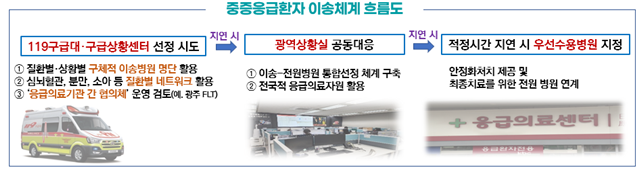
To prevent gaps in the transport of critically ill emergency patients, authorities will check the operating status of specialty hospitals and other facilities in advance and share the information with 119 ambulance crews and regional emergency medical situation rooms so it can be used to select receiving hospitals. Coordination between 119 emergency dispatch centers and regional emergency medical situation rooms will be strengthened, while deployment systems for doctor helicopters and ambulances dedicated to critically ill patients will be maintained.
In particular, the pilot project to innovate the emergency patient transport system in Gwangju and the Honam region, which was conducted during the first half of this year, will be expanded nationwide before the holiday. This is intended to ensure that systems for the rapid transport and transfer of critically ill patients continue to operate smoothly in the field throughout the holiday.
The MOHW and the National Emergency Medical Center will operate situation rooms around the clock to monitor regional emergency medical response systems and the preparations of on-call medical institutions. They will also maintain standing deployment systems for rapid response teams at public health centers and Disaster Medical Assistance Teams (DMATs) at 45 disaster base hospitals nationwide in preparation for emergencies such as mass-casualty incidents.
Lee Jung-gyu, director of public medical policy, said, "We will do everything we can to ensure that the emergency medical system operates smoothly so people can spend the Chuseok holiday safely." He added, "To allow emergency room medical staff to focus on treating critically ill emergency patients, we ask people to first use nearby local hospitals and clinics when their symptoms are not severe."
[email protected] Jung Myung-jin, medical specialist Reporter