Will the Established Year-End Large-Cap Pattern Be Broken? Three Signals for a KOSDAQ Rebound
- Input
- 2026-09-21 08:57:18
- Updated
- 2026-09-21 08:57:18
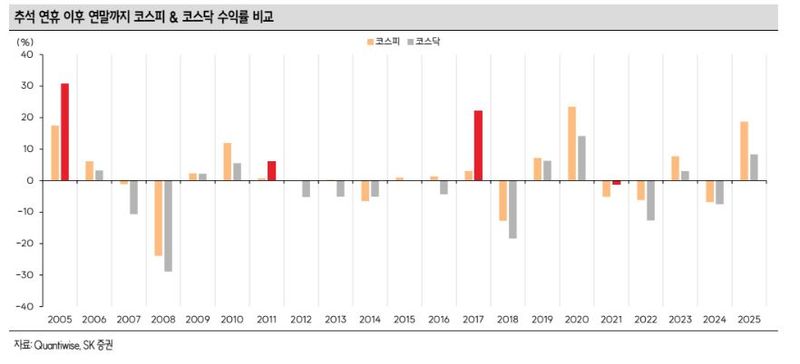
[Financial News] After Chuseok, domestic equities have traditionally seen large-cap stocks outperform KOSDAQ. However, analysts say this year could bring a different trend led by semiconductor equipment and robotics. Whether policies to invigorate KOSDAQ will lead to institutional inflows is also emerging as a key variable for the year-end market.
On the 21st, Na Seung-du, a researcher at SK Securities, analyzed data from 2005 onward and found that KOSDAQ outperformed the KOSPI Composite Index from the Chuseok holiday through year-end in only five instances. Selling by major shareholders to avoid capital gains taxes at year-end, along with demand for dividends and window dressing, tends to favor large-cap stocks. This helps explain why KOSDAQ's seasonal strength more often appears in January of the following year than at year-end.
What stands out is the common pattern in the years when KOSDAQ was particularly strong. In 2005, KOSDAQ outperformed the KOSPI Composite Index by 13 percentage points; in 2011, by 5.5 percentage points; and in 2017, by 19.3 percentage points. All three periods saw the same three conditions: a vacuum in large-cap leadership, a clear leading theme capable of driving KOSDAQ higher, and inflows of foreign and institutional capital.
In 2005, stem-cell research and biotechnology emerged as foreign investors sold large-cap stocks. In 2011, mobile games and entertainment became leading sectors as the profit outlook for shipbuilding and chemicals deteriorated amid the European financial crisis. In 2017, biotech stocks such as Celltrion affiliates and SillaJen filled the gap created by growing fatigue among large-cap stocks following the semiconductor supercycle.
Na said, "This year, the three conditions have not yet fully aligned." He added, "The debate surrounding the semiconductor cycle is still ongoing, so it is difficult to say that a clear vacuum has emerged among large-cap stocks." He further explained, "Third-quarter earnings are likely to determine whether large caps retain their leadership."
Meanwhile, changes are emerging within KOSDAQ. Momentum among the top biotech stocks by market capitalization remains weak, but foreign investor interest is flowing into semiconductor equipment and robotics. Analysts say the initial conditions for a new leading theme—seen in previous KOSDAQ rallies—are taking shape.
The final piece of the puzzle is institutional fund flows. The condition of simultaneous net buying by foreign investors and institutions has not yet been met, but the market mood could change if the government's KOSDAQ revitalization policies lead to actual institutional inflows.
Na said, "The key variables determining KOSDAQ's direction after Chuseok will be the third-quarter earnings of major companies and policy developments." He added, "Ultimately, the year-end KOSDAQ contest will depend not simply on a seasonal rebound, but on whether a vacuum emerges among large-cap stocks, whether semiconductor equipment and robotics expand into leading themes, and whether policy moves institutional fund flows."
[email protected] Kim Kyung-ah Reporter