Tackling 'Micro-Vibration,' a Major Challenge in Ultra-Small Satellite Technology: "Taking on the Challenge of Localizing SDA for Space Security"
- Input
- 2026-09-21 09:54:30
- Updated
- 2026-09-21 09:54:30
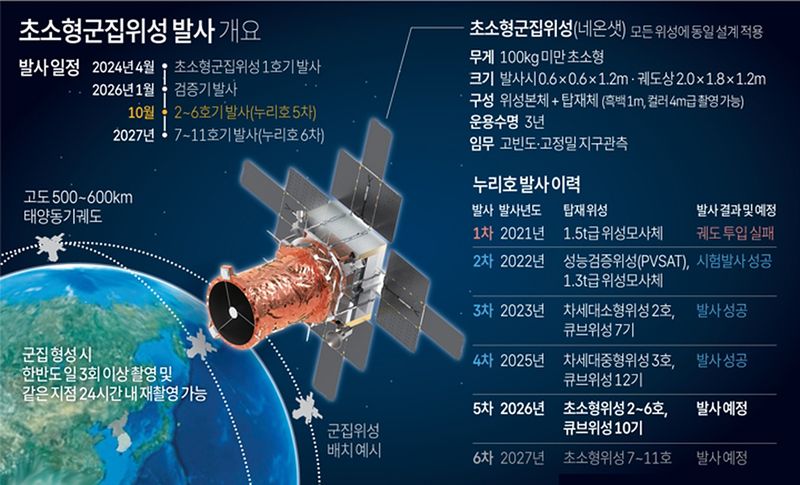
According to KRIT on the 21st, the research aims to develop proprietary technology that dramatically suppresses micro-vibration, regarded as the biggest challenge facing high-resolution satellite cameras, and to demonstrate it in space. The ultimate goal is to raise the quality of imagery used to observe space objects to the highest level.
Because of their weight and size limitations, ultra-small satellites are highly vulnerable to vibration. Successfully controlling micro-vibrations would extend mission life, reduce payload weight and launch costs, and, most importantly, enable ultra-precise tracking of space objects through maximized resolution, dramatically enhancing space-territory surveillance capabilities.
The project, being pursued as part of the Defense Innovation Company Support Program led by the Defense Acquisition Program Administration (DAPA) and carried out by KRIT, will conduct research over the next 36 months on an ultra-small satellite system for a Space Domain Awareness optical-payload mission with micro-vibration reduction. KRIT first leveraged close cooperation between its domestic division and U.S. office to identify an overseas research institution suited to the technical needs of domestic space venture STEP Lab and link it to an actual R&D project.
The partner in this global technological cooperation is SRI International (Stanford Research Institute), an independent nonprofit U.S. research institution that developed the underlying technology for Siri, the AI assistant on Apple's iPhone. During the project, STEP Lab plans to learn SRI's unparalleled space-object-tracking technology and research experience while building its joint research capabilities.
A KRIT official said, "We will continue to expand opportunities to link R&D projects and establish technological cooperation so that defense innovation companies can secure global competitiveness through exchanges with outstanding overseas research institutions."
The central target of this research, micro-vibration, refers to minute shaking generated by cooling devices and various moving components inside satellites. It has long been a technical obstacle that blurs the focus of optical cameras and significantly degrades observation capabilities. Ultra-small satellites are particularly vulnerable to such vibrations because of their smaller size, limiting their ability to produce high-resolution image data.
With KRIT's support, STEP Lab plans to successfully integrate its micro-vibration-reduction technology into an ultra-small satellite system, secure stable, ultra-precise observation data without shaking even in the extreme space environment, and demonstrate the systematic competitiveness of its proprietary payload technology.
The United States, Europe and other leading space powers have already overcome micro-vibration issues in large and medium-sized satellites and are operating them in the field. However, optimizing and fully integrating the technology into the ultra-lightweight, low-cost systems of ultra-small satellites, including CubeSats, is still considered a highly challenging technology and a key bottleneck in the global market. South Korea is understood to be taking on an ambitious challenge to overcome this obstacle.

[email protected] Lee Jong-yoon Reporter