Cardiac Arrests Spike 9% After Holiday Drinking... How to Perform a 10-Second Arrhythmia Self-Check
- Input
- 2026-09-21 08:18:33
- Updated
- 2026-09-21 08:18:33
[Financial News] It can be checked in just 10 seconds by placing three fingers on the wrist. Samsung Medical Center's arrhythmia team urged caution about Holiday Heart Syndrome after heavy drinking during the Chuseok holiday and introduced a self-check method for acute arrhythmia.
Even healthy people with no history of heart disease can develop Holiday Heart Syndrome, including acute arrhythmia, after heavy drinking during a holiday. The condition can lead to life-threatening illnesses such as stroke.
Park Kyoung Min, a professor of cardiology, warned, "If your heart begins to race for no apparent reason after overeating or drinking, or if you experience chest discomfort or dizziness, it could be acute arrhythmia that causes life-threatening complications such as stroke." Unlike common holiday symptoms such as fatigue, lethargy, and indigestion, Holiday Heart Syndrome caused by heavy drinking can be fatal, as can acute arrhythmia.
Holiday Heart Syndrome is a clinical syndrome in which otherwise healthy people with no history of heart disease develop arrhythmia after consuming more alcohol than usual over a short period, such as a weekend or holiday break. It was first reported in 1978 in the American Heart Journal. Studies have found that the strongest risk factor for acute arrhythmia is none other than heavy episodic drinking, or "Heavy Episodic Drinking."
A study by a research team from Ludwig-Maximilians-Universität München, which measured smartphone electrocardiograms (ECGs) and alcohol consumption among 3,028 Oktoberfest participants, found that 30.5% developed cardiac arrhythmias such as atrial fibrillation. The findings demonstrated that short-term heavy drinking can have an immediate harmful effect on the heart.
South Korea is no exception. According to the results of the Community Health Survey released by the Korea Disease Control and Prevention Agency (KDCA), one in three Korean adults, or 33.7%, binge drinks at least once a month, defined as seven or more drinks for men and five or more for women. The rate of high-risk drinking, defined as binge drinking at least twice a week, also reached 12%. South Korea's monthly binge-drinking rate ranked fifth-highest among the 27 OECD member countries.
Recent research by South Korean medical professionals found that the average number of out-of-hospital cardiac arrests occurring on the first weekday after a holiday was 88, which was 9% higher than the 80 cases recorded on ordinary weekdays. The risk of cardiac arrest was found to rise by as much as 10% immediately after an extended holiday lasting two to four days or longer, requiring particular caution.
Three stages of how heavy drinking attacks the heart
A study published in The American Journal of Cardiology in 2026 described the process through which heavy drinking causes arrhythmia in three stages. The first is autonomic nervous system disruption. Alcohol and its metabolite acetaldehyde suppress the parasympathetic nervous system, which calms the heart, while excessively stimulating the sympathetic nervous system and maximizing the heart's electrical instability.
The second is electrolyte depletion. Diuretic effects cause large amounts of potassium and magnesium, which are essential for a normal heartbeat, to be excreted. At the same time, T-type calcium channels in the heart muscle become abnormally activated.
The third is reduced left atrial contraction. Acute alcohol exposure temporarily weakens even the left atrium's mechanical contraction, which squeezes blood.
A study published in the international journal Cureus in 2025 found that drinking five or more alcoholic beverages within two hours seriously disrupts the heart's electrical signaling system, sharply increasing the risk of acute atrial fibrillation by 29%. Drinking six or more drinks a day was found to raise the risk of arrhythmia by as much as twofold.
Professor Park explained that, unlike ordinary acid reflux or indigestion, the appearance of certain symptoms indicates a very high likelihood of cardiovascular disease, including arrhythmia.
A 10-second arrhythmia self-check using your wrist
Kim Juwon, a professor of cardiology at Samsung Medical Center, introduced a self-check that anyone can perform in 10 seconds when arrhythmia is suspected.
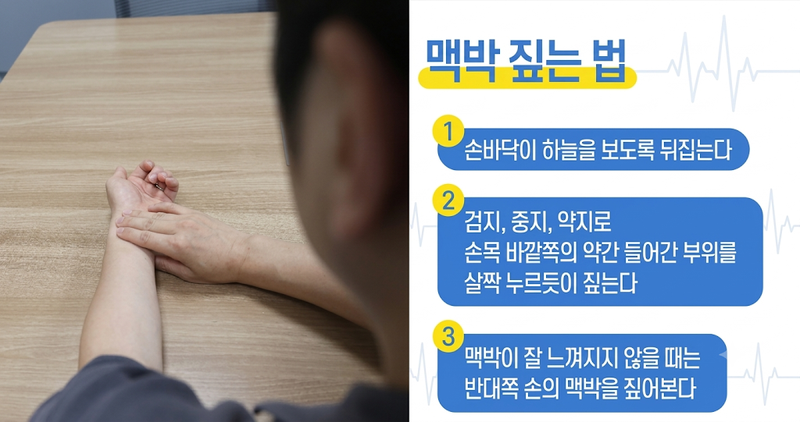
First, turn your palm upward and bend your wrist slightly downward. Place the index, middle, and ring fingers of your opposite hand on the slightly indented area on the outer side of your wrist and press gently. Focus on whether the intervals between your pulses are regular. Count your pulse for 10 seconds and multiply the number by six to calculate your heart rate per minute. If the intervals are irregular, or if your heart rate while at rest is too fast or too slow and falls outside the normal range of 60–100 beats per minute, you should suspect arrhythmia.
Professor Kim added, "As smartwatches have become more advanced, using the ECG recording function built into the device is also a good way to check for arrhythmia."
Professor Park cautioned, "Palpitations may be a simple symptom, but if you have been binge drinking, you should not take them lightly," adding, "If the symptoms persist for more than 10 minutes, you should visit a medical institution for an accurate diagnosis and treatment."
If an emergency, such as sudden arrhythmia symptoms, occurs during a holiday break, nearby hospitals, clinics, and emergency rooms that are open can be found through the Ministry of Health and Welfare's (MOHW) emergency medical portal E-GEN or the "Emergency Medical Information" smartphone app. If internet access is difficult, call 119, the Emergency Situation Management Center, or 129, the Ministry of Health and Welfare Call Center, for assistance.
Symptoms that should raise suspicion of cardiovascular disease, including arrhythmia
*A pounding heartbeat accompanied by an irregular pulse
*A tight, squeezing, or pressing sensation in the chest, particularly around the pit of the stomach
*Pain that begins in the chest and radiates to the left arm, jaw, or teeth
*Shortness of breath, cold sweats, dizziness, and weakness that makes you feel as though you are about to faint
[email protected] Jung Myung-jin, medical correspondent Reporter