German Chancellor Merz Suffers Second Straight Defeat to Far-Right Party in State Elections; Chancellorship in Jeopardy
- Input
- 2026-09-21 06:27:20
- Updated
- 2026-09-21 06:27:20
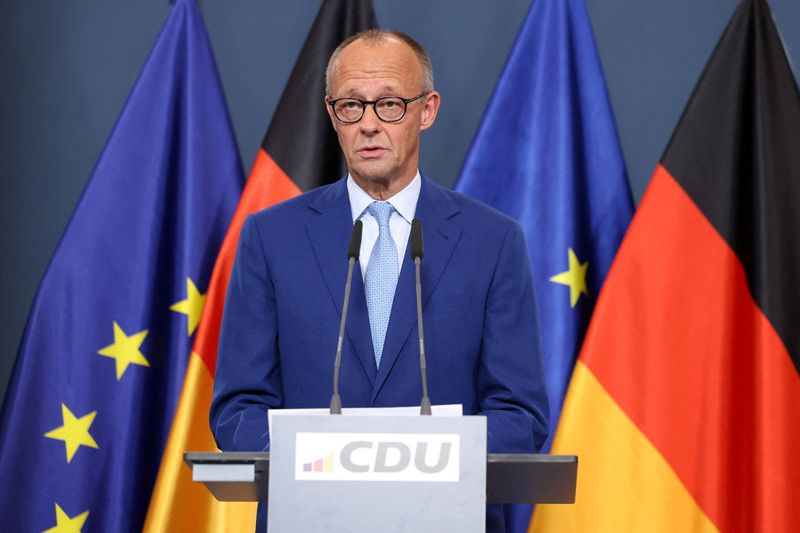
[Financial News] German Chancellor Friedrich Merz, who took office in May, has been driven into a political crisis by a string of state election defeats. Political renewal is expected to be unavoidable, particularly in the former East German regions, where he has suffered two consecutive defeats to the far-right Alternative for Germany (AfD), the second-largest party in the Bundestag.
According to local media outlets, including Deutsche Welle (DW), state parliament elections were held on the 20th (local time) in Berlin and Mecklenburg-Vorpommern, both in the former East Germany. According to the Mecklenburg-Vorpommern election commission, the AfD had won 38.4% of the vote as of 10:15 p.m. on the 20th, after counting had been completed at 1,954 of 1,974 polling stations. It overtook the center-left Social Democratic Party (SPD), which had received 35.4%.
Local media outlets predicted that although the AfD's share had risen from 20.3% in 2021, it would be difficult for the party to win a majority. They also forecast that the SPD, Die Linke (6.5%), and the Greens (5.6%) would form a left-wing coalition government as the state government was established.
The Christian Democratic Union (CDU), the center-right party led by Merz, currently has 4.9% of the vote and cannot be sure of entering the state parliament. If a party's final vote share falls below 5%, it receives no seats at all. The CDU has never before been shut out of a state parliament in any of Germany's 16 states.
In the Berlin state parliament election held on the same day, the AfD made significant gains, while the CDU could lose the mayor's office. As of 10 p.m., Die Linke led with 25.7% of the vote, followed by the CDU with 18.8% and the AfD with 16.0%. The AfD nearly doubled its share from 9.1% in the 2023 election, while the CDU's share fell by nearly 10 percentage points from 28.2%.
Local media outlets predicted that Merz's political standing would be shaken if the CDU also lost this state election. In the Saxony-Anhalt state parliament election on the 6th, the CDU won 17.2% of the vote, less than half its share five years earlier, suffering a crushing defeat to the AfD, which won 43.8%. Merz was reportedly skipping this month's United Nations General Assembly (UNGA) to focus on containing the state election defeat.
Various scenarios are now being discussed within the CDU, including replacing the chancellor and breaking up its coalition with the SPD following the heavy defeat in Saxony-Anhalt. At a press conference held at the CDU headquarters on the evening of the 20th, Merz described the Mecklenburg-Vorpommern exit-poll results as "a disaster." He said Berlin was "fairly okay."
He said, "Change requires strength. Not everyone will applaud, and in some areas it will take time to produce results." However, he added, "We accept this responsibility. I, too, will take responsibility because I want to move our country forward," making clear that he had no intention of resigning.
[email protected] Park Jong-won Reporter