Russia's First Parliamentary Election Since the Invasion Tops 50% Turnout, Strengthening Putin's Grip
- Input
- 2026-09-21 05:57:10
- Updated
- 2026-09-21 05:57:10
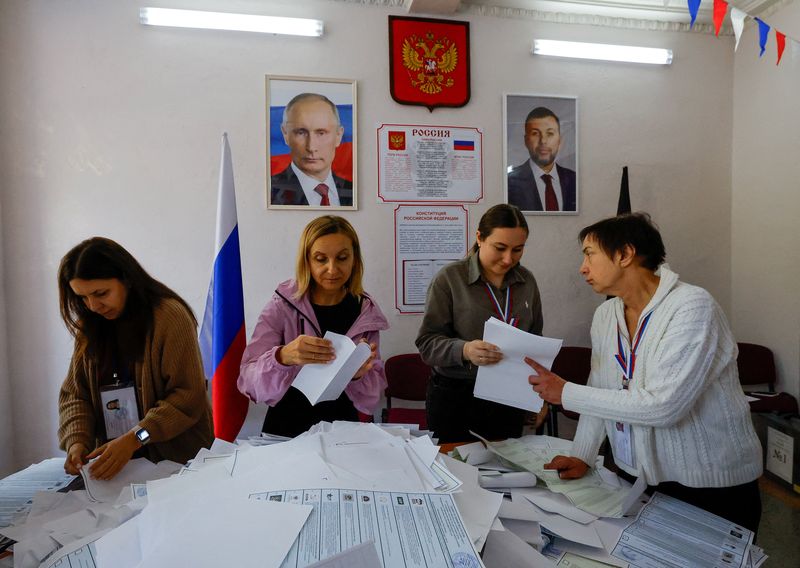
[Financial News] Russia held its first parliamentary election since invading Ukraine in 2022, and turnout surpassed 50%. The vote was also held in Ukrainian territories seized by Russia.
TASS Russian News Agency and other Russian media outlets reported on the 20th (local time), citing Russia's Central Election Commission, that turnout in the lower-house election stood provisionally at 56.66%. Russia's three-day lower-house election ended at 8 p.m. on the 20th. Of the 450 members of the Russian lower house, 225 are elected through nationwide party-list proportional representation and 225 through single-member-district plurality voting.
TASS emphasized that turnout in this election exceeded the figures recorded in the previous three parliamentary elections: 54.81% in 1993, 47.88% in 2016, and 51.72% in 2021.
For the first time since the 2022 invasion, Russia held parliamentary voting in the four Ukrainian regions it forcibly annexed. Turnout stood at 81.62% in Donetsk, 79.33% in Luhansk, 74.61% in Kherson, and 79.39% in Zaporizhzhia.
Galina Katyushenko, head of the regional election commission in Zaporizhzhia, attributed the relatively high turnout to the fact that "residents showed great interest in the first historic lower-house election held in our region."
Observers in and outside Russia believe the vote will strengthen the influence of Russian President Vladimir Putin and United Russia. Putin, who became president for a fifth term in 2024, left United Russia in 2012 and is now formally unaffiliated, but he continues to serve as the party's de facto leader.
Pyotr Tolstoy, a United Russia lawmaker and deputy speaker of the lower house, told reporters, "Moscow residents stood in line waiting to vote on the final day of the election," adding, "This shows that Moscow and all of Russia are united around the president." The Central Election Commission announced that United Russia was leading with 57.05% of the vote, with 25.02% of the ballots counted.
Ten parties, including United Russia, fielded candidates in the party-list vote, but none of them is an opposition party that criticizes the war in Ukraine. Among the previously registered parties, the liberal-leaning Russian United Democratic Party Yabloko was the only one to openly criticize the war. However, the Supreme Court of Russia excluded Yabloko from the party-list election last month. In addition, many anti-war figures had already been imprisoned or fled abroad before the parliamentary election. Even election observers from the Communist Party, which has voiced cautious criticism of Kremlin policies, were reportedly denied access to several polling stations.
Leonid Volkov, an aide to Alexei Navalny, the Russian opposition figure who died under mysterious circumstances in 2024, raised questions after learning that voters at some polling stations had been asked to use electronic voting machines because of malfunctions in the paper-ballot issuance system. On social media platform X, he urged voters to "demand a paper ballot."
Meanwhile, Ukraine launched approximately 1,600 drones at Russia early on the 20th. Ella Pamfilova, chair of Russia's Central Election Commission, claimed that the election system had blocked more than 100 million potentially dangerous attempts to access information. She also said that an attempt to gain unauthorized access to communications networks using artificial intelligence technology had occurred on the afternoon of the 18th and suggested that Ukraine was responsible.
[email protected] Park Jong-won Reporter