Trump Issues Hard-Line Threat: "Considering Whether to Completely Wipe Out Iran" ... Focus Turns to Behind-the-Scenes Diplomacy at the United Nations General Assembly and Inflation Fallout
- Input
- 2026-09-21 01:42:31
- Updated
- 2026-09-21 01:42:31
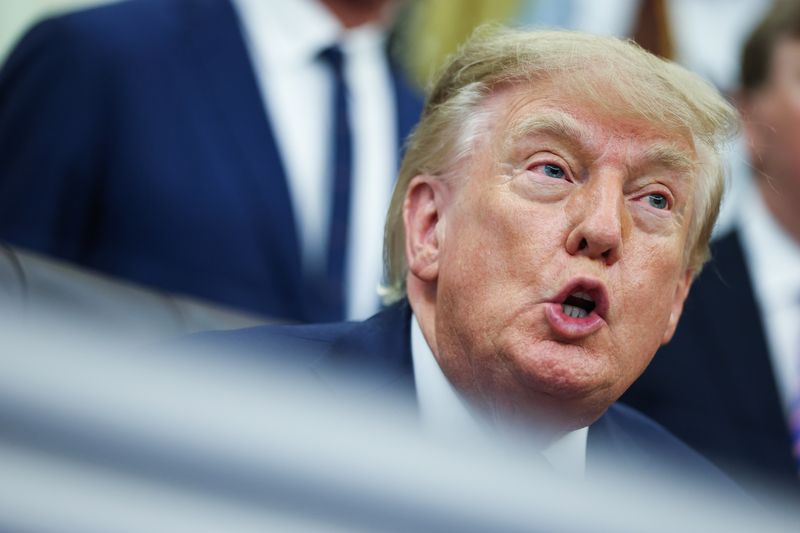
[Financial News] U.S. President Donald Trump warned of possible hard-line military action against Iran, saying he was "at the stage of deciding whether to completely wipe out the entire country." At the same time, he left open the possibility of meeting with Iran's president at this week's United Nations (UN) General Assembly, appearing to pressure Tehran toward an agreement through brinkmanship. In the United States, high oil prices and inflation caused by a prolonged war with Iran are emerging as key issues in the midterm elections.
Trey Yingst, Fox News' chief correspondent, said on the morning broadcast on the 20th (local time) that he had just spoken with President Trump. He reported that Trump said, "The president is currently in 'decision mode,' and very big things will happen in the not-too-distant future."
According to Yingst, Trump presented three options for dealing with Iran—annihilation, economic strangulation and a negotiated settlement—and threatened, "My question is, 'When, and whether, will I wipe out this entire country?' They'd better behave themselves." The remarks reaffirmed what he said in a June 17 interview with Axios: "A momentous decision is approaching on whether to annihilate them."
Although the threat of armed conflict has reached its highest point, room remains for a diplomatic settlement. Asked whether he would be willing to meet Iranian President Masoud Pezeshkian at the UN General Assembly in New York this week, Trump replied, "Maybe." The United States has allowed Pezeshkian and key Iranian delegates, including Foreign Minister Seyed Abbas Araghchi, to attend the General Assembly. Trump also plans to meet with the leaders of six Persian Gulf states during the gathering.
After returning to the White House early on September 19, a day ahead of schedule from his weekend trip to Camp David, the United States Department of State issued an emergency alert on the 20th through its embassies in nine Middle Eastern countries, including Israel and Saudi Arabia. It warned U.S. citizens staying in the region of "the possibility of unpredictable escalation." However, Trump sought to ease some concerns about escalation targeting the United States involving Iran-aligned Houthi rebels in Yemen, who attacked Riyadh, Saudi Arabia, the previous day. "They are in constant communication with us, and they have agreed not to fight with the United States," he said.
Meanwhile, Iran's military said in a statement from its Joint Operations Command that the United States had decided to resume attacks against Iran. It repeatedly warned of fierce retaliation against U.S. military bases and countries supporting the United States if Washington proceeded with the attack, keeping military tensions in the region high.
The prolonged armed conflict in the Middle East is also affecting U.S. politics and the economy. Iran's blockade of the Strait of Hormuz has continued for seven months, sending global energy prices soaring. According to the American Automobile Association (AAA), the U.S. national average gasoline price had risen to $4.48 per gallon as of the 20th.
At a September 18 rally in Gastonia, North Carolina, supporting Republican Party Senate candidate Michael Whatley, Trump downplayed the impact of high oil prices, saying, "It's a very cheap price to pay compared with what we've done. Oil prices will plunge like a rocket falling backward."
As inflation and the cost of living emerge as key issues in the approaching midterm elections, unease is growing within the Republican Party. Republican Senator Lisa Murkowski of Alaska publicly criticized the situation, saying, "Residents say, 'They told us the war would be over in a few weeks, but they're still there.'" She added, "They are feeling the impact of the cost of the war on their communities and are not satisfied with the current situation at all."
[email protected] Park Ji-hyun Reporter