South Korea-United States Investment Talks in Brinkmanship Over "Commercial Viability"... "They Could Still Be Scrapped or Collapse"
- Input
- 2026-09-20 23:54:44
- Updated
- 2026-09-20 23:54:44
[Financial News] The South Korean government's strategic investment negotiations with the United States are facing last-minute turmoil, with the two sides locked in a standoff over guarantees of "commercial viability." The South Korean government is maintaining a firm stance that it cannot make further concessions unless profitability and measures to recover the investment are clearly guaranteed. As a worst-case scenario, the negotiations themselves could be scrapped.
According to ruling-party officials, the Ministry of Trade, Industry and Energy (MOTIE), and the Ministry of Foreign Affairs (MOFA) on the 20th, detailed negotiations on investment in the United States have hit a final obstacle after continuing for more than nine months since the mutual tariff agreement reached last November. The United States is strongly demanding an upfront agreement on the $200 billion strategic investment sector, while South Korea is pushing firmly for safeguards guaranteeing "commercial viability" to be explicitly included.
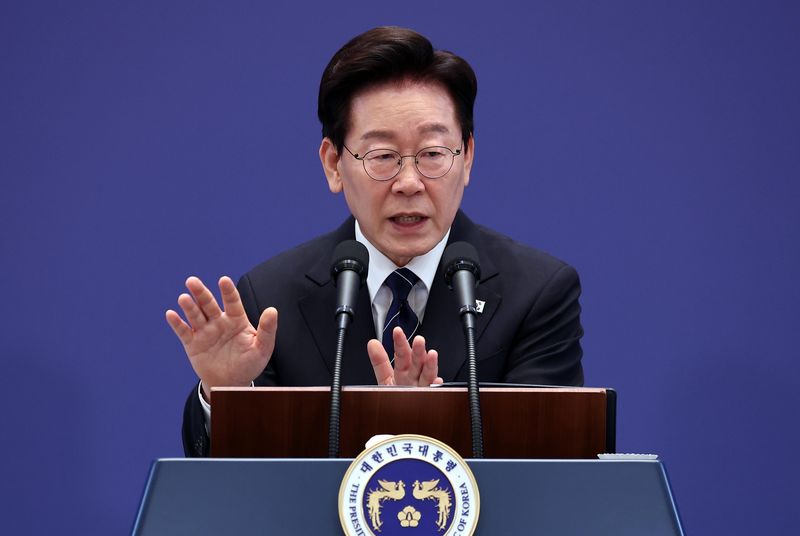
At a press conference on the 18th, President Lee Jae Myung directly acknowledged the difficulty of the negotiations, saying, "After reviewing the details, I found some parts difficult to agree to, so we are discussing them again." He added, "We will undertake only projects with commercial viability. The recovery of the investment, the distribution of returns, and measures to deal with losses are at issue."
Under this principle of prioritizing "commercial viability," projects sought by the United States—including the construction of a liquefied natural gas (LNG) export terminal in Louisiana, a carbon capture and storage (CCS) project in the U.S. Midwest, and a spent nuclear fuel recycling project—are now likely to be excluded from the agreement.
However, the two sides remain sharply divided over the key issues that are still on the table. The biggest issue is the codification of a $20 billion annual investment cap. South Korea is demanding that the remittance limit be explicitly specified to prevent astronomical "additional bills" during the remaining three years of President Donald Trump's term, but the United States is rejecting the demand.
Whether the six detailed items included in the existing joint fact sheet, or preliminary agreement, will be reflected is also under scrutiny. To recover the investment and cover losses, South Korea is strongly demanding the establishment of an umbrella-type special-purpose vehicle (I-SPV) that can offset profits from profitable projects against those from projects progressing slowly. It is also seeking long-term power purchase agreements (PPAs), the appointment of a Korean project manager (PM), and the authority to suspend investments and adjust profit-sharing ratios when unexpected variables arise. The United States, meanwhile, is reportedly pressing South Korea to invest in some projects even before their commercial viability is reviewed and is expressing reluctance over Seoul's detailed demands. Sources say the United States is also showing signs that its patience with South Korea's persistent demands is running out.
As the differences remain unresolved, MOTIE's report to a standing committee of the National Assembly, originally scheduled for the 17th, was postponed once. It was rescheduled for the 22nd, but the session could also be disrupted if the gap between the two sides is not narrowed.
A key government official said, "Our guiding principle in the negotiations is that we can invest only when commercial viability is clearly guaranteed." The official added, "If we ultimately fail to reach an agreement with the United States, it remains an open situation in which the possibility that the negotiations could be scrapped or collapse cannot be ruled out."
[email protected] Park Ji-hyun Reporter