[Editorial] Kim Seung-won Finally Withdraws as Nominee; Vetting System Must Be Improved
- Input
- 2026-09-20 19:24:23
- Updated
- 2026-09-20 19:24:23
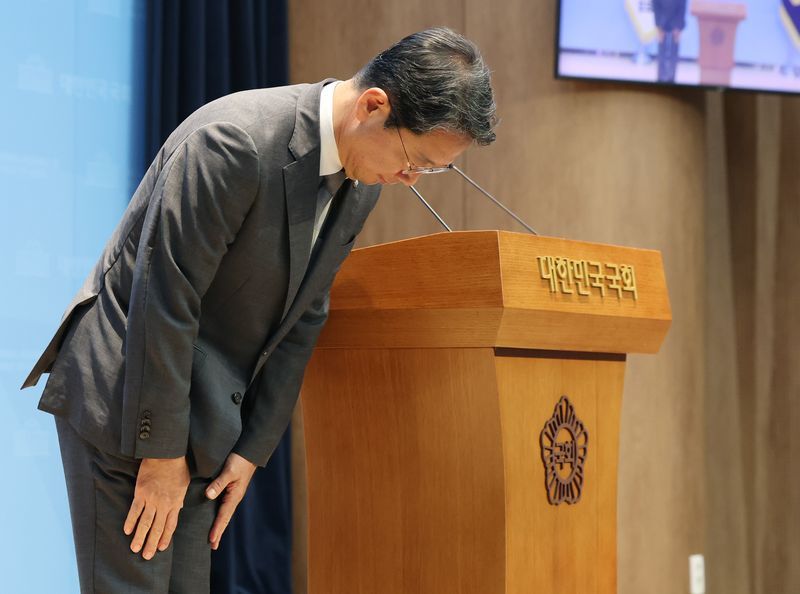
Although the reasons for the two nominees' unsuitability differed, this episode once again confirmed that no one can become a minister while going against the public's wishes and standards. The president and the National Assembly of the Republic of Korea hold authority over appointments and confirmation hearings, but no power can surpass or defy public opinion.
Opposition to the appointment of both nominees far outweighed support. Yong faced questions over the propriety of simultaneously serving as a lawmaker and a minister, while Kim was challenged over allegations of illegal solicitation. Various opinion polls showed overwhelming opposition to both. Nevertheless, the ruling Democratic Party of Korea spent the confirmation hearings blindly defending and standing up for the two nominees.
Even after the problems involving the two nominees had emerged as nearly established facts, ruling-party lawmakers showed no concern and devoted themselves to shielding them. The public was left even more disappointed as the lawmakers showed no ability to distinguish right from wrong and instead focused solely on concealing their own blemishes. In particular, the ruling-party lawmakers who even shed tears while taking Kim's side were utterly disgraceful.
This confirmation hearing exposed the problems of Korean politics and politicians in stark detail. One cannot help first wondering how many people among the country's leadership are upright and have virtually no moral or legal blemishes. Look not only at this hearing, but also at the people who have been forced to withdraw from consideration during confirmation hearings under past administrations. There is little else to say but that the power elite in our society is rotten. Did Kim, a former judge, not openly use his status as a lawmaker to make an improper request to the Ministry of Food and Drug Safety while associating with a woman from an entertainment establishment?
The shortcomings of confirmation hearings that scrutinize moral issues more closely than policy competence were again exposed. Yet the public also believes that morality cannot simply be overlooked. Conduct that violates the law and falls outside accepted moral standards cannot be dismissed and tolerated as something that can happen.
Contrary to public opinion, the ruling party leader's remark that "the more you look at it, the better the appointment appears" amounted to an admission of the sordid level of Korean politics. The ruling-party lawmakers not only refused to acknowledge the nominee's problems and shielded him, but also devoted their efforts to attacking the lawmaker who raised the allegations. Their conduct laid bare the low caliber of Korean politics. Politics must not be this way. Some things deserve protection, and some do not. It is difficult to understand whether they even anticipate that the backlash will eventually hit them and cost them public support.
The bigger problem is the vetting system's failure to filter out such an unqualified nominee. Kim's solicitation allegations were especially serious, having even become a matter for investigation, yet he passed the vetting process without being flagged. Allegations of sexual harassment, additional drunk driving, and habitual verbal abuse of aides surfaced, but none of them were caught during the vetting process. Alternatively, the vetting may have been cursory because those responsible were unwilling to challenge the president's personnel appointment.
President Lee Jae Myung said at a press conference that he would review the vetting system. Concrete improvements must be made this time. Accordingly, we hope confirmation hearings for renominated candidates will focus on assessing policy competence, with little need to scrutinize their morality.