"The Plant Is About to Start Operating, but the Roads and Water Supply Are Not Ready Yet": FKI Proposes Regulatory Improvements for Advanced Industries
- Input
- 2026-09-21 06:00:00
- Updated
- 2026-09-21 06:00:00
[Financial News] The Federation of Korean Industries (FKI) announced on the 21st that it had submitted 41 policy proposals for national advanced strategic industries to the Regulatory Rationalization Committee and other relevant bodies. The proposals were compiled after gathering opinions from companies in sectors including semiconductors, displays, batteries, biotechnology and robotics.
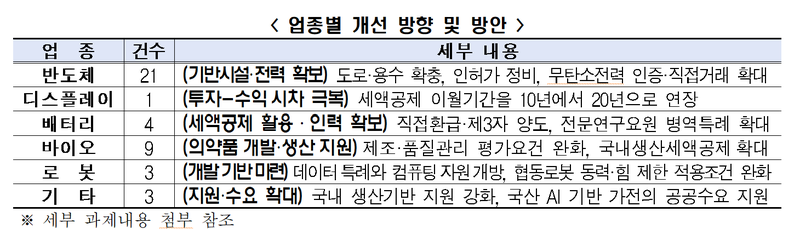
According to FKI, 20 of the 41 proposals can be reviewed or implemented by relevant agencies without legislative amendments, while the remaining 21 require action by the National Assembly. By sector, the proposals were concentrated in semiconductors (21), biotechnology (9), batteries (4) and robotics (3).
In the semiconductor sector, which received the largest number of proposals, companies voiced concern that delays in expanding essential infrastructure—including roads, water supplies and electricity—despite their astronomical investments could disrupt plant operations.
The Yongin Semiconductor Cluster is expected to see a sharp increase in surrounding traffic when vehicles transporting production materials for the first fab (Y1) overlap with construction vehicles for the second fab (Y2). The Y1 cleanroom is scheduled to begin operating in February 2027. However, the improvement project for Nationally Supported Local Route 57 (Wonsam–Mapyeong), the main access road, is not expected to receive notification from the Ministry of Land, Infrastructure and Transport (MOLIT) until after October. This has raised concerns that the work will not be completed before the cleanroom begins operating.
FKI requested, "Since the project already passed the preliminary feasibility study in August, it should be included in the '6th National Route and Local Route Construction Plan,' and the notification schedule should be moved up."
FKI also called for shorter permitting periods and expanded financial support to ensure the timely supply of industrial water. The Cheongju Wastewater Treatment Water Reuse Facility, which can process 35,000 tons per day, took a total of 42 months from the start of the project to the start of construction, including a 15-month feasibility study. Of its total project cost of KRW 62.2 billion, public funding from the central and local governments accounted for only 50%, leaving the private sector to cover the remaining half.
FKI proposed establishing special provisions for advanced-industry infrastructure in private investment procedures to reduce the period until construction begins to no more than 18 months. It also called for wastewater reuse facilities to be explicitly listed as eligible for central government funding under the enforcement decree of the Semiconductor Special Act.
Improving the certification and procurement conditions for carbon-free power in line with demands from global technology giants was also identified as a key issue. Companies currently using carbon-free power sources such as nuclear energy, in addition to renewable energy, have difficulty providing the electricity-purchase documentation that Google and Microsoft require from supply-chain companies. South Korea lacks a common domestic certification system that can certify both the amount of power used and its generation source without double counting. In addition, the current Electric Utility Act limits direct power-purchase contracts between companies and power generators to renewable energy.
FKI proposed amending the Framework Act on Carbon Neutrality and Green Growth to promptly establish a certification system for carbon-free power. It also called for the Electric Utility Act to be revised to allow companies to directly purchase carbon-free power, including nuclear power, in stages.
FKI additionally asked that companies be allowed to directly purchase large hydropower, a major source of environmentally friendly electricity, from facilities with an installed capacity of more than 20 megawatts (MW).
The battery and display industries, which require large-scale facility investments upfront, urged the government to allow companies to use tax benefits as a source of investment funding even during their initial loss-making periods.
Under the current tax credit for investments in national strategic technologies, the credit is deducted from corporate taxes payable. As a result, companies without taxable income because of losses or other reasons cannot immediately use the credit, even when they qualify for one. Unused tax credits can be carried forward for 10 years, but they expire if a company fails to generate enough profit to pay corporate taxes within that period. FKI called for measures such as a direct-refund system, similar to those used in the United States and other countries, that would provide early cash refunds for unused credits.
The battery industry also requested expanded military-service exemptions for specialized research personnel, the construction of energy-storage-system (ESS) testing facilities that the industry can use jointly, and broader mutual recognition of evaluation results. The proposals also included extending the period for using tax credits from the current 10 years to 20 years, reflecting the display industry's characteristic of requiring a long time to generate returns after investing in next-generation panels.
In future industries such as biotechnology and robotics, the proposals focused on easing regulations that hinder market entry and opening up artificial intelligence (AI) demonstration infrastructure.
In biotechnology, FKI proposed easing the good manufacturing practice (GMP) compliance assessment requirement for companies commissioned to conduct small-scale trial production during the early development stages of products such as cell therapies and mRNA vaccines. The requirement would be reduced from production records for three manufacturing batches to one. The proposal seeks to maintain strict safety standards at the product-approval stage while lowering entry barriers during research and development.
The proposals also included measures to improve the effectiveness of tax support for the biotechnology sector. FKI called for expanding the designation of national strategic technologies to include innovative synthetic drugs and key active pharmaceutical ingredients, and for vaccines and biopharmaceuticals to be included in the planned domestic production tax credit.
To strengthen the global competitiveness of the rapidly growing robotics industry, FKI proposed easing privacy regulations and opening government infrastructure. The proposal would lower regulatory barriers so that humanoid robots can use original video and audio data essential for recognizing and learning about their environments after receiving approval within secure demonstration zones.
FKI also proposed adding future vehicles, including autonomous and electric vehicles, as well as air-source heat pumps, which are energy-efficient equipment, to the list of items eligible for the domestic production tax credit. It also called for support to promote the distribution of home appliances equipped with domestically developed AI foundation models and to create public-sector demand for them.
FKI asked the government to prioritize the 20 proposals that can be reviewed or implemented without legislative amendments. It urged the National Assembly to swiftly advance the 21 proposals requiring legislation through the relevant standing committees. Among them, nine concern amendments to the Restriction of Special Taxation Act, making it the most common legislative category.
Kwon Hyuk-min, head of FKI's Growth Strategy Office, emphasized, "To strengthen the competitiveness of national advanced strategic industries, it is important to swiftly remove institutional obstacles that hinder companies' investment decisions and execution. The government and the National Assembly should rapidly improve the proposals that businesses can feel immediately in the field and create an environment in which corporate investment can continue."
[email protected] Lim Su-bin Reporter