Seoul's Jeonse Market Sees 1 Billion-Won Price Levels in the Northeast Amid a Move-In Cliff
- Input
- 2026-09-20 16:34:03
- Updated
- 2026-09-20 16:34:03
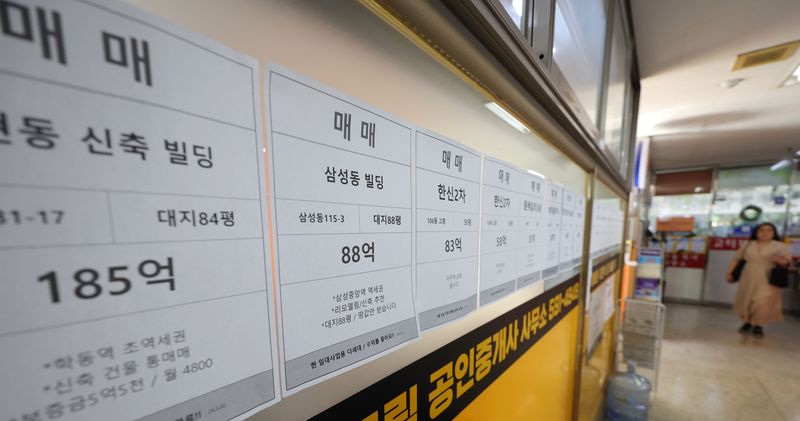
According to the KREB on the 20th, Seoul apartment jeonse prices had risen 7.79% cumulatively as of the second week of September. That is about 4.7 times last year's 1.16% increase over the same period and more than twice the 3.77% annual increase recorded last year. It is the highest level since 2015, when the jeonse market was severely strained by a shortage of available units and the increase reached 10.79%.
Seongbuk District recorded the largest increase. Jeonse prices there have risen 12.84% this year, the highest in Seoul, while its cumulative increase in sale prices, at 14.01%, also ranks first. An 84-square-meter unit on the 18th floor of Lotte Castle Classia in Gireum-dong signed a new jeonse contract for 1.1 billion won on the 15th of last month. An 84-square-meter, 23rd-floor unit at Raemian Gireum Centerpiece is listed for jeonse at 1.05 billion won.
Dongdaemun District's cumulative increases this year stand at 10.59% for sale prices and 8.43% for jeonse prices, making it one of the more notable gainers among the mid- to lower-tier districts. An 84-square-meter unit on the 53rd floor of Cheongnyangni Station Hanyang Sujain Gratte-ciel in Yongdu-dong was contracted at 1 billion won on the 30th of last month. The complex recorded new jeonse contracts in the low 800-million-won range last November, but asking prices for units on middle floors or higher are still around 1 billion won.
In Gangbuk District, where sale and jeonse prices are rising in tandem, the asking price for an 84-square-meter, 12th-floor unit at Hanwha Forena Mia in Mia-dong has climbed to 1.2 billion won. The latest jeonse transaction for a unit of the same size was 950 million won on June 26.
Nowon District's cumulative increase in jeonse prices stands at 12.25%, the second-highest in Seoul after Seongbuk District. There, too, a 1995-completed, 84-square-meter, ninth-floor unit at Geonyeong 3-cha in Junggye-dong was leased to a new tenant for 910 million won on the 11th.
The average jeonse-to-sale price ratio in northeastern Seoul, including Seongbuk, Dongdaemun and Nowon districts, is 55.8%. That is higher than Seoul's average of 52.3% and the 45.8% recorded in southeastern Seoul, which includes the three Gangnam districts (Gangnam, Seocho and Songpa). Jeonse prices appear to have rapidly caught up because rental supply remained scarce even as sale prices surged this year.
Supply conditions are also unfavorable. Real Estate R114 estimates that 26,951 Seoul apartment households are scheduled to move in this year, down 27.4% from last year's 37,103 households. The figure is expected to fall to 17,012 households next year, about half the average of the past five years.
Nam Hyuk-woo, a researcher at Woori Bank's Real Estate Research Institute, said, "A jeonse deposit of around 1 billion won is a price level associated with the Han River Belt, even if it does not reach the three Gangnam districts. In the mid- to lower-tier districts as well, benchmark jeonse prices are emerging around new construction, as they have in the sale market, so asking prices around 1 billion won can take shape."
The government is mobilizing available measures, including purchased rental housing, based on the policy stance that expanding housing supply is the fundamental solution to stabilizing the jeonse and monthly-rental market. A prime example is the Plan to Expand Purchased Rental Housing in the Capital Metropolitan Area, unveiled by the Ministry of Land, Infrastructure and Transport (MOLIT) on May 22. The plan calls for supplying 90,000 purchased rental homes in the Capital Metropolitan Area in 2026 and 2027, with 66,000 of them concentrated throughout Seoul and in 12 regulated areas of Gyeonggi Province. In the regulated areas alone, the planned supply is nearly double the 36,000 households provided during the preceding two years, from 2023 to 2024.
[email protected] Ahn Seung-hyun Reporter