Once You Fall In, It’s Hard to Escape on Your Own ... Jeju Tetrapod Accidents Peak in September
- Input
- 2026-09-20 16:34:48
- Updated
- 2026-09-20 16:34:48
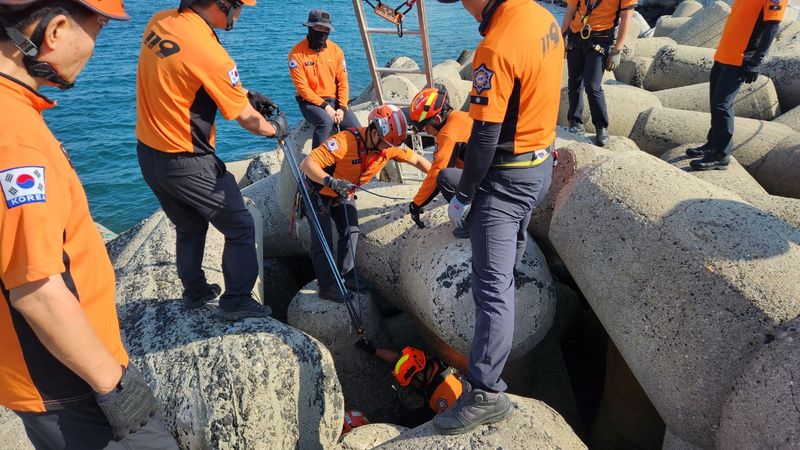
[Financial News, Jeju | By Jeong Yong-bok] Tetrapods, which protect breakwaters by blocking waves, have become recurring sites of accidents involving people along the Jeju coast. Their rounded, slippery surfaces and intricately interlocked concrete blocks make it difficult to escape without help after falling between them, prompting calls for extreme caution.
According to the Jeju Eastern Fire Station on the 21st, a total of 163 tetrapod-related safety accidents occurred in the province from 2021 through 2025. September had the highest monthly total, with 26 cases. Falls accounted for 67 of the accidents, or about 41% of the total.
People have also been repeatedly injured or killed in such incidents. The Jeju Regional Headquarters, Korea Coast Guard, separately tallied 17 falls from breakwater tetrapods from 2023 through July this year. Four people died and 13 were injured in those accidents.
By year, there were four cases in 2023, four in 2024 and four last year, while five had already occurred this year through July. The death toll was two in 2023, one in 2024 and one this year.
The fire authorities’ tally of 163 cases and the Coast Guard’s tally of 17 cannot be directly compared because the periods covered and accident classifications differ. Nevertheless, both sets of statistics show that tetrapod-related safety accidents continue to occur along the Jeju coast.
A fatal accident also occurred in July this year. At about 9:27 p.m. on July 2, a fisherman in his 70s fell from a tetrapod at a harbor in Dodu 2(i)-dong, Jeju City, while walking across the structure. He was rescued with severe head injuries and taken to a hospital, but died.
In July 2024, a man in his 50s also fell between tetrapods at a breakwater in Samyang-dong, Jeju City. Emergency responders from the 119 service rescued him while he was in cardiac arrest and took him to a hospital, but he eventually died.
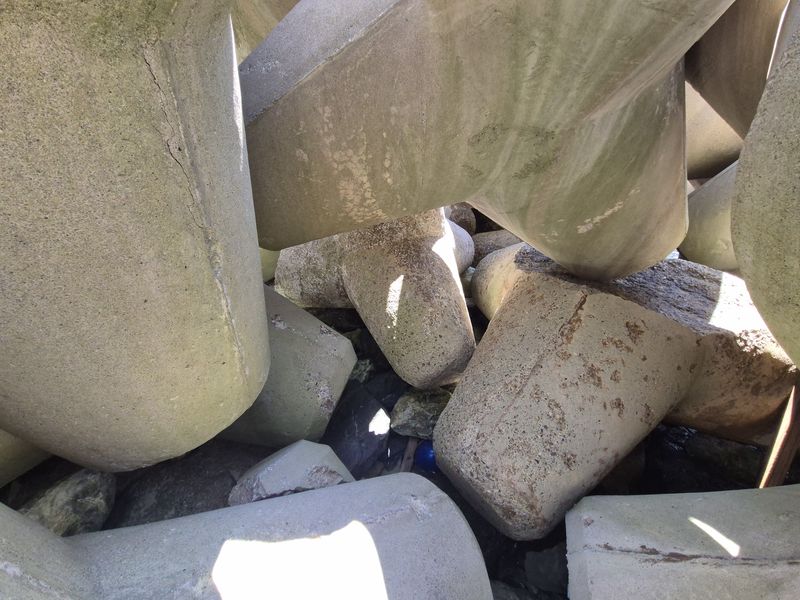
Tetrapods are not facilities designed for walking or fishing. They are wave-dissipating blocks made by stacking large concrete structures with four legs so that they interlock. Water flows through the gaps between the structures, dispersing the energy of the waves.
The problem is that the very design that reduces wave energy becomes a hazard when a person falls.
Tetrapods have rounded, sloped surfaces that become slippery when covered with seawater, moss and seaweed. The spaces between the blocks are irregular and intricately connected across multiple levels, so a person who loses their footing can fall deep into the structure.
The Jeju Regional Headquarters, Korea Coast Guard, explains that tetrapods are typically around 3 meters high and have a complex structure, making falls highly impactful and self-rescue difficult. If someone becomes trapped between the structures, the sound of the waves may also prevent calls for help from carrying outside clearly.
Similar accidents have also occurred nationwide. According to the Ministry of Oceans and Fisheries (MOF) and the Coast Guard, 462 safety accidents involving tetrapods and other hazards occurred at breakwaters nationwide from 2018 through June 2024, leaving 65 people dead.
The government is also expanding the designation of restricted-access areas and the installation of warning facilities to reduce accidents involving breakwaters and tetrapods. Within port areas, zones where accidents involving people have occurred or that are directly exposed to waves may be designated as restricted-access areas. Unauthorized entry into a designated restricted-access area may result in an administrative fine of up to 1 million won.
MOF has also introduced warning signs indicating the risk of falling from tetrapods, lines marking restricted-access areas and lighting facilities identifying hazardous areas at night.
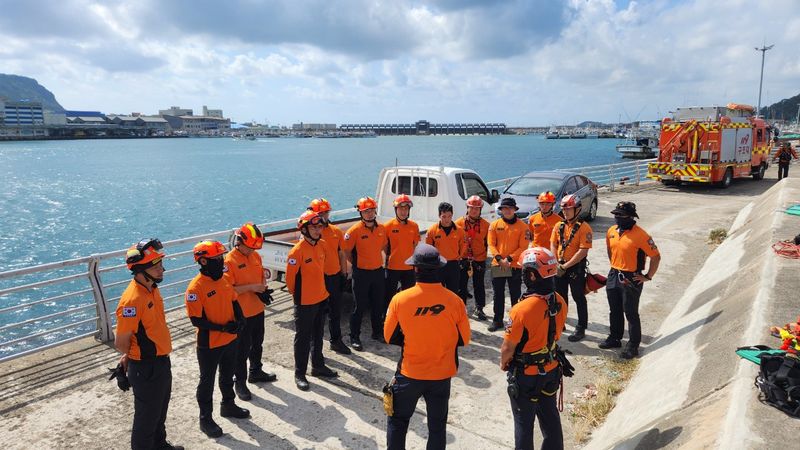
Jeju fire authorities are strengthening their rescue response ahead of autumn, when accidents tend to increase. The Eastern Fire Station conducted specialized training for responding to tetrapod accidents over three days from the 16th to the 18th, deploying 40 personnel, including rescue and pump-truck crews.
The crews simulated actual falls, focusing on rescuing people who had fallen between tetrapods and practicing techniques for hoisting them vertically with ropes. They also repeatedly practiced team-based response procedures, taking into account the fact that these incidents require several responders to move simultaneously.
Tetrapod accidents present challenges unlike those on ordinary flat ground, even after rescue personnel arrive at the scene. Responders must enter directly between irregular concrete structures, and ropes and safety equipment are needed to prevent further falls while lifting an injured person.
Kang Seong-bu, chief of the Jeju Eastern Fire Station, said, "As more anglers head out in autumn, the risk of falls and slips around tetrapods also increases. We will continue strengthening our on-site response capabilities through repeated drills that mirror real-world situations."
[email protected] Jeong Yong-bok Reporter