Jeju Sets Sights on Korea Racing Authority, Korea Airports Corporation and KETEP in Bid to Attract Six Public Institutions
- Input
- 2026-09-20 15:55:10
- Updated
- 2026-09-20 15:55:10
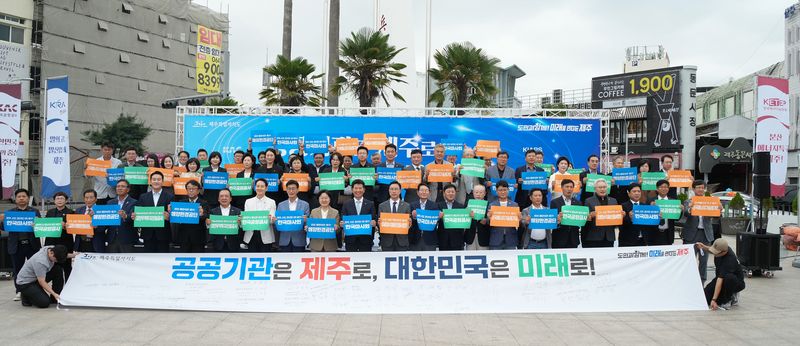
【Financial News, Jeju—Reporter Jeong Yong-bok】 As the government reviews the need for a second round of relocations involving some 350 public institutions based in the Seoul metropolitan area and plans to announce a relocation plan in the fourth quarter of this year, Jeju has narrowed its target list to six institutions. The province has made the Korea Racing Authority, Korea Airports Corporation and Korea Institute of Energy Technology Evaluation and Planning its top priorities, launching a campaign to attract them by linking their functions with Jeju's industries.
According to Jeju Special Self-Governing Province on the 20th, the second Jeju Pan-Citizen Campaign Headquarters for Attracting Public Institutions announced a call for public institutions to relocate to Jeju at Tamra Culture Plaza in Jeju City the previous day. About 200 people, including Jeju residents, business and civil society groups, and residents near innovation cities, took part.
The six institutions Jeju has designated as key targets are the Korea Racing Authority, Korea Airports Corporation, Korea Institute of Energy Technology Evaluation and Planning, the Next-Generation Numerical Weather Prediction Model Development Project Team, Korea Marine Environment Management Corporation and Korea Trade-Investment Promotion Agency (KOTRA).
The biggest change is that the provincial government and the provincial council now have the same list of candidates after the addition of the Next-Generation Numerical Weather Prediction Model Development Project Team.
On the 8th, Jeju Special Self-Governing Province named the Korea Racing Authority, Korea Airports Corporation, Korea Institute of Energy Technology Evaluation and Planning, Korea Marine Environment Management Corporation and KOTRA as its five preferred institutions. The following day, the Jeju Provincial Council called for the relocation of six institutions by adding the Next-Generation Numerical Weather Prediction Model Development Project Team. With Jeju now including the project team among its key candidates, the provincial government and council will jointly seek to persuade the government to approve the relocation of the same six institutions.
Among them, Jeju is working hardest to attract the Korea Racing Authority. The province is citing its status as the country's largest base for horse-industry production as justification. Jeju is home to 14,876 horses, accounting for 54.7% of the national total, while its domestic racehorse production stands at 1,021, or 91.5% of the country's total. Jeju Race Park and the Korea Racing Authority Jeju Ranch are already in operation.
Jeju's argument is that linking the KRA headquarters' policy and research functions with horse production and breeding, racing and tourism sites would simultaneously strengthen the institution's functions and the region's industries.
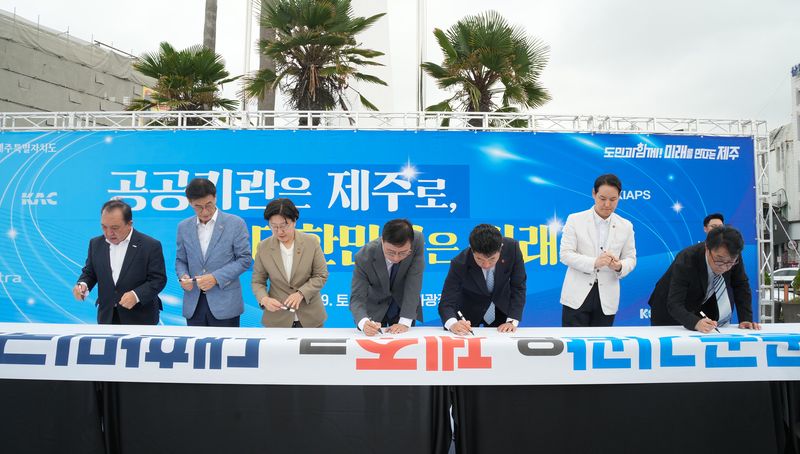
For Korea Airports Corporation, Jeju is emphasizing the island's transportation structure and aviation industry. The island depends heavily on air transport for resident mobility and tourist travel. The plan is to link Jeju Airport operations with future air transportation and the aerospace industry to maximize the policy benefits of relocating the KAC headquarters.
The Korea Institute of Energy Technology Evaluation and Planning has already entered the stage of receiving a formal relocation proposal. On the 17th, Jeju Governor Wi Seong-gon visited KETEP in Gangnam-gu, Seoul, and delivered a proposal to relocate its headquarters to Jeju to President Lee Seung-jae. He also proposed using the buildings and site in Jeju Innovation City and establishing settlement-support measures for relocating employees, including housing, education and transportation.
Jeju emphasizes that it is a region that has already gained firsthand experience with issues such as output curtailment and power-grid stability while operating renewable energy, electric vehicles, energy-storage systems and hydrogen infrastructure. Its strategy is to connect the institution that plans and evaluates national energy research and development with sites where such technologies are demonstrated.
The newly added key candidate, the Next-Generation Numerical Weather Prediction Model Development Project Team, is also drawing attention. Based in Dongjak District, Seoul, the project team is a public institution affiliated with the Korean Meteorological Administration and is working to improve the performance of a Korean numerical weather prediction model and develop forecasting technologies for responding to weather disasters. Its ongoing project to develop integrated spatiotemporal numerical forecasting technology is scheduled to end this year, but the Korean Meteorological Administration is pursuing plans to make the project team a permanent organization and establish a follow-up research and development strategy for 2027–2032.
Jeju's case for attracting the project team is that its numerical weather prediction research functions could be linked to an island exposed to climate risks such as typhoons, torrential rain and marine weather. However, the campaign must also consider how the project team's future organizational structure and follow-up research and development system will be arranged.
Korea Marine Environment Management Corporation has been presented as a candidate that could link marine environmental management and maritime industries with Jeju, while KOTRA could connect the island with international exchanges and export and investment support.
The KRA headquarters is in Gwacheon, the KAC headquarters is in Gangseo-gu, Seoul, the Korea Marine Environment Management Corporation is in Songpa District, Seoul, and KOTRA is in Seocho-gu, Seoul.
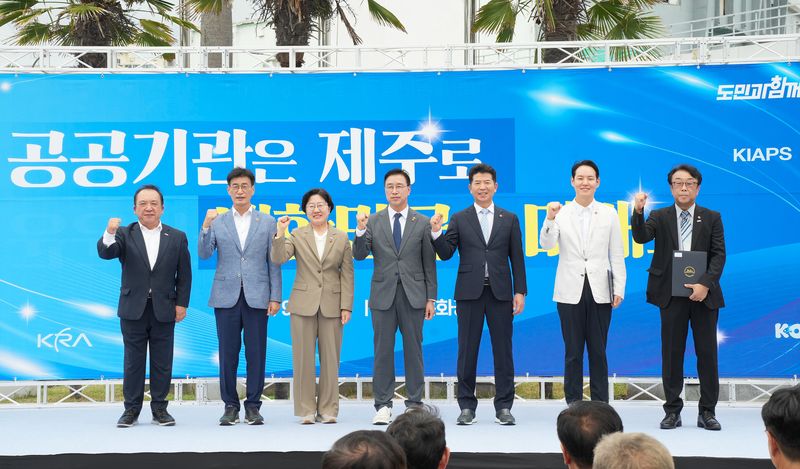
The fact that Jeju wants all six institutions does not mean that all of them will be included in the government's relocation targets.
On the 3rd, the government set out the principles for the second round of public-institution relocations to the regions: minimizing the number of institutions remaining in the Seoul metropolitan area, concentrating institutions around existing innovation cities, linking them with local universities and industries, expanding self-sufficient settlement infrastructure and carrying out the relocations quickly. Rather than dispersing institutions across multiple regions, the government plans to group functionally related institutions with existing innovation cities and industries.
Ultimately, the key to the campaign is not securing Jeju's share, but proving how national policy and each institution's competitiveness would improve if the institution moved to Jeju.
Jeju must provide specific links between each institution's functions and regional industries—for example, the KRA's horse industry, the KAC's air transportation and KETEP's renewable-energy demonstrations—along with housing, education and medical services for relocating employees and transportation access for nationwide operations.
Jeju Special Self-Governing Province plans to expand the current Pan-Citizen Campaign Headquarters into a nationwide campaign headquarters open to anyone in Korea and to strengthen its arguments and implementation plans for attracting each institution. It will also continue consultations with relevant ministries, including the Ministry of Land, Infrastructure and Transport (MOLIT), and with the institutions themselves.
The first hurdle will be whether the six institutions sought by Jeju are actually included among the potential relocation targets in the government's fourth-quarter plan. After that, competition among local governments nationwide is expected to intensify over the placement principles for each institution, links to innovation cities, relocation costs and settlement conditions.
[email protected] Jeong Yong-bok Reporter