30.93 Million to Travel for Chuseok; Worst Outbound Congestion Expected on Morning of 24th
- Input
- 2026-09-20 15:22:54
- Updated
- 2026-09-20 15:22:54
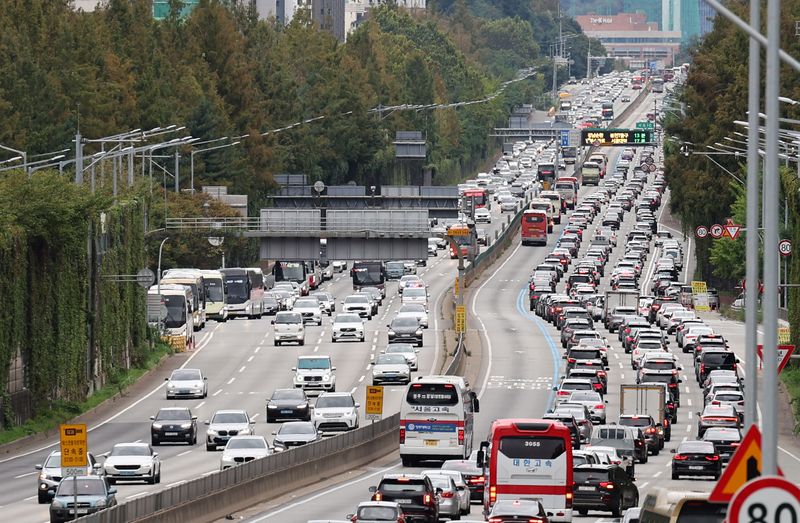
[Financial News] With travel demand compressed into the shortened four-day holiday, road conditions this Chuseok are expected to be worse than last year. A total of 30.93 million people are expected to travel during the measures period, while average daily expressway traffic is forecast at 6.05 million vehicles. Outbound travel is expected to peak on the morning of the 24th, and return travel on the afternoon of the 25th. The trip from Seoul to Busan could take up to 11 hours and 5 minutes.
On the 20th, the Ministry of Land, Infrastructure and Transport said the government will designate the five-day period from the 23rd to the 27th as the 'Special Transportation Measures Period' and activate a joint special transportation measures headquarters with related agencies. Demand projections from The Korea Transport Institute (KOTI) and Korea Expressway Corporation show that the total number of travelers will fall 3.5% from last year, when 32.04 million people traveled. This is because this year's holiday period is shorter than last year's, which lasted more than 10 days. The issue is travel density. The average daily number of travelers is expected to reach 11.82 million, up 56.0% from last year's 7.57 million, while 12.99 million people are expected to travel on Chuseok day alone. The forecast was calculated based on a travel-behavior survey of 10,024 people conducted by KOTI.
Passenger cars are expected to account for a pronounced 88.4% share of all trips. Average daily expressway traffic is forecast to rise 11.8% from last year's 5.41 million vehicles to 6.05 million. On Chuseok day, when travelers heading to and returning from their hometowns overlap with visitors to ancestral graves, MOLIT expects 6.84 million vehicles to take to the roads, 6.7% more than last year's 6.41 million. For the Seoul-Busan route, estimated travel times are 10 hours to 11 hours and 5 minutes for outbound travel and 8 hours 30 minutes to 9 hours for the return trip.
MOLIT identified five key priorities for the measures: improving traffic flow; expanding travel convenience and services; ensuring transportation safety; increasing public transportation services; and establishing preparedness for adverse weather.
On the roads, 299 sections of expressways and national highways have been designated as congestion-prone areas and will receive intensive management, including guidance on vehicle detours. Shoulder lanes will be opened on 64 expressway sections. Measures to reduce costs are also being introduced. Expressway tolls will be waived for four days before and after Chuseok, while fuel prices at expressway service stations will be reduced by 100 won per liter.
Rail passengers will encounter a changed ticket-booking environment for the first time. Following the integration of Korea Railroad Corporation (KORAIL) and SR Corporation, passengers can now check and book tickets for all trains nationwide through the integrated app 'Korail+' in one place. They can also use transportation and travel services that combine accommodation bookings with local festivals. KTX fares have been reduced by an average of 10%, while fares for reverse-direction Chuseok travel will receive discounts of up to 50%.
This is the first major holiday since the two organizations became one. MOLIT announced on August 31 that the institutional integration process between KORAIL and SR Corporation had been completed, and the integrated KTX began operations on the first of this month. The high-speed rail competition system that began with the launch of the Super Rapid Train (SRT) in 2016 has come to an end after 10 years. The ticket-booking app 'Korail+' opened first on August 3, and fare adjustments lowered the Seoul-Busan fare from 59,800 won to 54,400 won.
Air travel congestion is also being managed. Departure halls will open up to 30 minutes earlier at Incheon International Airport, and real-time waiting conditions at Incheon International Airport, Gimpo International Airport, Gimhae International Airport and Jeju International Airport can be checked through major online portals. Incheon International Airport will increase the number of participating airlines for self-check-in from 20 to 24 and those offering self-bag drop from 10 to 13. Temporary parking lots will also be secured to ease parking shortages.
To accommodate the increase in passengers, bus and rail services will be expanded by 11.8% from normal levels, or 11,567 additional runs, while the number of seats will rise 11.1%, or by 853,000 seats. Vulnerable facilities will be inspected in real time in preparation for torrential rain and other hazards. If weather conditions deteriorate, operators will take preventive measures such as slowing trains or rerouting air routes.
The key factor is the weather. Based on the projected track released by the Korean Meteorological Administration on the 17th, Typhoon No. 25 Dujuan was heading toward an area east of Japan, and its direct impact on the Korean Peninsula was forecast to be limited. However, the Korean Meteorological Administration explained on the 20th that the storm's track remained highly uncertain, with the 70% probability radius around its projected position expanding to as much as 440 kilometers. Five typhoons, including Typhoon Sarah, which struck the Korean Peninsula on Chuseok day in 1959, Typhoon Abby in 1986, Typhoon Oliwa in 1997, Typhoon Saomai (2000), and Typhoon Maemi in 2003, have caused extensive damage around the Chuseok holiday.
[email protected] Ahn Seung-hyun Reporter