[Exclusive] "Even though I earn more than 3 million won a month, I still can't make it"... More than 13,000 borrowers approved for debt adjustment in the first half alone... The fear of high interest rates
- Input
- 2026-09-20 17:10:15
- Updated
- 2026-09-20 17:10:15

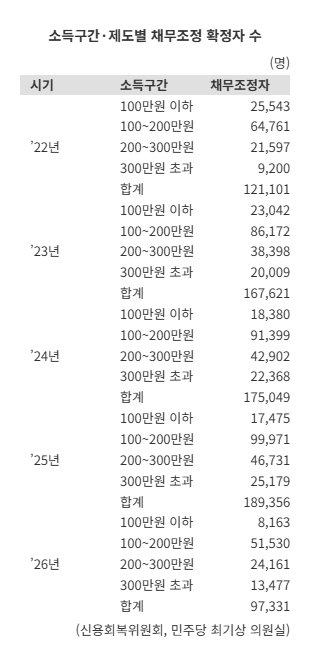
[Financial News] As soaring prices have been compounded by persistently high interest rates, nearly 100,000 borrowers were approved for debt adjustment in the first half of this year alone. In particular, the number of borrowers earning more than 3 million won a month who received debt adjustments surged from around 9,000 in 2022 to the 20,000s in 2023 and has continued to rise. This indicates that more middle-income borrowers, including self-employed people, are struggling with debt burdens they cannot afford.
According to data that the Credit Counseling and Recovery Service submitted on the 20th to the office of Choi Ki-sang of the Democratic Party of Korea, 97,331 borrowers were approved for debt adjustment in the first half of this year under the combined categories of Swift Debt Adjustment, Pre-workout Debt Adjustment and Individual Workout. Since 189,356 borrowers were approved for debt adjustment in 2025, the number is also expected to continue rising this year. The number of borrowers approved for debt adjustment has steadily increased from 113,863 in 2021 to 121,101 in 2022, 167,621 in 2023 and 175,049 in 2024. In particular, the number surged in 2023 due to the fallout from COVID-19.
By income level, 8,163 borrowers earning 1 million won or less, 51,530 earning between 1 million and 2 million won, 24,161 earning between 2 million and 3 million won, and 13,477 earning more than 3 million won were approved for debt adjustment in the first half of this year. The number of borrowers earning 1 million won or less who were approved for debt adjustment has been steadily declining.
The number of borrowers earning 1 million won or more who received debt adjustments all showed an upward trend. In particular, the number of borrowers earning at least 3 million won a month, classified as part of the middle-income group, is also increasing. The number of debt-adjustment borrowers earning at least 3 million won stood at 5,519 in 2021, 9,200 in 2022, 20,009 in 2023, 22,368 in 2024 and 25,179 in 2025. The figure had already exceeded 13,000 in the first half of this year.
By type of debt adjustment, approvals for Pre-workout Debt Adjustment are declining, while those for Swift Debt Adjustment and Individual Workout are increasing. Borrowers who are delinquent for 30 days or less can use Swift Debt Adjustment; those delinquent for 31 to 89 days can use Pre-workout Debt Adjustment; and long-term delinquent borrowers who have been in arrears for 90 days or more can use Individual Workout.
The number of borrowers approved for Swift Debt Adjustment rose from 16,766 in 2022 to 53,659 last year, increasing 3.2-fold in just three years. In the first half of this year, 27,070 borrowers were approved for Swift Debt Adjustment. More borrowers are unable to withstand even a month of debt delinquency. The number approved for Pre-workout Debt Adjustment rose from 23,383 in 2022 to 37,795 in 2023, but then fluctuated between declines and increases, falling to 34,690 in 2024 before rising to 35,726 in 2025. Another 15,028 borrowers were approved in the first half of this year, indicating that the decline is continuing.
The number of long-term delinquent borrowers with sharply reduced repayment capacity is also increasing. The number of borrowers approved for Individual Workout, which applies to those delinquent for 90 days or more, rose from 80,952 in 2022 to 99,971 last year. The figure reached 55,233 in the first half of this year, putting it on track to exceed 100,000 for the first time in a full year.
A financial-sector official said, "As we have entered an era of high interest rates, the repayment conditions of financially vulnerable borrowers are also highly likely to worsen further going forward. When the base rate rises, market rates rise, and lending rates inevitably face continued upward pressure." The official added, "As more people with incomes are giving up, saying they can no longer cope, this is a time when banks and other financial institutions need to make greater efforts toward inclusive finance."
[email protected] Park Moon-soo Reporter