Houthi Rebels Attack Saudi Capital With Drones and Missiles... Fears Grow of Conflict Spreading
- Input
- 2026-09-20 15:33:43
- Updated
- 2026-09-20 15:33:43
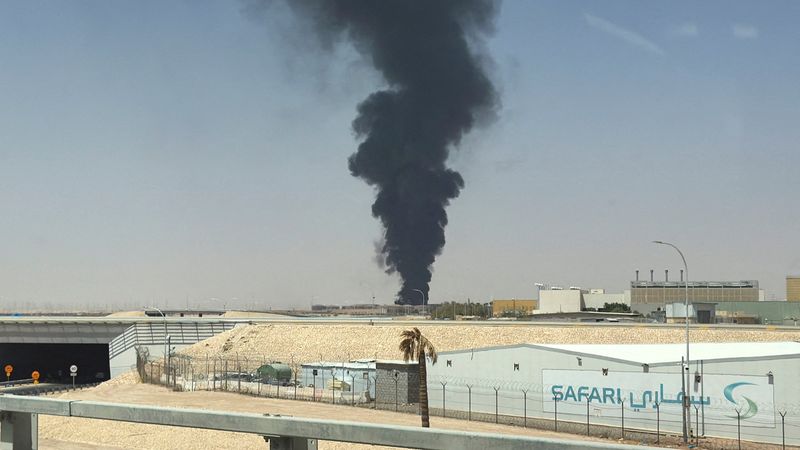
[Financial News] Houthi rebels, an Iran-backed armed group in Yemen, are stepping up attacks on Saudi Arabian territory.
The British Broadcasting Corporation (BBC), Agence France-Presse (AFP), and other foreign media outlets reported on the 19th, local time, that Houthi rebels had attacked Riyadh, the Saudi capital, with ballistic missiles and drones and struck oil facilities in the Red Sea, raising concerns that the regional conflict could spread.
Foreign media outlets reported that several explosions were heard in Riyadh, but Saudi authorities did not confirm any damage and said they had successfully intercepted a ballistic missile.
Authorities from the Saudi-led coalition also said air defenses had thwarted attacks targeting civilians in Bisha, Taif, Farasan, and Yanbu.
Air raid sirens sounded in Riyadh for the first time since July. At KKIA, black smoke was seen rising from fuel storage tanks, while firefighters were filmed battling the blaze. Flights were temporarily suspended.
Middle Eastern countries, including Kuwait, Bahrain, and Egypt, condemned the Houthi rebels' airstrikes on Riyadh.
In a statement, the Houthi rebels acknowledged using multiple ballistic and cruise missiles and drones to attack Riyadh and other "sensitive areas," including Yanbu, where facilities operated by state-owned energy company Saudi Aramco are located. A rebel spokesperson claimed the attacks were justified, saying, "This is a response to the crimes Saudi Arabia has committed against Sanaa, the capital of Yemen."
The rebels also said their recent seizure of Mocha, a Red Sea port, and Perim Island, along routes used to ship crude oil to Asia and Europe, was retaliation for Saudi Arabia's blockade of airports and ports in northwestern Yemen.
The Houthi side previously said last week that Saudi forces had carried out about 300 airstrikes in Yemen.
After Iran effectively made crude oil shipments through the Strait of Hormuz difficult, Saudi Arabia came to rely on rerouted exports through the Red Sea.
With oil shipments through the Red Sea becoming uncertain following the disruption in the Strait of Hormuz, investment bank JPMorgan told investors it was struggling to assess the war's impact on its oil price outlook.
The Houthi rebels seized Sanaa, the Yemeni capital, and other areas in 2014, prompting Saudi Arabia to intervene militarily in March 2015. A ceasefire agreement reached in 2022 began to unravel last July after the Houthis allowed Iranian aircraft to fly through Yemeni airspace.
The Houthi rebels are currently engaged in a civil war with Yemen's government, which is supported by Saudi Arabia and other countries and recognized by the international community. Even amid the conflict, the rebels have attacked Saudi Arabian territory several times over the past few months.
AFP recently reported that an estimated 48 people had been killed in clashes between the Houthis and forces backed by Saudi Arabia.
On the 18th, the International Organization for Migration (IOM), an agency affiliated with the United Nations, said that 104,796 people had been displaced by Yemen's civil war.
As the Houthi rebels seize strategic locations, including the Bab-el-Mandeb Strait, which connects to the entrance of the Red Sea, Gulf states and the United States are considering how to stop them.
The United States has been providing Saudi Arabia with information, including the locations of Houthi rebels, but has ruled out direct involvement in military operations.
Saudi Crown Prince Mohammed bin Salman Al Saud spoke by phone with US President Donald Trump twice last week. CNN reported that the United States had rejected a proposal for airstrikes and was instead increasing intelligence sharing and other support.
Yemen's government forces have struggled despite receiving support and training from Saudi Arabia for years. They have lost control of areas including the Bab-el-Mandeb Strait, even though US intelligence officials had warned for months that the Houthi rebels could threaten major waterways.
As the Houthi rebels have taken control of waterways in the Red Sea, concerns in the international community have grown. The rebels, however, have emphasized that ships can navigate safely except for Saudi Arabian vessels.
Experts in the United States and the Gulf countries believe Saudi Arabia would have difficulty deterring the Houthi rebels on its own. Gulf News reported that military operations might weaken the rebels but would still be unlikely to eliminate the threat entirely.
[email protected] Yoon Jae-jun Reporter